Remove an automation workflow you no longer need from your Automations list in Sender.
Where to Find This Setting
In the Sender dashboard, go to: Automations (left sidebar) → Automations list
Locate the automation you want to delete.
Steps to Delete an Automation
Step 1 — Locate the Automation
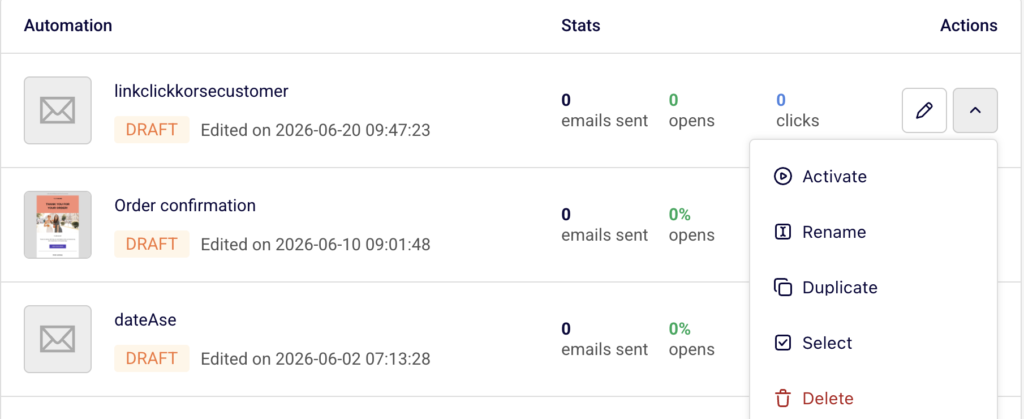
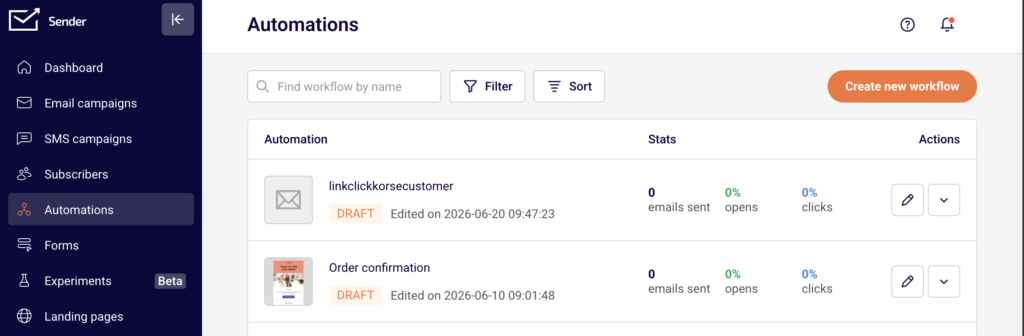
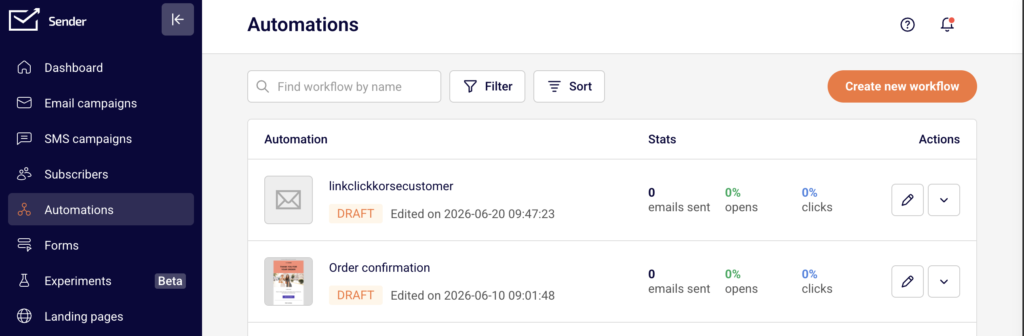
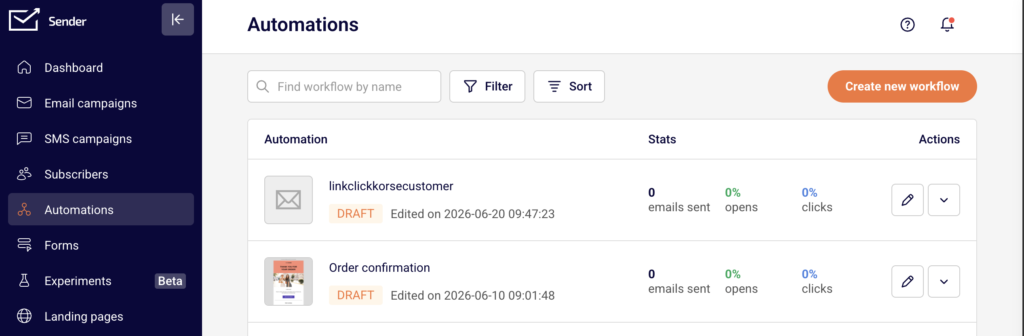
Open the Automations page from the left sidebar. You'll see a list of all your automation workflows along with their status, last edited date, and performance stats. Use the Find workflow by name search bar at the top or scroll through the list to find the workflow you want to remove.
Step 2 — Open the Actions Dropdown
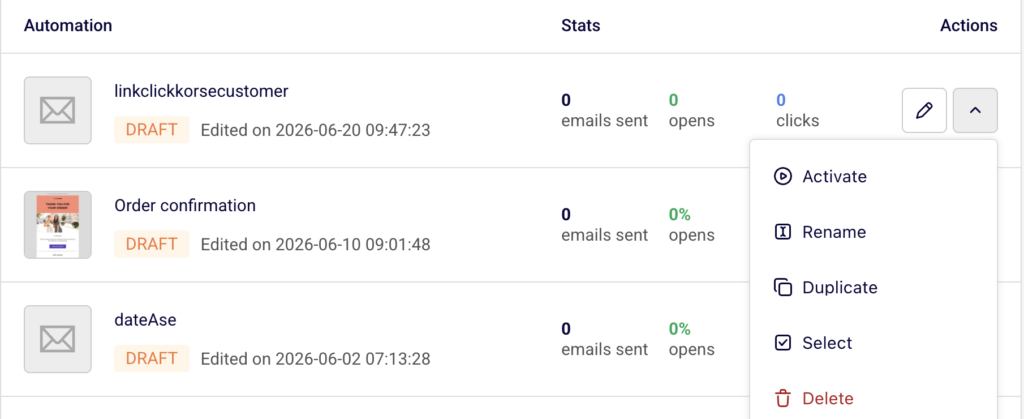
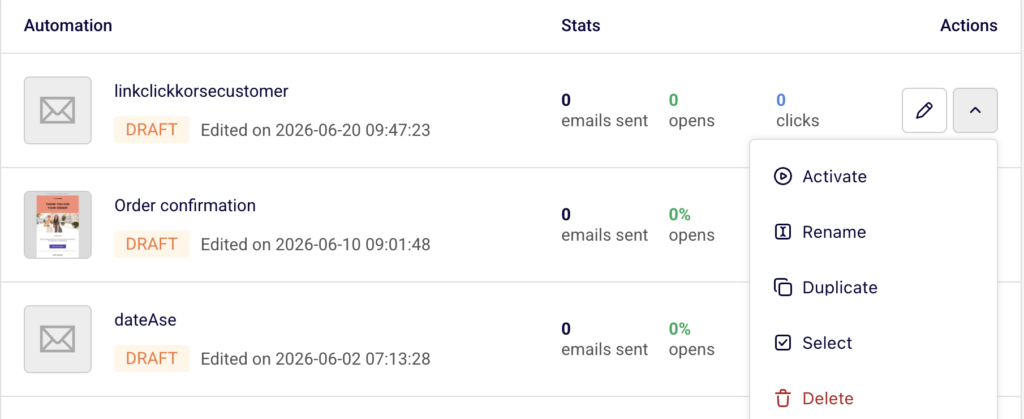
In the Actions column on the right side of the automation row, click the dropdown arrow (▼) next to the edit icon. A menu appears with the following options: Activate, Rename, Duplicate, Select, and Delete. Click Delete at the bottom of the menu.
Step 3 — Confirm Deletion
A Delete workflow confirmation dialog appears asking: "Are you sure you want to delete workflow [workflow name]?" Click Yes, I am sure to permanently delete the automation. To cancel, click No, let's keep it and the workflow will remain unchanged.
What Happens After the Change
The automation is permanently removed from your Automations list. This action cannot be undone.
Any contacts that were actively inside the workflow will no longer receive further messages from this automation. Previously sent emails from the deleted workflow are not affected — they remain in recipient inboxes and in your campaign reporting history.
The workflow's statistics are no longer accessible once the automation is deleted. If you need to preserve performance data, review or export the stats before deleting.
Common Issues
Delete option is not visible → The Delete option is located inside the dropdown menu (▼) in the Actions column, not the pencil icon. Click the dropdown arrow next to the edit icon to reveal it.
Accidentally deleted the wrong automation → Deletion is permanent and cannot be reversed. Consider using Duplicate to create a backup copy before deleting, or use Pause (via Activate/Pause toggle) if you only need to stop the workflow temporarily.
Active automation was deleted while contacts were mid-workflow → Contacts currently inside the workflow will stop receiving any remaining steps. Messages already sent are not recalled or removed.
FAQs
Can I recover a deleted automation? No. Once you confirm deletion by clicking Yes, I am sure, the workflow is permanently removed. There is no trash or recovery option for deleted automations.
Should I pause an automation instead of deleting it? If you might need the workflow again, pausing is a better option. Open the Actions dropdown and click Activate or Pause to change the workflow status without removing it.
Does deleting an automation unsubscribe contacts or remove them from my lists? No. Deleting an automation only removes the workflow itself. Subscribers remain in their groups and lists and are not unsubscribed or affected in any way.
Can I delete multiple automations at once? Yes. Use the Select option from the Actions dropdown to select individual workflows, then use the bulk action to delete them together.
Use the duplicate option to create an identical copy of an existing automation workflow, preserving all steps, triggers, and email content.
Where to Find This Setting
In the Sender dashboard, go to: Automations → Automations list
Locate the automation you want to duplicate from the list.
Steps to Duplicate an Automation
Step 1 — Locate the Automation
Open the Automations page from the left sidebar. Your existing workflows are displayed in a list with their name, status, and stats. Find the automation you want to duplicate. You can use the Find workflow by name search field or scroll through the list.
Step 2 — Open the Actions Menu
In the Actions column on the right side of the automation row, click the dropdown arrow (▼) next to the Edit (pencil) icon. A menu appears with the following options: Activate, Rename, Duplicate, Select, and Delete.
Step 3 — Select Duplicate
Click Duplicate from the dropdown menu. The duplication happens instantly — no confirmation dialog is required. A green notification banner appears at the top of the page confirming "Workflow duplicated". The new copy is added to the top of your automations list.
Step 4 — Review and Rename the Copy
The duplicated workflow appears with the original name followed by (COPY) — for example, "Welcome (B2B)" becomes "Welcome (B2B) (COPY)". To rename it, click the dropdown arrow (▼) on the new automation and select Rename. Enter your preferred name and click Update.
What Happens After the Change
The duplicated automation is set to Draft status. It is not active and will not trigger for any contacts until you manually activate it.
All workflow stats on the copy are reset to zero — 0 emails sent, 0% opens, and 0% clicks. The duplicate is an independent workflow. No historical data or enrolled contacts carry over from the original.
The original automation remains completely unchanged. Its status, enrolled contacts, and stats are unaffected by the duplication.
You can review both the original and the duplicate from the Automations list. Click the Edit (pencil) icon on the copy to open the workflow builder and make any modifications before activating.
Common Issues
Duplicate not appearing in the list → The copy is added to the top of the automations list. If you have sorting or filters applied, the new workflow may not be immediately visible. Clear any active filters or sort by most recent to find it.
Copy has the same name as another workflow → Sender appends (COPY) to the original name automatically. If a previous copy already exists with the same name, rename the new duplicate immediately using the Rename option to avoid confusion.
Duplicate is not sending emails → Duplicated workflows are always created in Draft status. Open the Actions dropdown on the copy and click Activate to make it live.
FAQs
Does duplicating an automation affect the original workflow? No. The original automation keeps its status, contacts, stats, and configuration. The duplicate is a fully independent copy.
Will contacts from the original automation be copied over? No. The duplicated workflow starts with no enrolled contacts and zero stats. Only the workflow structure, steps, and email content are copied.
Can I duplicate an automation that is currently active? Yes. You can duplicate an automation regardless of its current status — Active, Paused, or Draft. The duplicate will always be created in Draft status.
Is there a limit to how many times I can duplicate an automation? There is no restriction on the number of times you can duplicate a workflow. Each copy is created as a separate automation in your list.
Can I edit the duplicated automation before activating it? Yes. Click the Edit (pencil) icon on the duplicated workflow to open it in the workflow builder. Make any changes to triggers, steps, or email content, then activate it when ready.
This guide explains how to deactivate and reactivate automation workflows in Sender to temporarily stop or resume subscriber processing.
Where to Find This Setting
In the Sender dashboard, go to: Automations (left sidebar) → Automations list.
To manage a specific workflow, locate it in the list and use the Actions dropdown (▼) on the right side of the row. You can also open the automation builder by clicking the edit icon (pencil) or the stats icon (chart) to access controls from the top bar.
Steps to Deactivate (Pause) an Automation
Step 1 — Locate the Active Automation
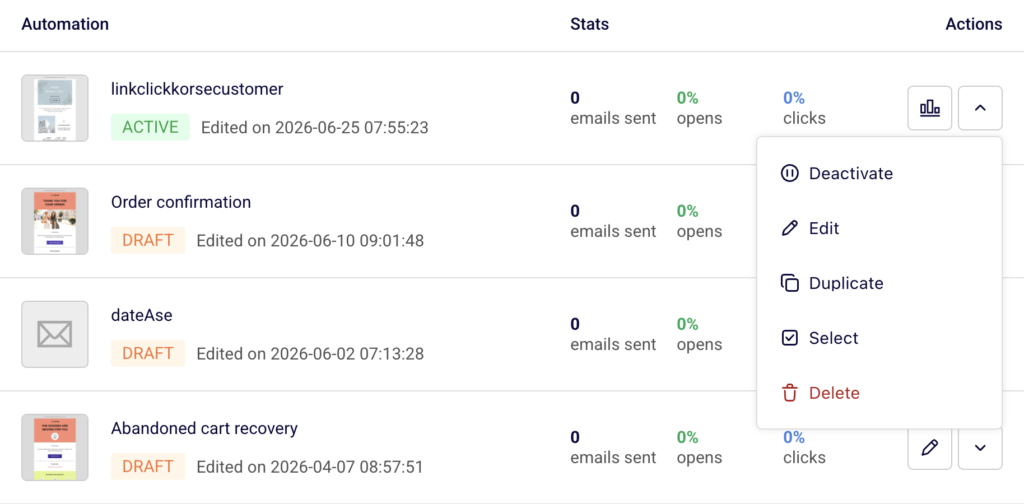
Open the Automations page from the left sidebar. Active workflows display a green ACTIVE badge next to their name. If you have many automations, use the Filter button at the top and select Active to narrow the list. The Actions column for active automations shows a stats icon (chart) and a dropdown arrow (▼).
Step 2 — Deactivate the Workflow
You can deactivate from two locations:
From the automations list: Click the dropdown arrow (▼) next to the automation and select Deactivate.
From the automation builder: Click the stats icon or Edit to open the workflow. Click the Deactivate button in the top-right corner of the builder.
The workflow status changes from Active to Draft immediately, and a confirmation toast message reading “Workflow deactivated” appears at the top of the page.
Step 3 — Verify the Status Change
After deactivating, confirm the automation now shows a DRAFT badge (orange) in the automations list. The Actions column icon reverts from the stats chart to the pencil (edit) icon. The dropdown menu now displays Activate instead of Deactivate.
Steps to Activate (Resume) an Automation
Step 1 — Locate the Draft Automation
On the Automations page, find the workflow you want to resume. It displays a DRAFT badge. Use the Filter button and select Draft if needed to narrow the list.
Step 2 — Activate the Workflow
From the automations list: Click the dropdown arrow (▼) next to the automation and select Activate.
From the automation builder: Open the workflow by clicking the pencil icon. Click the Activate button in the top-right corner.
A confirmation toast message reading “Activated” appears. The status changes to Active immediately.
Step 3 — Confirm Activation and Review Stats
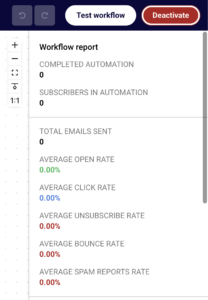
After activating, the automation displays a green ACTIVE badge. The right panel in the builder switches from Trigger Setup to the Workflow report, which shows live statistics including total emails sent, average open rate, average click rate, unsubscribe rate, bounce rate, and spam reports rate. The Actions dropdown in the list now shows Deactivate and Edit instead of Activate and Rename.
What Happens After the Change
When you deactivate an automation, its status changes from Active to Draft. No new subscribers enter the workflow while it is in Draft status. The workflow stops processing any pending actions for contacts currently inside the automation.
When you reactivate the automation, it returns to Active status and begins accepting new subscribers matching the trigger conditions. The Workflow report panel becomes available again in the builder, displaying cumulative performance data.
You can review updated results at any time by clicking the stats icon (chart) in the automations list for any active workflow, or by opening the builder where the Workflow report panel appears on the right side.
Common Issues
Automation won’t activate → The workflow has incomplete steps. Check the Completion indicator in the top-right corner of the builder (e.g., “0/3”). All required steps — trigger, conditions, and actions — must be fully configured before activation is allowed.
Status still shows Draft after clicking Activate → A required field is missing, such as the subscriber group in the trigger setup. Open the builder, review the Trigger Setup panel on the right, and ensure all required fields including Select group are filled in.
Stats not visible after activation → The Workflow report panel only appears when the automation is in Active status. If you see the Trigger Setup panel instead, confirm the workflow was activated successfully by checking for the green Active badge in the top bar.
Deactivate option not available in the dropdown → The automation is already in Draft status. Only active automations display the Deactivate option. Draft automations show Activate instead.
FAQs
Does deactivating an automation delete it? No. Deactivating changes the status to Draft. The workflow, all its steps, and historical performance data are preserved. You can reactivate it at any time.
Will contacts currently inside the automation continue to receive emails after deactivation? No. Once deactivated, the automation stops processing all pending steps for contacts already in the workflow.
Can I edit an active automation without deactivating it? No. To modify workflow steps, you must first deactivate the automation. Use the dropdown menu and select Deactivate, make your changes in the builder, then click Activate to resume.
Is there a separate “Paused” status in Sender? No. Sender uses two automation statuses: Active and Draft. Deactivating an active automation returns it to Draft. There is no intermediate “Paused” state.
Can I activate an automation directly from the builder? Yes. When viewing a Draft automation in the builder, the Activate button appears in the top-right corner. Clicking it immediately sets the workflow to Active.
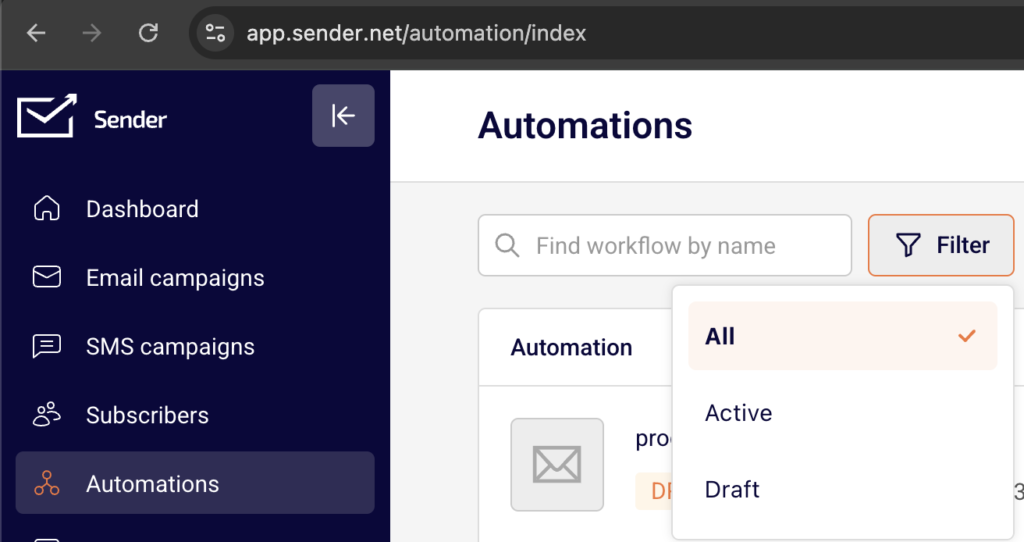
Where can I filter automations by status? On the Automations list page, click Filter at the top. You can filter by All, Active, or Draft.
This guide explains how to edit an automation that is currently live (active) in Sender, including how changes affect the workflow status and existing contacts.
Where to Find This Setting
In the Sender dashboard, go to: Automations (left sidebar) → select the automation you want to edit.
If the automation is active, its status badge displays ACTIVE in green next to the workflow name.
Steps to Edit a Live Automation
Step 1 — Open the Automation for Editing
On the Automations list page, locate the active workflow you want to modify. Click the dropdown arrow (▾) in the Actions column to the right of the automation, then select Edit.
Alternatively, click the pencil icon (✏️) next to the automation row to go directly into the workflow builder. The builder opens and the automation status changes from ACTIVE to DRAFT. While in draft status, the workflow stops accepting new contacts until you reactivate it.
Step 2 — Modify the Workflow Steps
Click any step on the canvas to open its settings panel on the right side. Depending on the step type, you can adjust:
Trigger step: Update the trigger title, change the trigger type under WHAT WILL TRIGGER THE WORKFLOW?, select a different group under SELECT GROUP, or toggle Repeat workflow on or off.
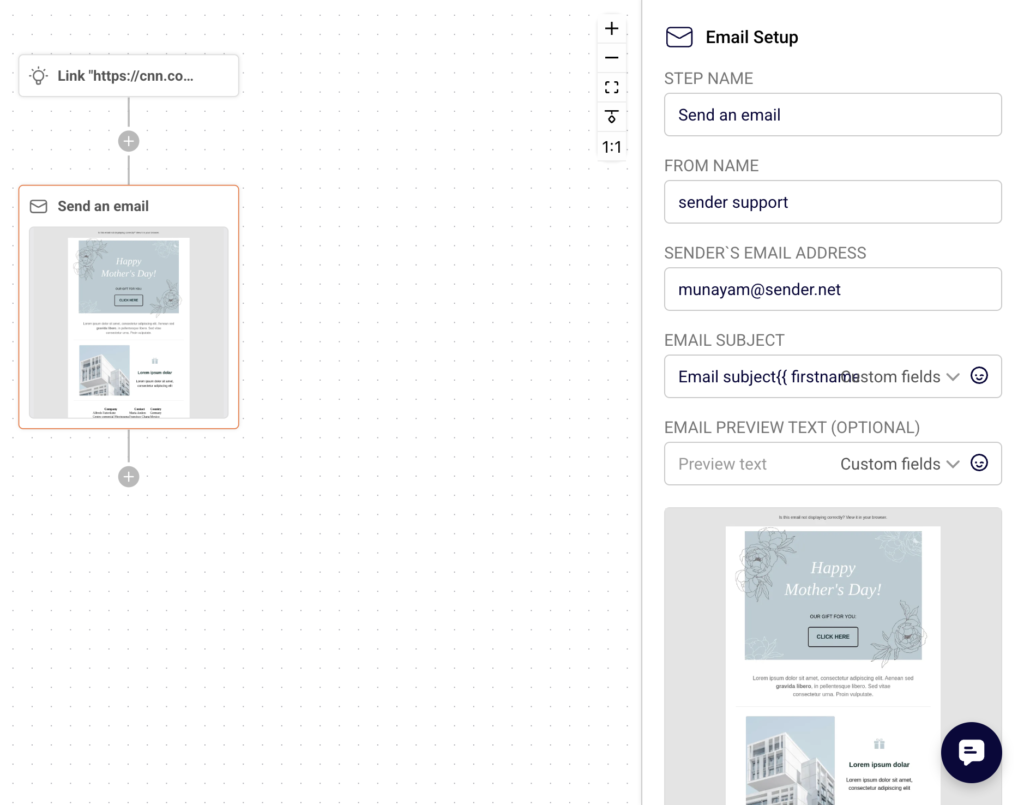
Email step: Edit the STEP NAME, FROM NAME, EMAIL SUBJECT, or EMAIL PREVIEW TEXT (OPTIONAL). Click Edit email content to open the email designer and modify the message body. To add a new step, click the + icon between any two existing steps. The ADD A NEW STEP panel appears with options: Condition, Delay, Email, SMS, Action, and Split. Select the step type to insert it into the workflow.
Step 3 — Rename the Automation (Optional)
To change the workflow name, click the pencil icon (✏️) next to the automation title in the top navigation bar. Type the new name and confirm.
Step 4 — Save Your Changes
After making edits to any step, click Save at the bottom of the step settings panel on the right. Each step must be saved individually. Unsaved changes are lost if you navigate away from the step.
Step 5 — Reactivate the Automation
Once all edits are complete, click the Activate button in the top-right corner of the builder. The workflow status returns to ACTIVE, and the automation begins accepting new contacts again based on the updated configuration.
What Happens After the Change
When you open an active automation for editing, its status switches to DRAFT immediately. New contacts stop entering the workflow until you reactivate it. Contacts that were already inside the workflow before you made changes continue through the original steps. They are not affected by your edits. Once you click Activate, the automation resumes with the updated workflow. All new contacts entering from that point forward follow the revised steps. You can confirm the current status by checking the Status badge at the top of the builder or the status label on the Automations list page.
Common Issues
If the automation does not reactivate → Ensure all required fields in each step are filled in and saved. Missing fields (such as an empty email subject) can prevent activation.
If edits are not reflected in the workflow → Click Save in the step settings panel before moving to another step or leaving the builder.
If new contacts are not entering the automation → The workflow may still be in DRAFT status. Click Activate in the top-right corner to resume.
If the automation shows DRAFT after you opened it → This is expected. Editing an active automation automatically switches it to draft mode until you reactivate.
FAQs
Can I edit an active automation without deactivating it first?
When you open an active automation for editing, Sender automatically changes the status to DRAFT. You must click Activate after saving your changes to make it live again.
Do existing contacts in the workflow lose progress when I edit?
No. Contacts already inside the automation continue through the original steps. Edits apply only to new contacts entering after reactivation.
This guide covers best practices to help you get better results from your automation workflows in Sender.
Where This Applies
In the Sender dashboard, go to Automations from the left sidebar.
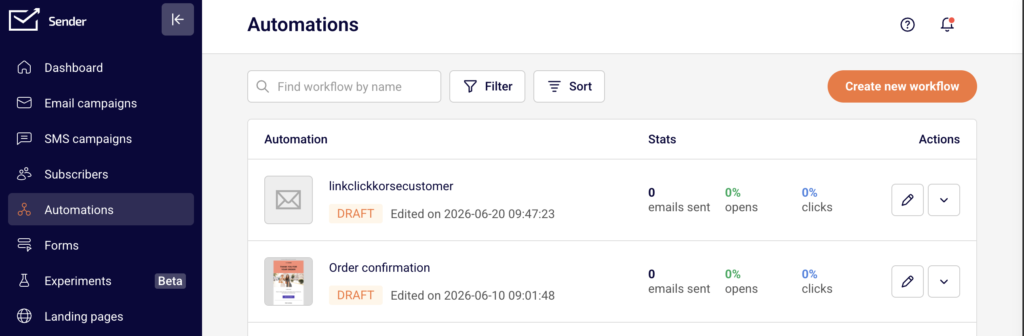
These practices apply across the entire automation workflow — from how you configure your trigger in Trigger Setup, to how you structure steps like Delay, Condition, Email, Action, and Split in the workflow builder, to how you monitor performance using the emails sent, opens, and clicks stats on the Automations list page.
Recommended Practices
Use Delay Steps to Space Out Your Emails
Avoid sending multiple emails back-to-back within the same workflow. Add a Delay step between each Email step and set it to at least 1–3 days using the Time delay option under Delay Setup. Spacing emails gives contacts time to engage with each message before receiving the next one.
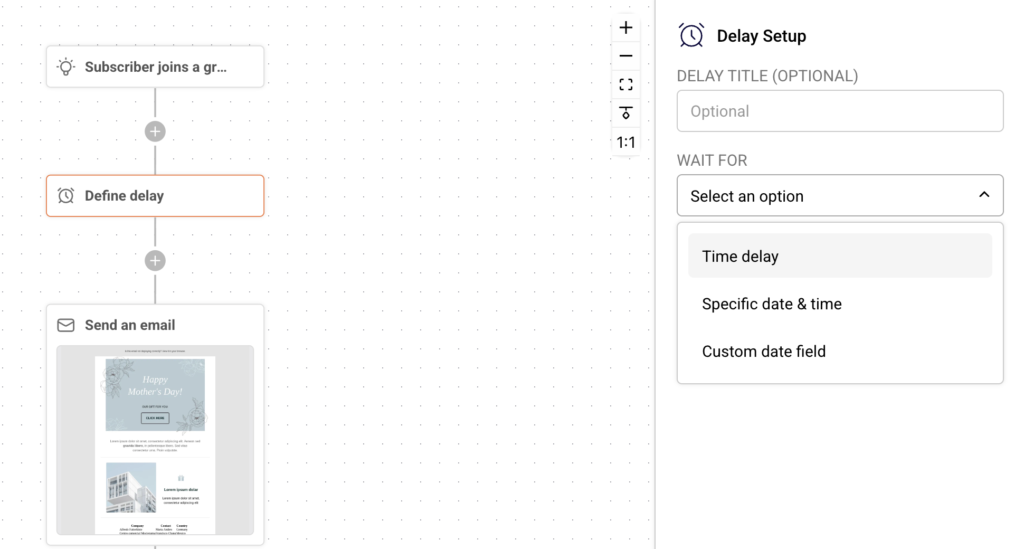
Workflows that send too frequently risk higher unsubscribe rates and lower open rates. Use the Days or Hours unit in the SELECT TIME PERIOD UNIT dropdown to control pacing precisely.
Add Conditions to Target Engaged Contacts
Insert a Condition step before follow-up emails to filter contacts based on their behavior. In Condition Setup, select Workflow email activity to check whether a contact opened or clicked a previous email in the workflow.
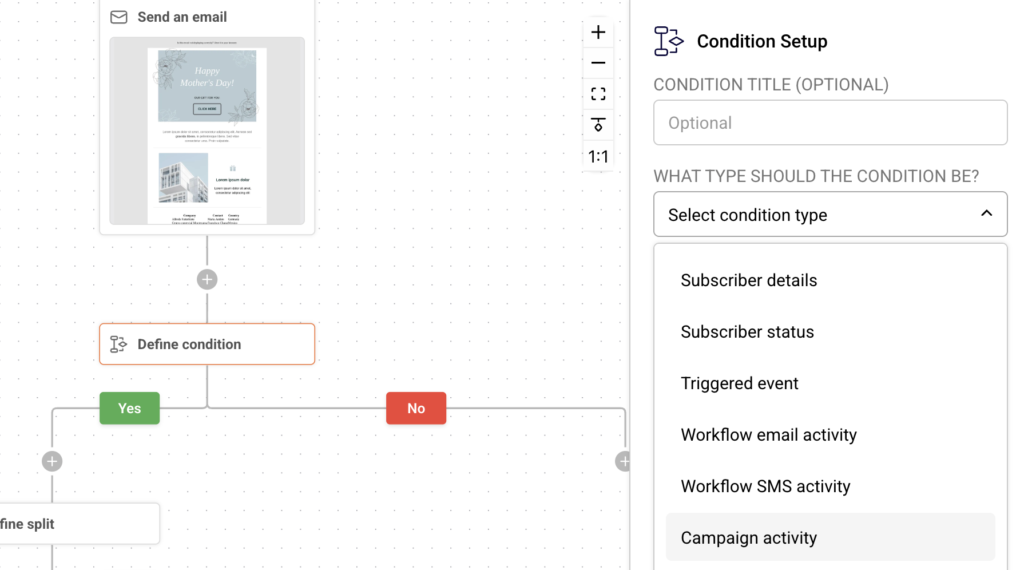
This creates Yes and No branches so you can send different content to engaged and unengaged contacts. Targeting engaged subscribers improves click rates and prevents unnecessary sends to contacts who are not interacting with your messages.
Use Clear Naming Conventions for Workflows and Steps
Give each workflow a descriptive name that includes its purpose and audience — for example, “Welcome – New Subscribers” or “Abandoned Cart – SaaS.” Use the Rename option from the actions dropdown on the Automations list, or the pencil icon next to the workflow name in the builder.
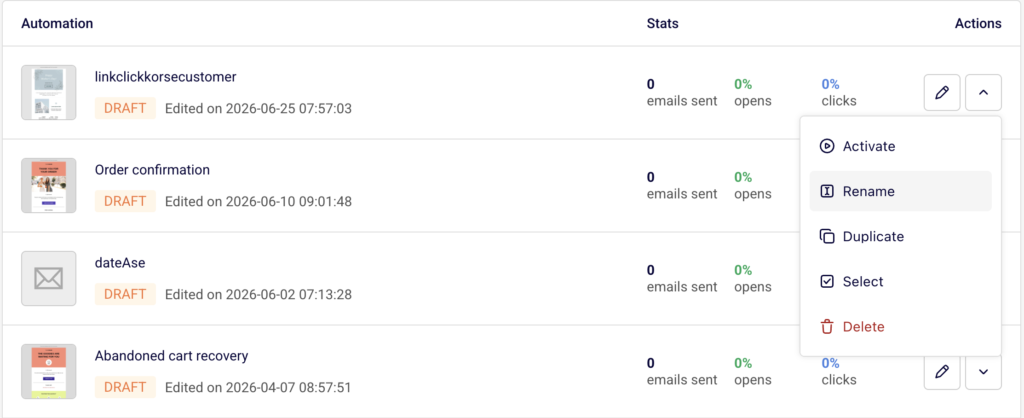
Also fill in the optional title fields on each step (TRIGGER TITLE, DELAY TITLE, CONDITION TITLE, ACTION TITLE). Clear naming helps you identify and manage workflows at scale without opening each one individually.
Keep Workflows Short and Focused
Limit each workflow to a single goal, such as onboarding, cart recovery, or re-engagement. If a workflow grows beyond 5–7 steps, consider splitting it into separate automations connected by an Action step set to Move subscriber to another group or Copy subscriber to another group, which can then trigger a new workflow. Shorter workflows are easier to troubleshoot, and isolating each sequence makes it simpler to identify which part of your funnel is underperforming.
Test Workflows in Draft Before Activating
Keep new workflows in DRAFT status while you verify every step. Click through each step in the builder to confirm that triggers, delays, conditions, and email content are configured correctly. Check the Completion indicator in the top-right corner of the builder — it shows how many steps are fully configured (e.g., “2/3”). Only click Activate once all steps show complete. Activating an incomplete workflow can result in contacts entering a sequence with missing emails or undefined conditions.
What to Avoid
Sending the first email immediately after the trigger fires without any delay. This can overwhelm new contacts, especially if they just completed a signup or purchase. Add at least a short Delay step before the first Email step.
Stacking multiple conditions in sequence without an email or action between them. This adds complexity without clear benefit and makes the workflow harder to debug. Place conditions only where they directly affect the next action.
Using generic workflow names like “Test” or “Workflow 1.” This makes it difficult to identify the purpose of each automation on the Automations list, especially as you build more workflows.
Always use descriptive names. Leaving the Repeat workflow toggle enabled without understanding its impact. When enabled in Trigger Setup, the workflow repeats every time a contact reactivates the trigger. This is useful for recurring events but can cause unwanted duplicate sends for one-time sequences like welcome emails.
Running automations indefinitely without reviewing their performance. Workflows that were effective initially may degrade over time as audience behavior changes. Schedule regular reviews to catch declining engagement early.
How to Track Results
Emails sent, opens, and clicks — Found in the Stats column on the Automations list page. A healthy automation should show consistent open and click rates relative to the number of emails sent.
Step-by-step performance — Open the workflow builder and review how contacts move through each step. Look for drop-offs after specific Delay or Condition steps, which can indicate timing issues or poorly targeted branches.
Bounce rate, unsubscribe rate, and spam rate — Found on the main Dashboard page. A spike in any of these after activating a new automation signals a problem with targeting, frequency, or content.
Review frequency — Check performance at least once a month. For high-volume workflows like abandoned cart or welcome sequences, review weekly. Compare metrics over time to adjust delay timing, condition logic, or email content.
FAQs
How often should I review automation performance?
Review at least once a month. For high-volume workflows like cart abandonment or welcome sequences, check stats weekly to catch issues early.
Should I use one long automation or multiple short ones?
Shorter workflows are easier to manage and debug. Split complex sequences into separate automations and connect them using the Action step to move contacts between groups.
What is a good delay between emails in a workflow?
A delay of 1–3 days between emails works well for most sequences. Use shorter delays (hours) for time-sensitive flows like cart recovery, and longer delays (3–7 days) for nurture sequences.
When should I use a Condition step?
Use a Condition step when you want to branch the workflow based on subscriber behavior or attributes — for example, checking if a contact opened a previous email using the Workflow email activity condition type.
You can open and modify an active workflow in the builder, but changes may affect contacts currently in the sequence. Consider duplicating the workflow using the Duplicate option, making your changes on the copy, then swapping which one is active.
Conditions & Filters
This guide shows how to configure conditions and filters in Sender automation workflows to control how contacts are routed through Yes/No logic branches.
Where to Find This Setting
In the Sender dashboard, go to: Automations (left sidebar) → select the workflow you want to edit → the workflow opens in the visual builder. Click any existing Define condition block on the canvas, or click a + icon between steps and select Condition from the ADD A NEW STEP menu. The Condition Setup panel opens on the right side of the screen.
Steps to Configure Conditions & Filters
Step 1 — Open the Condition Setup Panel
Click the Define condition block in your workflow canvas. The Condition Setup panel appears on the right. To add a new condition, click the + icon between any two steps and select Condition from the step menu (alongside Delay, Email, SMS, Action, and Split). You can optionally enter a label in the CONDITION TITLE (OPTIONAL) field to identify the block in your workflow.
Step 2 — Select a Condition Type
Open the WHAT TYPE SHOULD THE CONDITION BE? dropdown and choose one of the seven available condition types:
Subscriber details — filter by contact field data (Email, Phone number, First name, Last name, Birthday).
Subscriber status — filter by the contact's current status (ACTIVE, BOUNCED, UNSUBSCRIBED, SPAM REPORT).
Workflow email activity — filter by whether a contact interacted with a specific email in the current workflow.
Workflow SMS activity — filter by SMS interaction within the current workflow.
Campaign activity — filter by engagement with a specific campaign.
Group membership — filter by whether a contact belongs to a selected group.
Segments — filter by segment membership.
Step 3 — Define the Comparison Rules
The fields that appear depend on the condition type you selected in Step 2.
For Subscriber details: Select a field from the SELECT A FIELD dropdown. Then choose a comparison operator from the HOW SHOULD THE VALUE BE COMPARED? dropdown — options include Equals, Does not equal, Contains, Does not contain, Starts with, Ends with, Is provided, and Is one of. For most operators, enter the target value in the ENTER COMPARISON VALUE text field.
For Subscriber status: Choose a comparison operator from HOW SHOULD THE VALUE BE COMPARED? (Is, Is not, or Is one of), then select a status from the WHICH STATUS? dropdown — ACTIVE, BOUNCED, UNSUBSCRIBED, or SPAM REPORT.
For Workflow email activity / Workflow SMS activity: Select the specific workflow email or SMS message from the dropdown. The condition then evaluates whether the contact interacted with that message.
For Campaign activity: Select a campaign from the SELECT CAMPAIGN dropdown.
For Group membership: Select a group from the SELECT GROUP dropdown, then set the MATCHES field to Include (contact is in the group) or Exclude (contact is not in the group).
Step 4 — Save and Review the Branch Paths
Click Save to apply the condition. On the canvas, the condition block displays two branch paths — a green Yes path (condition is met) and a red No path (condition is not met). You can add further steps under each branch by clicking the + icon below Yes or No.
What Happens After You Save
After saving, the updated condition logic applies to new contacts entering the workflow. Contacts already past the condition block continue under the logic that was active when they reached it. The workflow status remains Draft or Active unless you change it manually. The Completion indicator in the top-right corner of the builder updates to reflect configured steps.
Common Issues
Contacts are not following the expected branch → The comparison operator or value may be misconfigured. Open the condition block, verify the WHAT TYPE SHOULD THE CONDITION BE? selection, and confirm that the field, operator, and value match the intended filter criteria.
The Yes path receives no contacts → The condition may be too restrictive. Check that the comparison value is exact — for example, Equals is case-sensitive and requires an exact match, while Contains checks for partial matches.
Condition block still shows "Define condition" → The block was not saved. Click the block to open Condition Setup, complete all required fields, and click Save.
Group membership condition is not filtering correctly → Confirm the MATCHES field is set to Include or Exclude as intended, and verify that the correct group is selected in the SELECT GROUP dropdown.
FAQs
Can I use multiple conditions in sequence?
Yes. Add additional Condition blocks under any branch by clicking the + icon and selecting Condition. Each block evaluates independently.
What comparison operators are available for subscriber detail fields?
Eight operators: Equals, Does not equal, Contains, Does not contain, Starts with, Ends with, Is provided, and Is one of (comma-separated values).
Can I change a condition type after saving?
Yes. Click the condition block, select a new type from the WHAT TYPE SHOULD THE CONDITION BE? dropdown, reconfigure the fields, and click Save. Changes apply only to new contacts reaching that block.
Do existing contacts follow updated conditions?
No. Contacts already past the condition block continue on the branch they were originally routed to.
What happens if I delete a condition block?
Click the ✕ icon on the condition block to remove it. Any steps connected under the Yes/No branches will be disconnected. Review and reconnect your workflow before activating.
Can I add a condition immediately after the trigger?
Yes. Click the + icon directly below the trigger block and select Condition to filter contacts before any other step executes.
Delays & Timing Rules
This guide shows how to configure delay blocks and timing rules in Sender automation workflows to control when contacts proceed to the next step.
Where to Find This Setting
In the Sender dashboard, go to: Automations (left sidebar) → select the workflow you want to edit → the workflow opens in the visual builder. Click any existing Define delay block on the canvas, or click a + icon between steps and select Delay from the ADD A NEW STEP menu. The Delay Setup panel opens on the right side of the screen.
Steps to Configure Delays & Timing Rules
Step 1 — Open the Delay Setup Panel
Click the Define delay block in your workflow. The Delay Setup panel appears on the right. To add a new delay, click the + icon between any two steps and select Delay from the step menu (alongside Condition, Email, SMS, Action, and Split). You can optionally enter a label in the DELAY TITLE (OPTIONAL) field to identify the block in your workflow.
Step 2 — Select a Delay Type
Open the WAIT FOR dropdown and choose one of three delay types:
Time delay — pauses the workflow for a fixed duration (e.g., 2 days, 4 hours).
Specific date & time — pauses the workflow until a specific calendar date and time.
Custom date field — pauses the workflow relative to a date stored in a subscriber's custom field (e.g., a birthday or renewal date).
Step 3 — Configure the Delay Duration
The fields that appear depend on the delay type selected in Step 2. For Time delay: Enter a number in the OF field and select a unit from the SELECT TIME PERIOD UNIT dropdown — Minutes, Hours, Days, Weeks, or Months. Toggle SHOW ADVANCED SETTINGS to restrict when the workflow resumes. The advanced panel exposes RESUME FLOW ON day-of-week selectors (Sun through Sat) and a TIME field with hour, minute, and AM/PM inputs. For Specific date & time: Click the Choose date & time field to open a calendar picker. Select a date and set the time using the hour and minute inputs below the calendar. For Custom date field: Select a field from the CUSTOM DATE FIELD dropdown, then choose a timing rule from the UNTIL dropdown — Before, After, or Exact time. If you select Before or After, enter an offset number and unit (Minutes, Hours, Days, Weeks, or Months). Exact time resumes the workflow at the precise date stored in the field.
Step 4 — Save the Delay Block
Click Save to apply the delay configuration. The block label on the canvas updates to show the configured wait duration (e.g., "Wait 2 Days"). If advanced settings are enabled, the day-of-week and time restrictions also take effect.
What Happens After You Save
After saving, the delay applies to new contacts entering the block. Contacts already waiting in a previously configured delay continue under the original timing. The workflow status remains Draft or Active unless you change it manually. The Completion indicator in the top-right corner of the builder updates to reflect the configured step.
Common Issues
Contacts are not progressing past the delay → The delay duration may still be active. Verify the OF value and SELECT TIME PERIOD UNIT match your intended wait period. For Specific date & time, confirm the selected date has not already passed.
Emails are sending at unexpected times → Advanced settings may be restricting delivery days. Toggle SHOW ADVANCED SETTINGS and check which days are selected under RESUME FLOW ON and what TIME is set.
Custom date field delay is not working → The subscriber's custom date field may be empty or improperly formatted. Confirm the correct field is selected in the CUSTOM DATE FIELD dropdown and that subscribers have valid date values.
Delay block still shows "Define delay" → The block was not saved. Click the block to open Delay Setup, complete all required fields, and click Save.
FAQs
Can I change a delay after activation?
Yes. Click the delay block, update the settings, and click Save. Changes apply only to new contacts entering the block.
What time units are available for Time delay? Five units: Minutes, Hours, Days, Weeks, and Months.
What do the advanced settings control?
The RESUME FLOW ON day selectors restrict the workflow to resume only on chosen days. The TIME field sets the exact hour and minute the workflow should continue. This is useful for ensuring contacts proceed during business hours or specific days.
Do existing contacts follow updated delay settings?
No. Contacts already waiting in the delay block continue under the timing that was active when they entered it.
Can I use multiple delay blocks in a row?
Yes. Add additional Delay blocks by clicking the + icon after any step and selecting Delay. Each block applies its own independent wait period.
What happens if a Specific date & time has already passed?
Contacts entering the delay block after the configured date has passed will proceed to the next step immediately.
This guide covers how triggers work in Sender automation workflows, including how to select, configure, and update them to control when and how contacts enter your automations.
Where to Find This Setting
In the Sender dashboard, go to Automations in the left sidebar. This opens the automation list view.
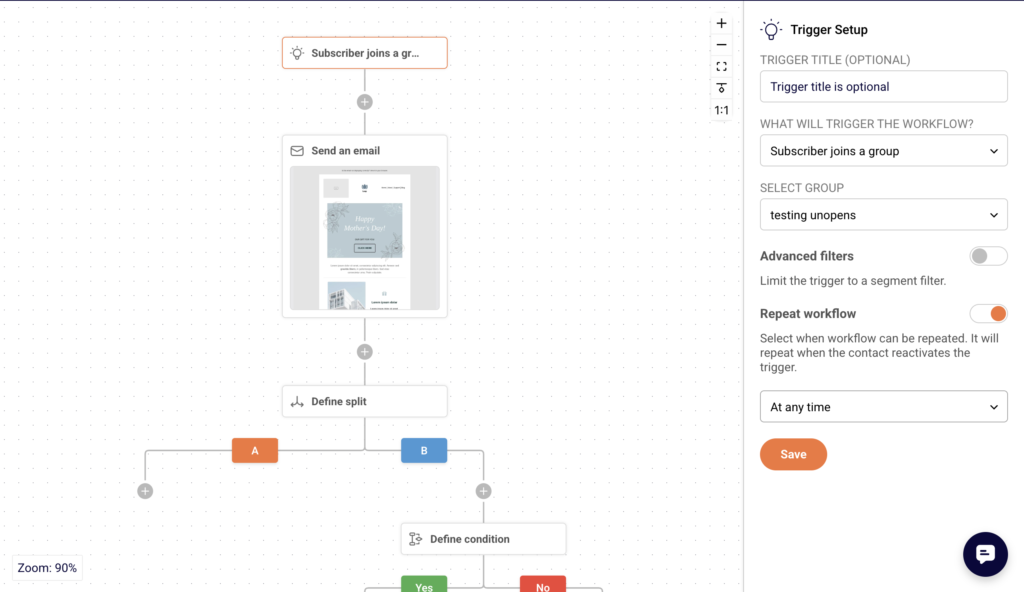
Click the edit (pencil) icon next to the workflow you want to modify, or open any existing workflow. The trigger is always the first block at the top of the workflow canvas. Click it to open the Trigger Setup panel on the right side of the screen.
How Triggers Work
A trigger defines the event that causes a contact to enter the workflow. Each automation has one trigger block, and it must be configured before the workflow can be activated.
The trigger block appears at the top of the canvas and is labeled with the selected trigger type. When a contact performs the event matching your trigger, they enter the workflow and proceed through the steps in order — emails, delays, conditions, and actions.
Steps to Configure a Trigger
Step 1 — Open the Trigger Block
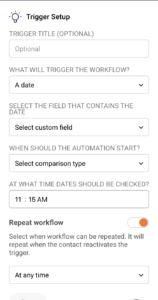
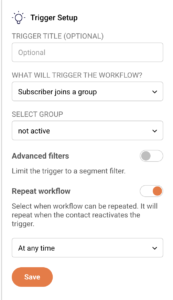
Click the trigger block at the top of the workflow canvas. The Trigger Setup panel opens on the right. You will see the TRIGGER TITLE (OPTIONAL) field at the top, followed by the WHAT WILL TRIGGER THE WORKFLOW? dropdown. If a trigger type is already selected, its current settings are displayed below the dropdown.
Step 2 — Select the Trigger Type
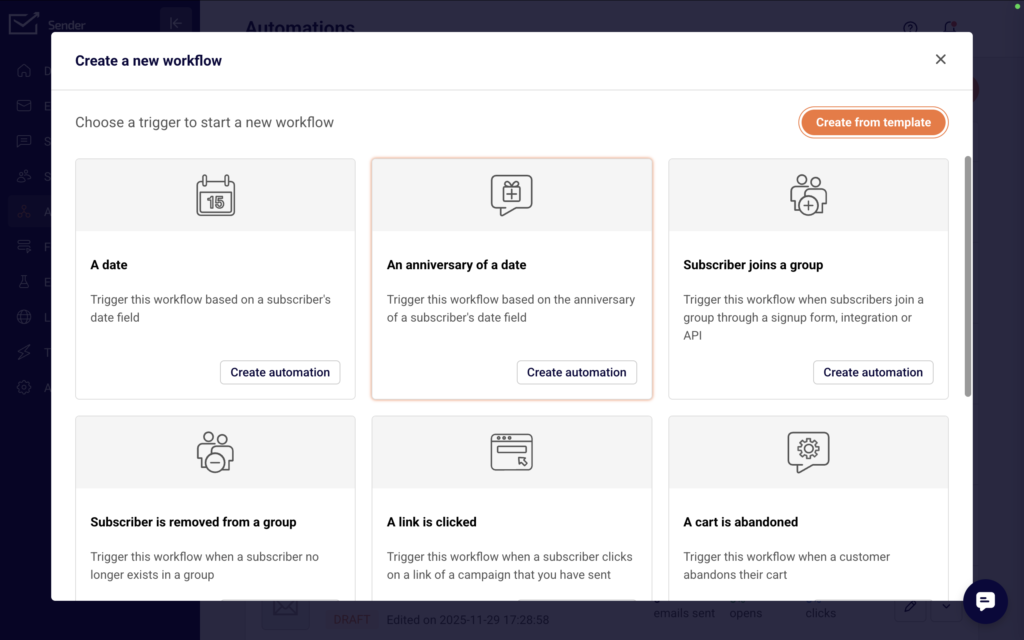
Open the WHAT WILL TRIGGER THE WORKFLOW? dropdown. The available trigger types are:
A date — fires based on a date stored in a subscriber custom field.
An anniversary of a date — fires on the recurring anniversary of a stored date.
Subscriber joins a group — fires when a contact is added to a selected group.
Subscriber is removed from a group — fires when a contact leaves a group.
A link is clicked — fires when a contact clicks a specific link.
A cart is abandoned — fires on an ecommerce cart abandonment event.
A product is purchased — fires when a purchase event is recorded.
An order is fulfilled — fires when an order fulfillment event occurs.
Subscriber unsubscribed — fires when a contact unsubscribes.
Subscriber field updated — fires when a subscriber custom field value changes.
Subscriber status changed — fires when a subscriber’s status changes. Select the type that matches the event you want to use.
Step 3 — Configure Trigger-Specific Settings
Each trigger type reveals its own configuration fields once selected. For Subscriber joins a group, choose the target group from the SELECT GROUP dropdown.
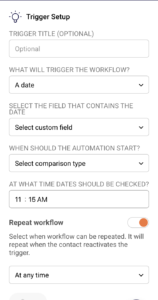
For A date, select the custom field that contains the date under SELECT THE FIELD THAT CONTAINS THE DATE, choose the comparison type under WHEN SHOULD THE AUTOMATION START?, and set the check time under AT WHAT TIME DATES SHOULD BE CHECKED?. Other triggers follow a similar pattern — select the relevant group, link, field, or event that defines the trigger condition.
Step 4 — Set the Repeat Workflow Option
Below the trigger-specific fields, the Repeat workflow toggle controls whether a contact can re-enter the workflow if they activate the trigger again.
When disabled, each contact enters the workflow only once. Enable it if contacts should be able to re-enter when they re-trigger the event.
Step 5 — Save the Trigger
Click Save at the bottom of the panel. The trigger block on the canvas updates to reflect the selected type and settings. The Completion counter in the top-right corner of the builder advances when the trigger is fully configured.
What Happens After You Save
After saving, the updated trigger applies to new contacts who perform the trigger event going forward. Contacts already inside the workflow are not affected by trigger changes — they continue through the steps that were active when they entered. The workflow status remains Draft unless you manually activate it. A trigger must be fully configured (along with all other required steps) before the workflow can be set to Active.
Common Issues
Contacts are not entering the workflow — The trigger conditions may not be met. Verify the correct group, date field, or event is selected. Also confirm the workflow status is Active, not Draft.
Trigger changes are not affecting existing contacts — This is expected. Trigger updates only apply to contacts who enter the workflow after the change is saved. Existing contacts follow the logic that was active when they entered.
The Save button is grayed out — All required fields for the selected trigger type must be completed before Save becomes active. Check that every dropdown and field in the Trigger Setup panel has a value selected.
Workflow does not start after activation — Confirm the trigger event is actually occurring. For example, if the trigger is Subscriber joins a group, verify that contacts are being added to the specified group.
FAQs
Can I change a trigger type after the workflow is active?
Yes. Open the trigger block and select a new type from the WHAT WILL TRIGGER THE WORKFLOW? dropdown. Changes apply only to new contacts entering the workflow after you save.
Do existing contacts follow updated trigger settings?
No. Contacts already in the workflow continue based on the trigger configuration that was active when they entered.
Can a workflow have more than one trigger?
No. Each automation workflow has a single trigger block. To respond to multiple events, create separate workflows for each trigger type.
What does the Repeat workflow toggle do?
When enabled, contacts can re-enter the workflow each time they activate the trigger event. When disabled, each contact enters the workflow only once, regardless of how many times they trigger the event.
What trigger types are available for ecommerce?
Three ecommerce-specific triggers are available: A cart is abandoned, A product is purchased, and An order is fulfilled. These require an active ecommerce integration.
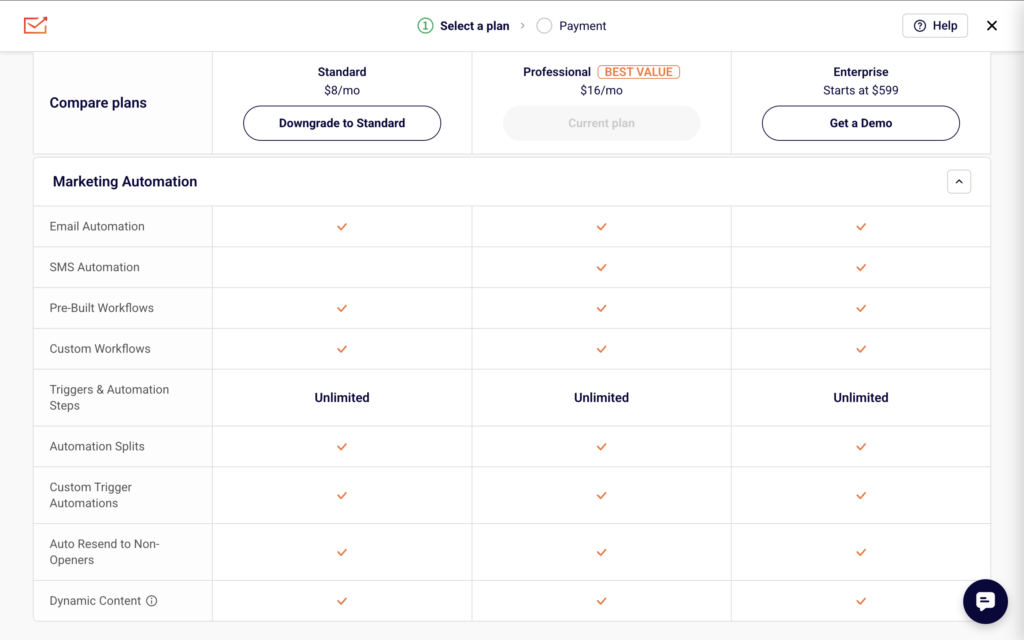
Each Sender plan includes email automation, but the available features and sending volumes differ depending on your subscription tier. This guide outlines what each plan supports so you can manage your workflows accordingly.
Where to Find This Setting
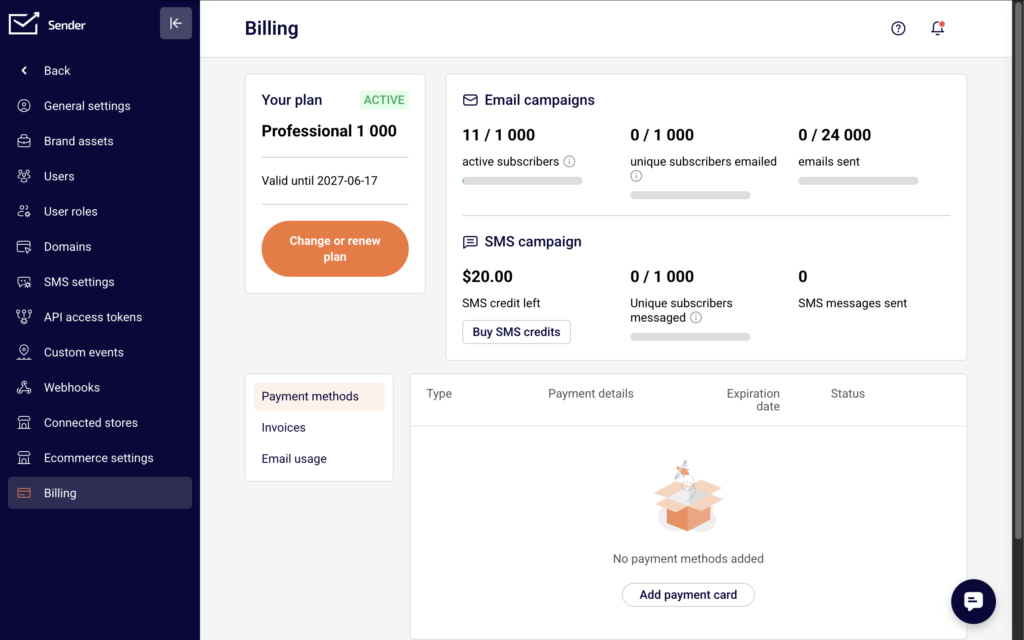
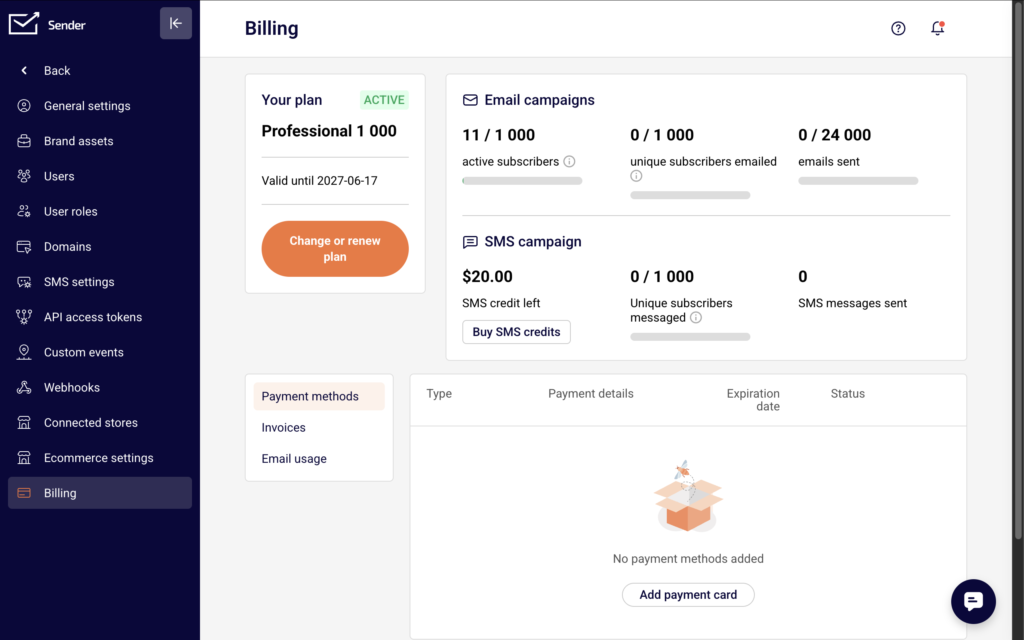
In the Sender dashboard, go to Automations in the left sidebar. To review your current plan and its limits, go to Account settings → Billing. Your active plan name, subscriber count, and email volume are displayed at the top of the Billing page.
Click Change or renew plan to view the full feature comparison across all plans.
Steps to Check Your Automation Limits
Step 1 — Review Your Current Plan
Open Account settings → Billing. Your plan name appears under Your plan (for example, Professional 1 000). Below it, you can see your active subscriber count, unique subscribers emailed, and total emails sent against your plan’s monthly allowance. These volume limits apply to all emails sent through automations and campaigns combined.
Step 2 — Compare Automation Features by Plan
Click Change or renew plan, then scroll down to Compare plans and features. Expand the Marketing Automation section to see which automation capabilities are included in each tier.
The four plans — Free, Standard, Professional, and Enterprise — share many automation features but differ in a few key areas.
Step 3 — Identify Feature Differences
All four plans include Email Automation, Pre-Built Workflows, Custom Workflows, Automation Splits, Custom Trigger Automations, Dynamic Content, and unlimited Triggers & Automation Steps. The differences are:
SMS Automation is available on Professional and Enterprise only.
Advanced automation (multichannel scenarios and other advanced workflow features) is listed as a Professional and Enterprise benefit.
Step 4 — Check Your Sending Volume
Automation emails count toward your plan’s monthly email limit. On the Billing page, the Email campaigns section shows your usage (for example, 0 / 24 000 emails sent). The monthly limits by plan are:
Free: up to 15,000 emails/month, up to 2,500 subscribers
Standard: up to 12x your subscriber count per month
Professional: up to 24x your subscriber count per month
Enterprise: unlimited emails If your automations are close to hitting these limits, emails within active workflows may be delayed or not sent until the next billing cycle.
What Happens After the Change
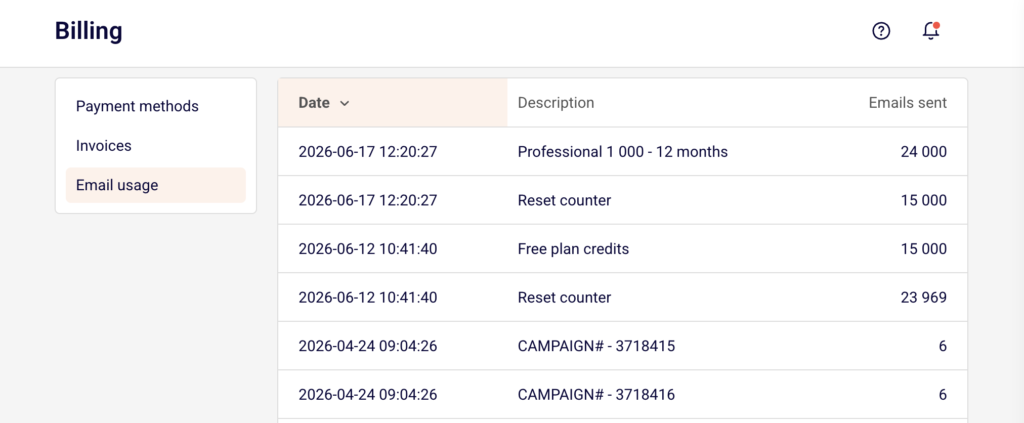
If you upgrade your plan, additional automation features become available immediately. Any existing workflows that use features from the new tier (such as SMS steps on Professional) will function once the plan is active. If you downgrade, features not included in the lower plan become unavailable. Workflows using those features (for example, SMS Automation steps on a Standard plan) will not execute those specific steps. The workflow itself remains in your Automations list but affected steps will not send. Your monthly email sending limit resets with each billing cycle. You can monitor current usage at any time under Account settings → Billing.
Common Issues
Automation emails are not sending → Your monthly email limit may be reached. Check your usage under Account settings → Billing in the Email campaigns section.
SMS step is not available in the workflow builder → SMS Automation requires a Professional or Enterprise plan. Verify your plan under Account settings → Billing.
Auto Resend to Non-Openers option is missing → This feature is not available on the Free plan. Upgrade to Standard or higher to access it.
Workflow shows DRAFT after adding advanced steps → Some features require a specific plan tier. If the workflow cannot be activated, check whether all steps are supported on your current plan.
FAQs
Do automation emails count toward my monthly sending limit?
Yes. All emails sent through automations count toward the same monthly email allowance shown on your Billing page.
Can I use email automation on the Free plan?
Yes. The Free plan includes email automation, pre-built workflows, custom workflows, automation splits, custom trigger automations, dynamic content, and unlimited triggers and automation steps.
What does “Advanced automation” include on the Professional plan?
It enables multichannel scenarios (combining email and SMS in one workflow) and other advanced workflow features not available on Standard or Free.
Is there a limit on the number of automation workflows I can create?
There is no stated limit on the number of workflows across any plan. The constraint is on monthly email volume and subscriber count, not on the number of automations.
What happens to active automations if I downgrade my plan?
Workflows remain in your list, but steps relying on features not available in the lower plan (such as SMS steps) will stop executing. Email-only steps continue to function within the new plan’s sending limits.
This guide explains how to identify bounced recipients from a sent email campaign and resend the campaign to soft-bounced subscribers in Sender.
Where to Find This Setting
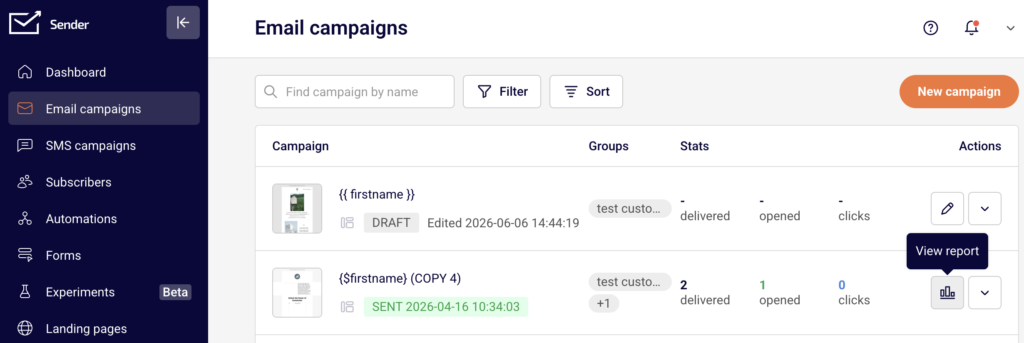
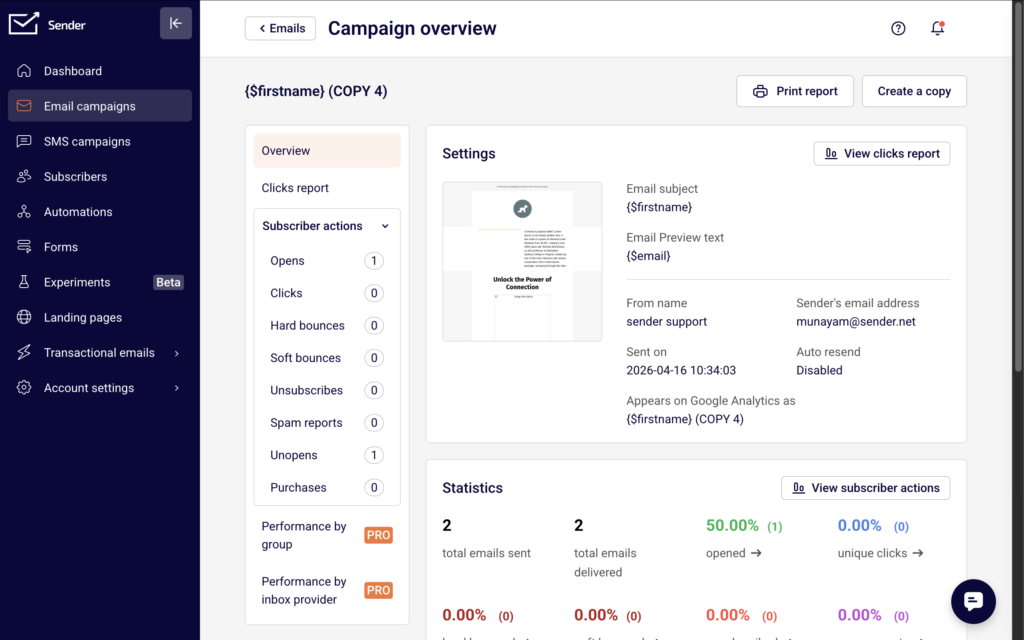
In the Sender dashboard, go to: Email campaigns → select a sent campaign → click the report icon (bar chart) in the Actions column → Subscriber actions → Soft bounces or Hard bounces.
The bounce data is located in the Campaign overview report for any campaign with a Sent status. From the Subscriber actions sidebar, you can view individual bounced recipients, export the list, and decide whether to resend.
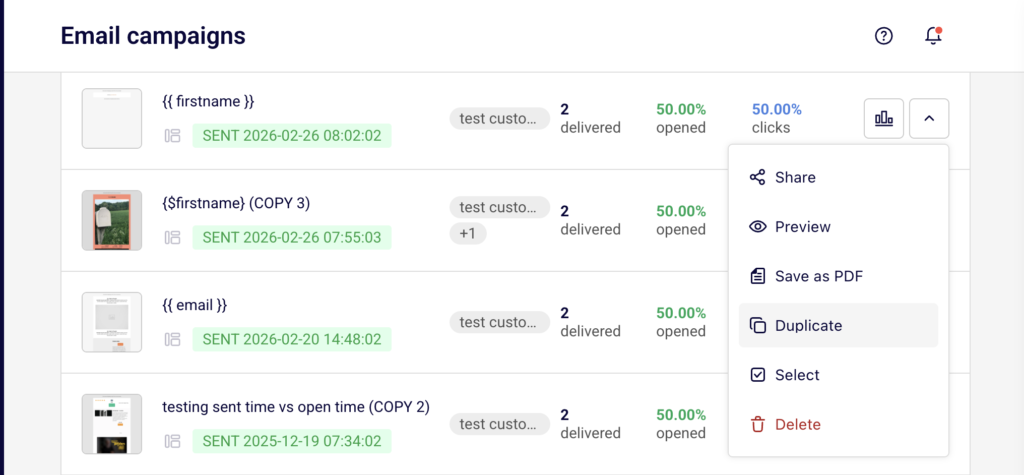
The Create a copy button on the Campaign overview page lets you duplicate the sent campaign into a new Draft for resending.
Steps to Resend to Bounced Recipients
Step 1 — Review bounced recipients in the campaign report
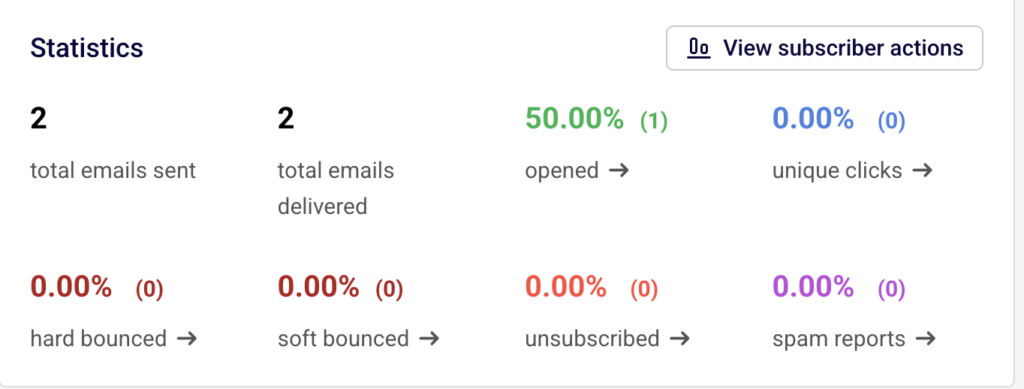
In the Email campaigns list, locate the sent campaign and click the report icon in the Actions column to open the Campaign overview. In the Statistics section, check the hard bounced and soft bounced counts.
Click the arrow next to soft bounced → to open the Subscriber actions page filtered to the Soft bounces tab. Review the listed email addresses, bounce reasons, and timestamps. Only soft-bounced recipients are candidates for resending.
Step 2 — Export the soft-bounced recipient list
On the Subscriber actions page with the Soft bounces tab selected, click Export in the top-right corner. This downloads a file containing the email addresses of all soft-bounced recipients from that campaign. Save this file — you will use it to target these subscribers in the resend campaign. You can also use Print to create a printable version of the bounce report for reference.
Step 3 — Create a copy of the original campaign
Return to the Campaign overview page and click Create a copy in the top-right corner. Sender duplicates the campaign with all its settings and design intact, adding (COPY) to the campaign name.
The new campaign appears at the top of your Email campaigns list with a Draft status. Click the edit icon to open the campaign workflow.
Step 4 — Update recipients and send
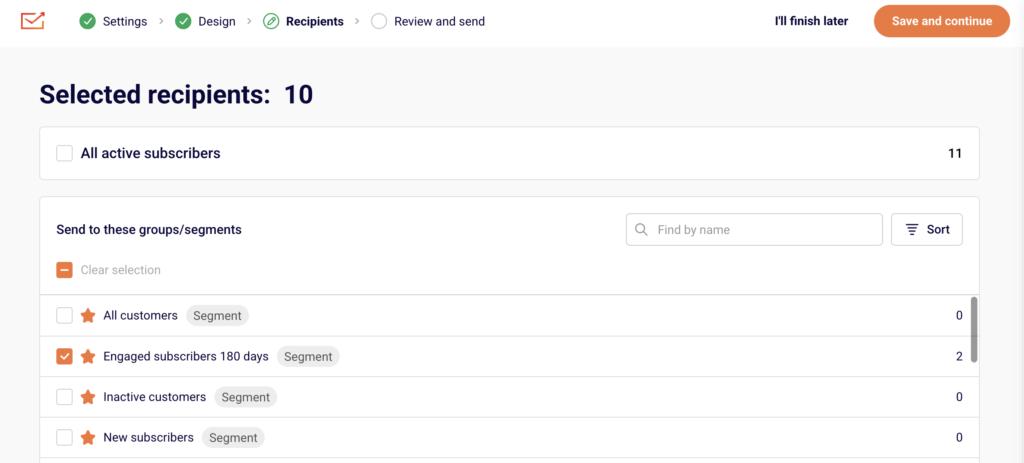
In the campaign workflow, navigate to the Recipients step. Remove the original recipient groups or segments, and select only the subscribers who soft-bounced.
You can re-import the exported soft-bounce list as a new group, or manually select the relevant subscribers. Once the recipients are configured, proceed to the Review and send step. Click Send now to deliver immediately or Schedule to set a future date, time, and timezone for delivery.
Sending Behavior
Hard bounces vs. soft bounces — A hard bounce means the email address is permanently unreachable (e.g., the address does not exist). Sender automatically marks hard-bounced subscribers with a Bounced email status, and they are excluded from future sends. Soft bounces are temporary delivery failures (e.g., a full inbox) and these subscribers remain eligible for resending.
Bounced subscriber status — When a subscriber’s email status changes to Bounced, they are excluded from the All active subscribers recipient list and from any campaign targeting active subscribers. Only subscribers with an Active email status receive campaigns.
Create a copy behavior — Using Create a copy on a sent campaign duplicates the campaign settings, design, and subject line into a new Draft campaign. The recipient selection is not carried over from the original send — you must configure recipients manually in the copied campaign.
Campaign sending after resend — The resent campaign is tracked as a separate campaign in your Email campaigns list with its own statistics, including delivery, opens, clicks, and bounces. The original campaign report remains unchanged.
Sending Tips
Only resend to soft bounces — Hard-bounced addresses are permanently invalid. Resending to them will result in another bounce, waste your send quota, and may harm your sender reputation.
Wait before resending — Soft bounces are often caused by temporary issues such as a full inbox or a server outage. Wait at least 24–48 hours before resending to give the issue time to resolve.
Update the subject line — When creating a copy for resending, consider changing the subject line slightly to differentiate it from the original send and to reduce the chance of being filtered as a duplicate by inbox providers.
Check your send limits — Each resend campaign counts against your plan’s email send limit. Verify your remaining sends on the Billing page before sending.
Review bounce reasons — On the Hard bounces and Soft bounces tabs, each entry includes the bounce reason. Use this information to determine whether a resend is appropriate or whether the addresses need to be removed from your list.
Common Issues
Hard-bounced recipients cannot receive resends → Hard bounces indicate a permanent delivery failure. Sender marks these subscribers as Bounced, and they are automatically excluded from future sends. You cannot resend to hard-bounced addresses without first reactivating the subscriber, which is not recommended.
Exported bounce list does not match expected count → The export reflects the data at the time of download. If subscribers were removed or their status changed between sending and exporting, the count may differ from the campaign report.
Copied campaign sends to all subscribers instead of bounced ones → The Create a copy feature does not automatically target bounced recipients. You must manually update the recipient selection in the Recipients step to include only the soft-bounced subscribers.
Resend campaign shows new bounces → Some soft-bounced addresses may bounce again if the underlying issue has not been resolved. Monitor the resend campaign’s report and consider removing repeatedly bouncing addresses from your subscriber list.
FAQs
What is the difference between a hard bounce and a soft bounce? A hard bounce means the email address is permanently undeliverable — for example, the address does not exist or the domain is invalid. A soft bounce is a temporary failure, such as a full mailbox or a server timeout. Sender marks hard-bounced subscribers as Bounced and excludes them from future sends automatically.
Can I resend to hard-bounced recipients? No. Hard-bounced subscribers are marked with a Bounced email status and are excluded from active recipient lists. Resending to permanently invalid addresses harms your sender reputation and wastes your send quota. Focus resend efforts on soft-bounced recipients only.
How do I find bounced recipients for a specific campaign? Go to Email campaigns, find the sent campaign, click the report icon in the Actions column, then expand Subscriber actions in the sidebar. Click Hard bounces or Soft bounces to see the list of affected recipients, including bounce reasons and timestamps.
Can I export the list of bounced recipients? Yes. On the Subscriber actions page, select the Hard bounces or Soft bounces tab, then click Export in the top-right corner. The exported file contains the email addresses and bounce details for that campaign.
Does Sender automatically resend to bounced recipients? No. The Auto resend feature in Campaign settings automatically resends the campaign to subscribers who did not open the first send — it does not specifically target bounced recipients. To resend to soft-bounced subscribers, you must manually create a copy of the campaign and update the recipient list.
Will resending to soft-bounced recipients affect my sending limits? Yes. Each resend is a separate campaign that counts against your plan’s email send limit. Check your available sends on the Billing page before sending the copied campaign.