Category: SMS setup and compliance

  • SMS quiet hours and sending time restrictions

    This guide walks you through how to understand SMS quiet hours, comply with sending time restrictions, and use Sender's scheduling tools to send SMS campaigns at appropriate times.

    Where to Find This Feature

    In the Sender dashboard, go to: SMS campaigns

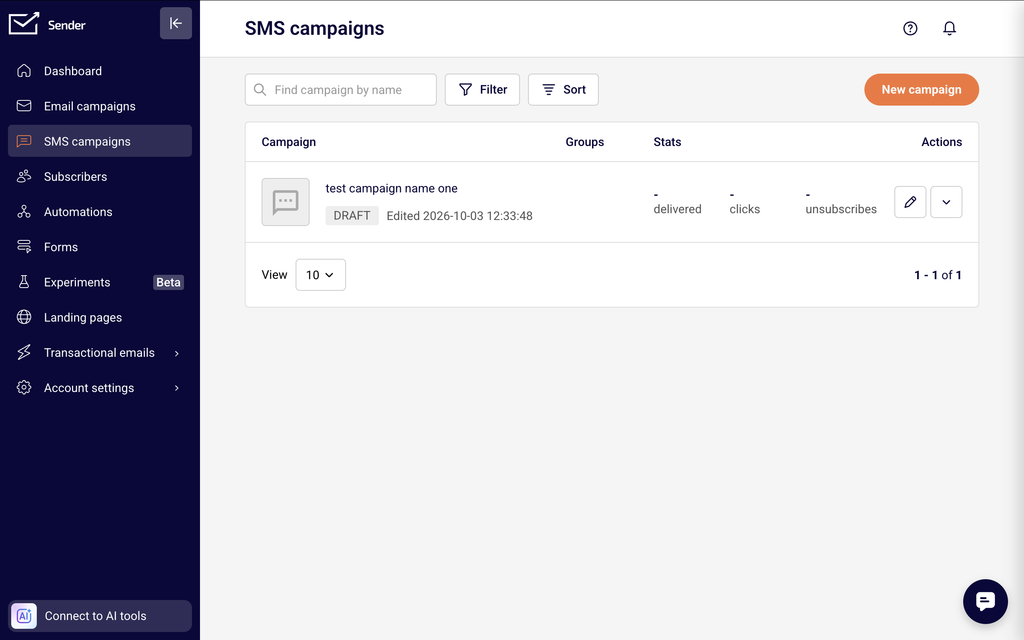
    You will see the SMS campaign library, which contains your drafted, scheduled, sending, and sent campaigns. The New campaign button at the top lets you create a new SMS campaign. Sending time settings are configured during the final step of campaign creation, called Review and schedule, where you choose when your campaign is sent.

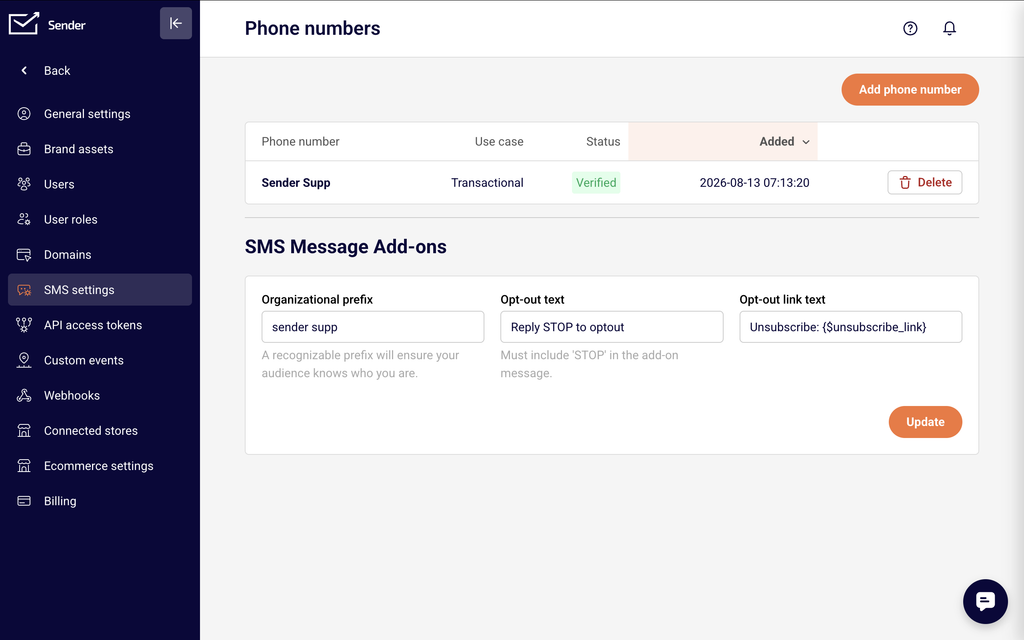
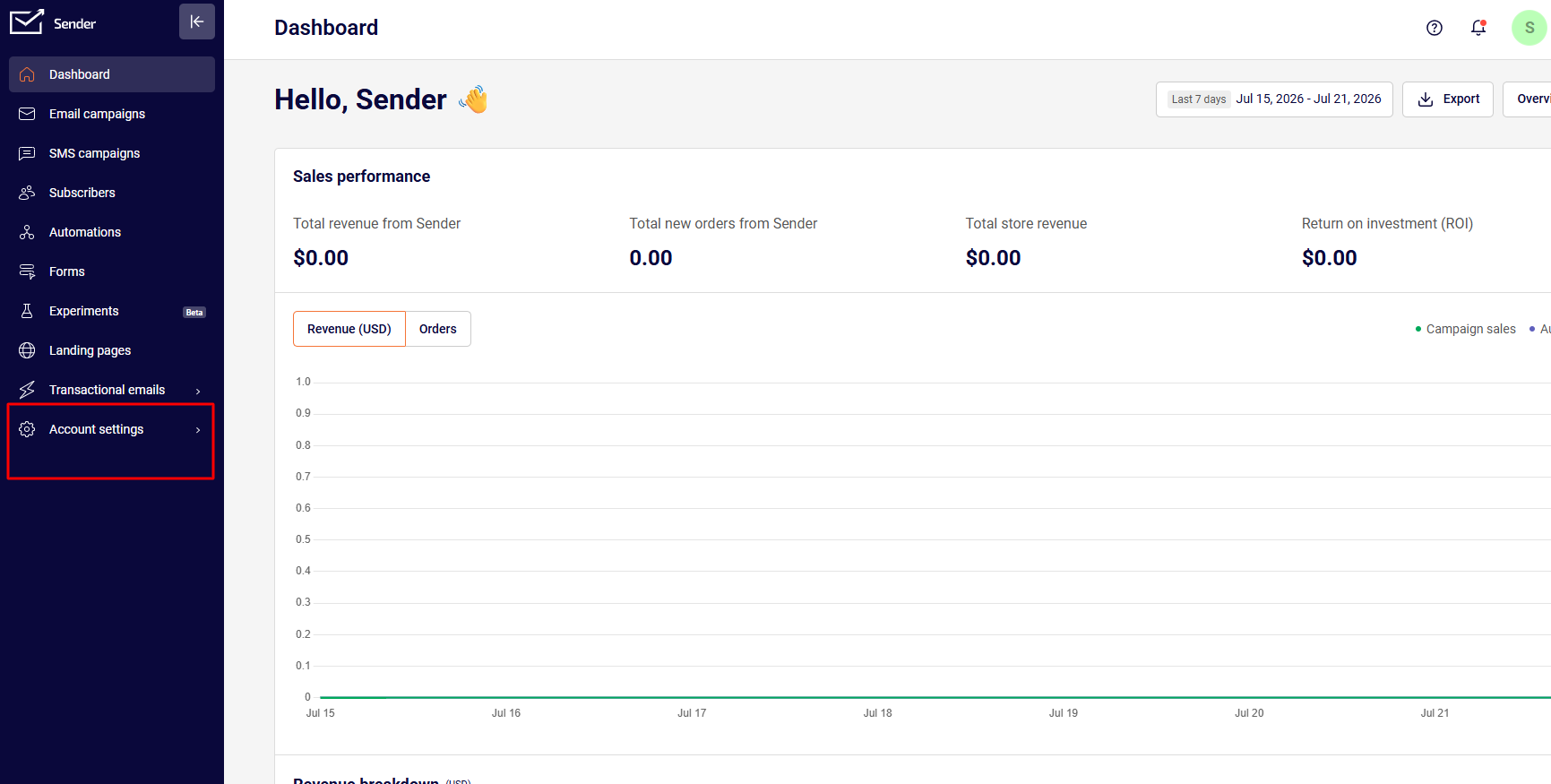
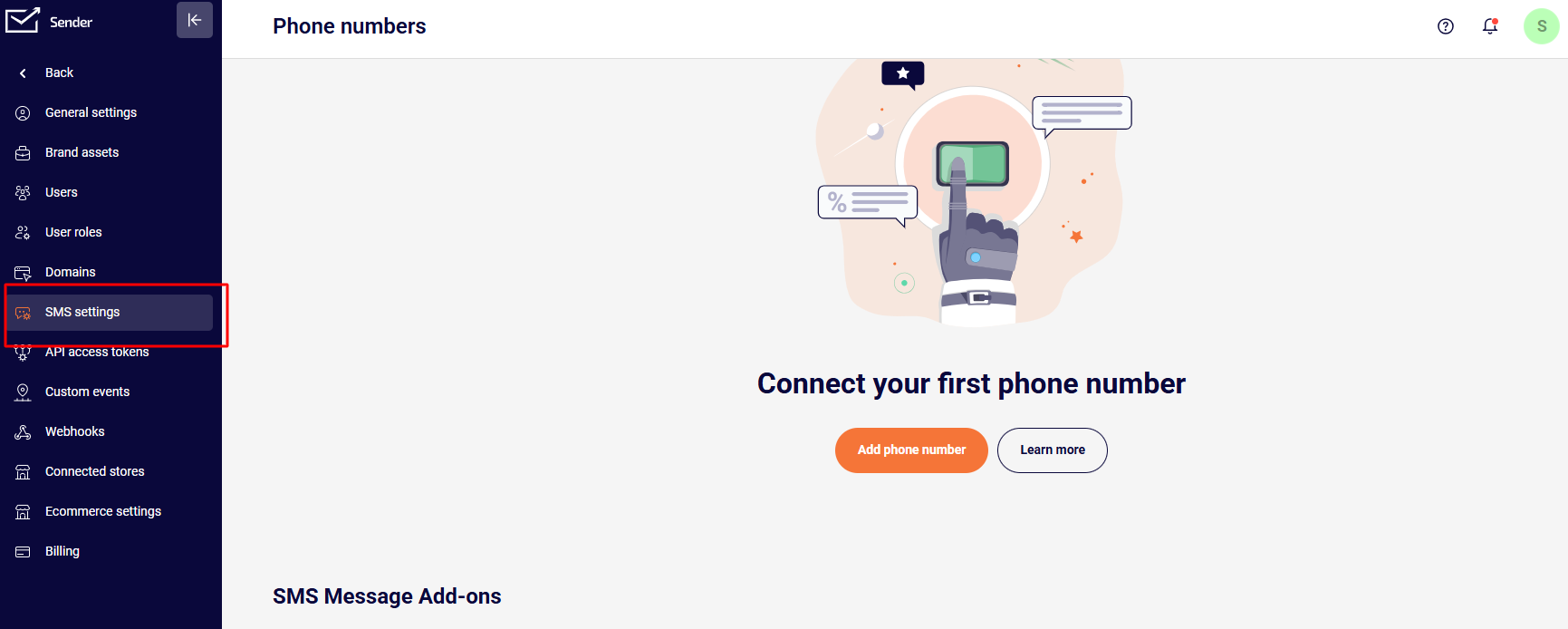
    To manage your sender phone numbers and SMS message add-ons, go to: Account settings → SMS settings

    Steps to Configure SMS Sending Times and Respect Quiet Hours

    Step 1 — Understand SMS Quiet Hours

    Quiet hours are time windows during which sending marketing SMS messages is restricted or prohibited. Under the TCPA (Telephone Consumer Protection Act, a US federal regulation governing telemarketing communications), businesses cannot text customers before 8:00 AM or after 9:00 PM in the recipient's local time zone. Similar restrictions may apply in other jurisdictions under regulations like the GDPR or local carrier rules. Scheduling your SMS campaigns outside of these restricted windows helps you stay compliant and reduces the risk of complaints, opt-outs, and potential fines.

    Step 2 — Create Your SMS Campaign Content

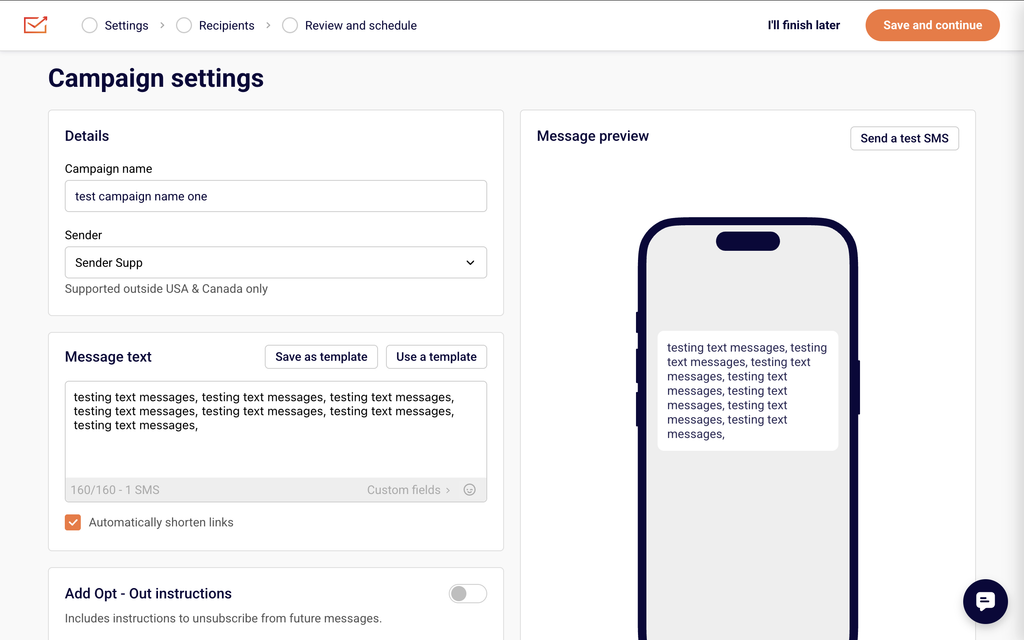
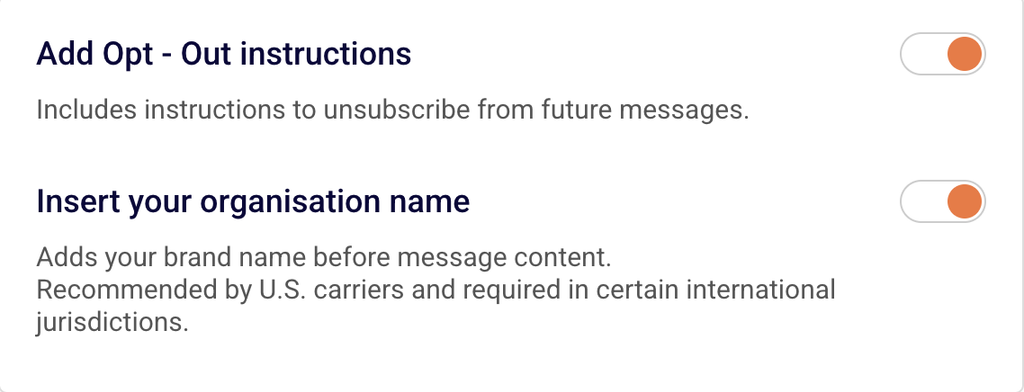
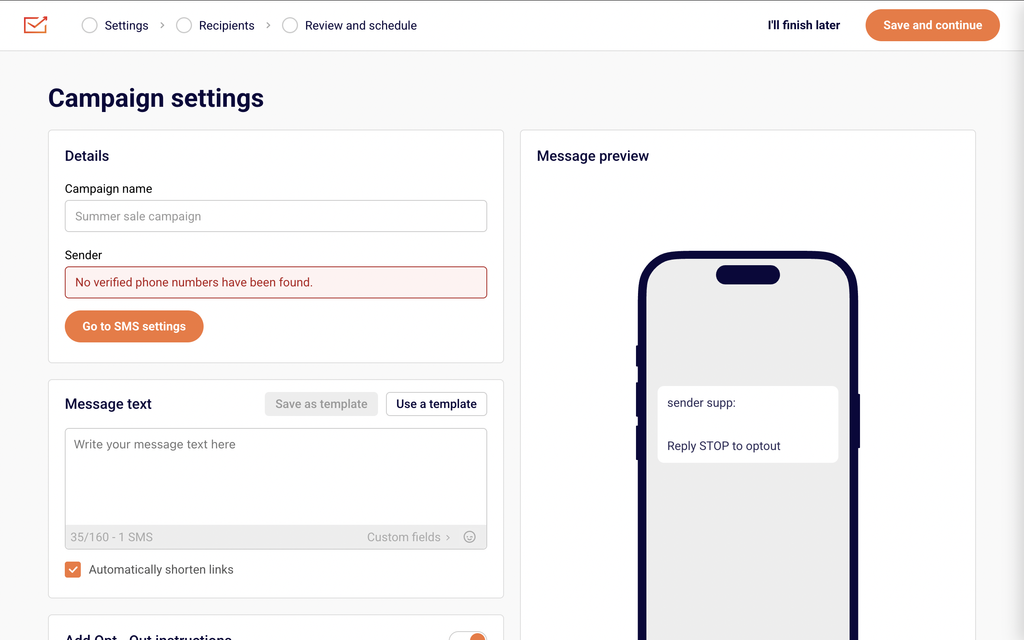
    In the Sender dashboard, click SMS campaigns in the left sidebar, then click New campaign. On the Campaign settings page, enter a Campaign name, select a verified phone number from the Sender dropdown, and write your message in the Message text field. Enable the Add Opt-Out instructions toggle to include unsubscribe instructions. Enable Insert your organisation name to prepend your brand name to the message, which is recommended by U.S. carriers. Click Save and continue to proceed to the Recipients step, select your subscriber groups or segments, and then click Save and continue again to reach the final step.

    Step 3 — Schedule Your Campaign for a Compliant Sending Time

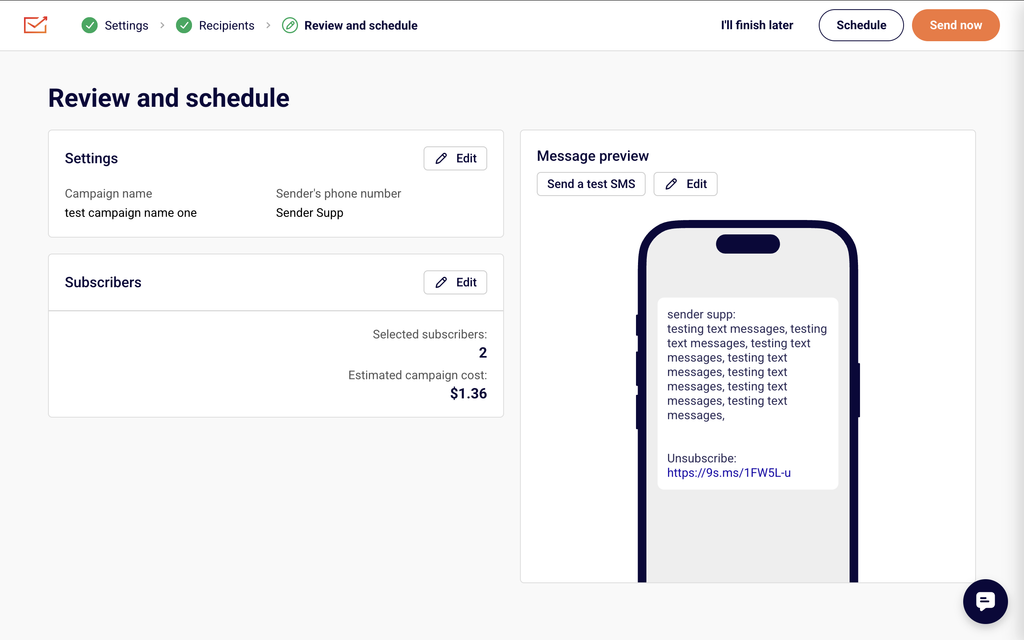
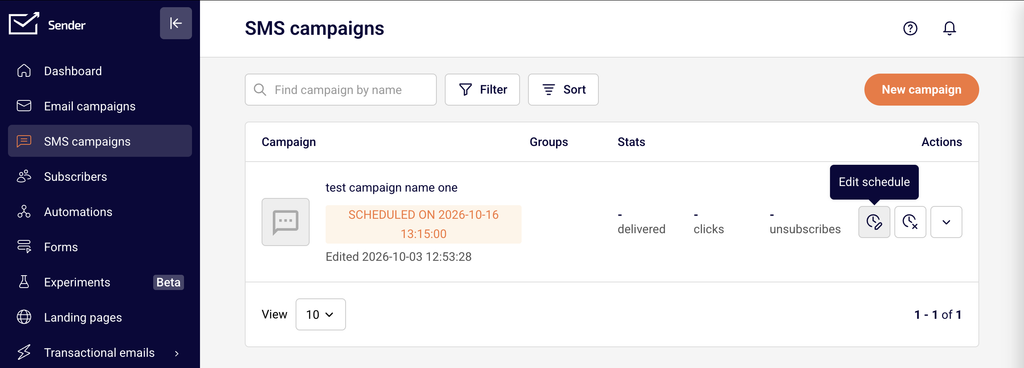
    On the Review and schedule step (labeled Confirm and send), you will see a summary of your campaign settings, subscriber count, estimated cost, and a message preview. To send at a specific time that respects quiet hours, click Schedule to send. A Schedule campaign dialog will appear with a calendar date picker and a Select time field. Choose a date and set the time to fall within the compliant sending window — between 8:00 AM and 9:00 PM in your recipients' local time zone. Click Schedule to confirm. Your scheduled campaign will appear in the SMS campaign list with the scheduled delivery date and time.

    Step 4 — Verify Your Scheduled Time Before Sending

    Before finalizing, review the scheduled date and time displayed in the campaign summary. Confirm that the sending time accounts for time zone differences if your subscribers are in multiple regions. If you need to send immediately and it is within the compliant window, you can click Send now instead. You can also click Send a test SMS from the message preview panel to verify the message content and delivery before launching the full campaign.

    SMS Compliance Requirements

    TCPA (Telephone Consumer Protection Act) — Applies to businesses sending SMS to recipients in the United States. The TCPA generally prohibits sending marketing text messages before 8:00 AM or after 9:00 PM in the recipient's local time zone. Sender's scheduling tools allow you to set a specific delivery time to help you stay within these windows.

    GDPR (General Data Protection Regulation) — Applies to businesses sending SMS to recipients in the European Union and European Economic Area. While the GDPR does not specify exact sending hours, it requires that marketing communications be sent only with explicit consent and in a manner that respects the recipient's rights. Some EU member states have additional rules restricting commercial messaging during certain hours or on certain days.

    Carrier-Level Restrictions — Mobile carriers in various countries may impose their own rules on when and how marketing SMS can be delivered. These can include restrictions on sending times, content filtering, and throughput limits. Violating carrier policies can result in message blocking or sender ID suspension. Check Sender's SMS documentation or contact support for details about restrictions in your target countries.

    Sender's SMS Policies — Sender requires that all SMS campaigns include opt-out instructions and recommends including your organization name in every message. Sender also requires a verified phone number or registered sender ID before you can send campaigns. These policies complement regulatory requirements and help protect your sending reputation.

    Always consult a legal professional for jurisdiction-specific advice on SMS sending time restrictions and compliance obligations.

    What Happens Next

    After scheduling your campaign, it will appear in the SMS campaigns list with a Scheduled status and the delivery date and time displayed alongside it.

    You can return to SMS campaigns at any time to view, edit, or cancel scheduled campaigns before they are sent.

    To verify everything is working correctly, use the Send a test SMS option on the Review and schedule step to send a test message to your own phone number before launching the campaign.

    Your scheduled SMS campaigns will also be visible in campaign reports after delivery, where you can track delivery status, failed messages, and other performance metrics.

    Common Issues

    SMS sent outside compliant hours → This happens when the scheduled time does not account for time zone differences between your account's time zone and your recipients' local time zones. Review your account time zone under Account settings → General settings → Time zone, and adjust your scheduled delivery time to ensure it falls within 8:00 AM–9:00 PM for all recipient regions.

    Campaign shows "No verified phone numbers have been found" → This occurs when no sender phone number has been verified or approved. Go to Account settings → SMS settings to check your phone number status. If your phone number shows In Progress, wait for verification to complete before creating a campaign.

    Scheduled campaign not sending at the expected time → This can happen if the time zone set in your Sender account does not match your intended delivery time zone. Confirm the time zone under Account settings → General settings and recalculate the schedule if your recipients are in a different region.

    Recipients report receiving messages at inconvenient times → This typically occurs when your subscriber list spans multiple time zones and you schedule a single send time. Consider segmenting your audience by region and scheduling separate campaigns for each time zone to ensure all messages arrive within compliant hours.

    FAQs

    What are SMS quiet hours? Quiet hours are time periods during which sending marketing SMS messages is restricted or prohibited by regulations. In the United States, the TCPA generally requires that marketing texts not be sent before 8:00 AM or after 9:00 PM in the recipient's local time zone. Other countries and carriers may have their own restrictions. Consult a legal professional for guidance specific to your jurisdiction.

    Does Sender automatically block SMS during quiet hours? Sender provides scheduling tools that let you control exactly when your campaign is sent. It is your responsibility to schedule campaigns at times that comply with applicable regulations. Use the Schedule to send feature on the Review and schedule step to set a delivery time within the compliant window for your audience.

    How do I schedule an SMS campaign in Sender? During campaign creation, complete the Settings and Recipients steps, then on the Review and schedule step, click Schedule to send. Select a date and time using the calendar and time picker in the Schedule campaign dialog, then click Schedule to confirm.

    What time zone does Sender use for scheduling? Sender uses the time zone configured in your account settings. You can check or update this under Account settings → General settings → Time zone. Make sure this setting aligns with the time zone you intend for your campaign delivery.

    What should I do if my subscribers are in multiple time zones? Segment your subscriber list by geographic region or time zone. Create separate campaigns for each segment and schedule each one to arrive within the compliant sending window for that region. This ensures all recipients receive your message during appropriate hours.

    Can I send an SMS campaign immediately instead of scheduling it? Yes. On the Review and schedule step, click Send now to deliver the campaign immediately. Before doing so, confirm that the current time falls within the compliant sending window for your recipients' time zones.

    Are there sending time restrictions outside the United States? Yes. Many countries have their own regulations governing when commercial SMS messages may be sent. Some EU member states, for example, restrict marketing messages during evenings, weekends, or public holidays. Carrier-level rules may also apply. Check Sender's SMS documentation or contact support for specific country restrictions, and consult a legal professional for compliance guidance.

  • How to Import Subscriber Phone Numbers

    This guide walks you through how to import subscriber phone numbers into Sender for the first time, so your contacts are ready for SMS campaigns.

    Where to Find This Feature

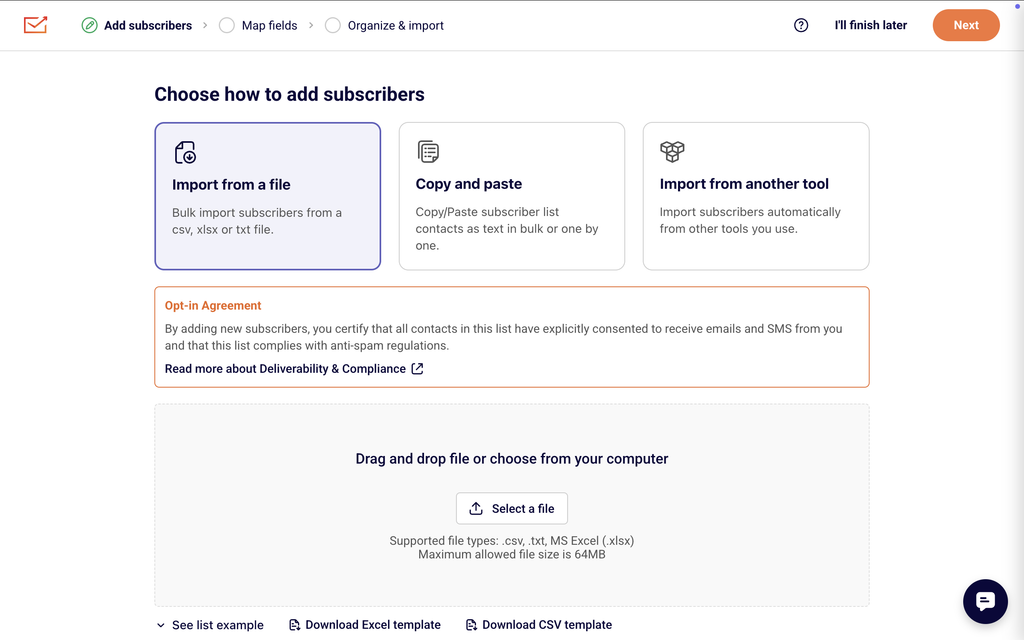
    In the Sender dashboard, go to: Subscribers → Subscribers → Add subscribers

    This opens the Import subscribers page, where you can upload a file containing subscriber data including phone numbers. You will see four import methods at the top of the page: Import from a file, Copy/Paste subscriber list, Import from Mailchimp, and Import from GetResponse. Below the import method tabs, you will find a file upload area, a list format example, and template download options.

    Steps to Import Subscriber Phone Numbers

    Step 1 — Prepare Your File

    Before uploading, format your file so that each subscriber is on a separate row and each field (email, first name, last name, phone number) is in a separate column. Phone numbers must be in international format with the country code prefix (e.g., +1 for the United States, +44 for the United Kingdom). For example: +12345678901.

    Sender accepts .csv, .txt, and .xlsx (MS Excel) files up to 64 MB. You can click Download Excel template or Download CSV template on the import page to get a pre-formatted file to work with.

    Step 2 — Upload Your File

    On the Import subscribers page, make sure the Import from a file tab is selected. Drag and drop your file into the upload area, or click the Import file button to select a file from your computer. Sender will process the file and display a preview of your data in the next step.

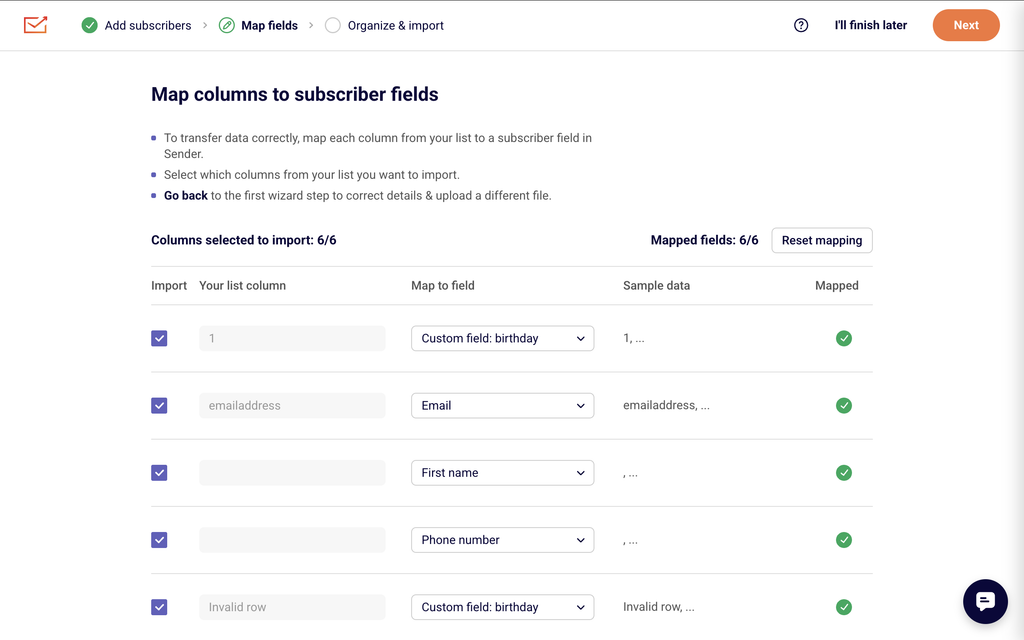
    Step 3 — Map Columns to Subscriber Fields

    After uploading, Sender displays the Match the columns section with a preview of your data. Each column has a dropdown at the top. Verify that Sender has correctly matched your columns to the right subscriber fields — particularly that your phone number column is mapped to Phone number.

    If a column is not matched correctly, click the dropdown and select the correct field. You can also search for a field by name, select Create a new field if you need a custom field, or choose Skip this column to exclude a column from the import. A count at the bottom shows how many subscribers will be imported.

    Step 4 — Assign to a Group and Start the Import

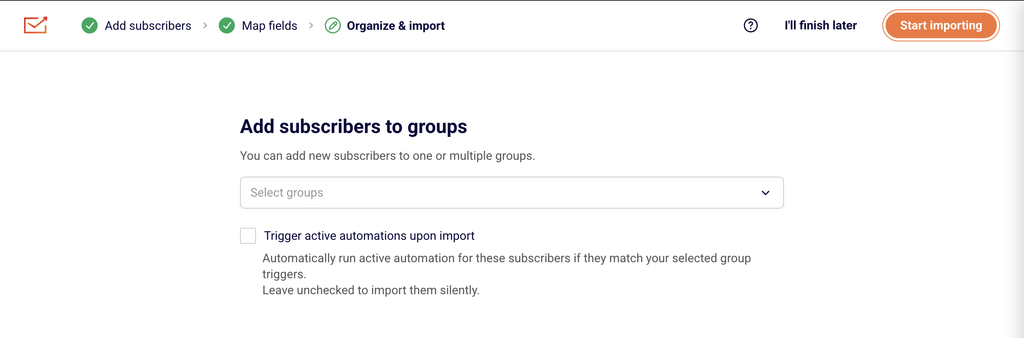
    Below the column mapping preview, you will see the Add subscribers to a group section. Click the Choose groups dropdown to assign imported subscribers to one or more existing groups, or select Create a new group to make a new one. Assigning subscribers to a group makes it easier to target them later in SMS campaigns.

    When everything looks correct, click the Start import button. Sender processes the import and returns you to the Subscribers list, where you can verify that the new subscribers and their phone numbers appear.

    SMS Compliance Requirements

    Consent (TCPA / GDPR) — Before importing phone numbers, you must have explicit opt-in consent from each subscriber to receive SMS marketing messages. In the United States, the Telephone Consumer Protection Act (TCPA) requires prior express written consent. In the European Union, the General Data Protection Regulation (GDPR) requires a clear legal basis for processing personal data, including phone numbers. Only import phone numbers for contacts who have given you verifiable permission.

    Phone number format — Sender requires phone numbers in international format, which includes the country code prefix followed by the subscriber's number (e.g., +14155551234). Numbers that do not include the country code may not be recognized correctly and will not be usable for SMS sending.

    Opt-out instructions — Most carrier regulations and Sender's own SMS policies require every marketing SMS to include opt-out instructions, such as "Reply STOP to unsubscribe." While this requirement applies when sending messages rather than during import, ensure your imported list only contains subscribers who have not previously opted out.

    Purchased or rented lists — Do not import phone numbers from purchased, rented, or scraped lists. Sending SMS messages to contacts who have not opted in violates carrier policies and SMS regulations, and may result in account suspension.

    Always consult a legal professional for guidance specific to your jurisdiction and business.

    What Happens Next

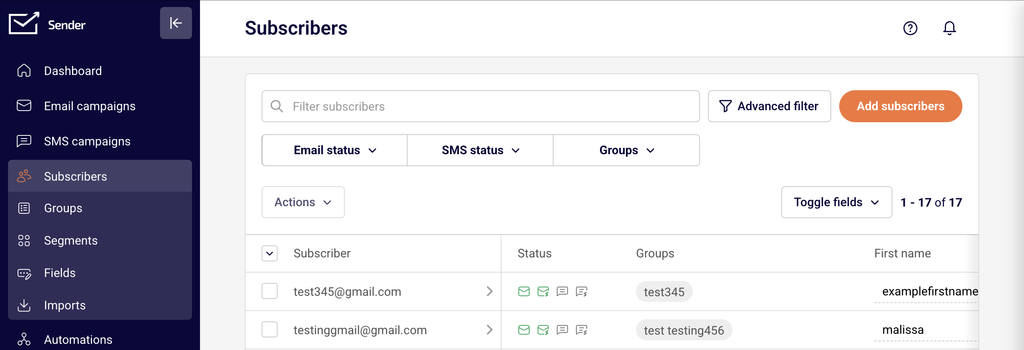
    After importing, go to Subscribers → Subscribers and click on any imported contact to view their profile. The subscriber profile displays an SMS campaign section showing the imported phone number with its status (e.g., ACTIVE). The Subscriber activity log on the right side of the profile confirms the import with entries such as "Phone set to [number] — Source: Import."

    Imported subscribers with valid phone numbers are immediately available for SMS campaigns. To verify your setup, you can send a test SMS to your own number by creating a new SMS campaign from SMS campaigns → New campaign.

    You can manage subscriber phone numbers, group assignments, and field mappings at any time from the Subscribers section of the dashboard.

    Common Issues

    Phone numbers not appearing after import → The phone number column was not mapped to the Phone number field during the column matching step. Re-import the file and make sure the dropdown above the phone number column is set to Phone number.

    Phone numbers in incorrect format → Numbers missing the country code prefix (e.g., 5551234567 instead of +15551234567) may not be recognized. Update your file so every phone number starts with + followed by the country code, then re-import.

    Subscribers not showing as SMS-active → If a subscriber's profile shows the SMS campaign section but the phone number is missing or the status is not ACTIVE, the phone number may have been formatted incorrectly or the column was skipped during import. Check the subscriber's profile and edit the phone number manually if needed.

    File upload fails → Sender supports .csv, .txt, and .xlsx files up to 64 MB. Make sure your file is in one of these formats and does not exceed the size limit. If the file is too large, split it into smaller batches.

    Duplicate subscribers → If a subscriber with the same email address already exists, Sender updates the existing record with the imported data, including the phone number. This does not create duplicate entries.

    FAQs

    What file formats does Sender accept for importing subscribers?

    Sender accepts .csv, .txt, and MS Excel (.xlsx) files. The maximum file size is 64 MB. You can download a pre-formatted template from the Import subscribers page by clicking Download Excel template or Download CSV template.

    What phone number format does Sender require?

    Phone numbers must be stored in international format with the country code prefix (e.g., +1 for the United States, +44 for the United Kingdom). The full number should start with + followed by the country code and subscriber number, such as +14155551234.

    Do I need consent to import subscriber phone numbers?

    Yes. SMS regulations like TCPA (US) and GDPR (EU) require explicit consent from recipients before sending marketing SMS. You should only import phone numbers for subscribers who have actively opted in to receive SMS messages from your business. Consult a legal professional for guidance specific to your jurisdiction.

    Can I import phone numbers without email addresses?

    Sender's import process uses email addresses as the primary subscriber identifier. Each row in your import file should include an email address along with the phone number to ensure the subscriber record is created or matched correctly.

    Can I assign imported subscribers to a group?

    Yes. During the import process, the Add subscribers to a group section lets you select one or more existing groups from the Choose groups dropdown, or create a new group by selecting Create a new group. This helps organize your SMS subscribers for targeted campaigns.

    What happens if I import a phone number for an existing subscriber?

    If the email address in your import file matches an existing subscriber, Sender updates that subscriber's record with the newly imported phone number. The existing subscriber data is not duplicated.

    How do I verify that the phone numbers were imported correctly?

    After importing, go to Subscribers → Subscribers and click on a recently imported contact. The subscriber profile will display the phone number under the SMS campaign section, along with its status. The Subscriber activity log will also show a "Phone set to [number] — Source: Import" entry confirming the import.

    Are there SMS sending restrictions by country?

    Yes. Some countries have specific carrier restrictions on sender IDs, content, or sending hours. Check Sender's SMS documentation or contact support for details about restrictions in your target countries.

  • Compliance and Opt-In Rules

    This guide walks you through the key compliance requirements and opt-in rules you need to follow before sending SMS messages in Sender for the first time.

    Where to Find This Feature

    In the Sender dashboard, go to Account settings → SMS settings.

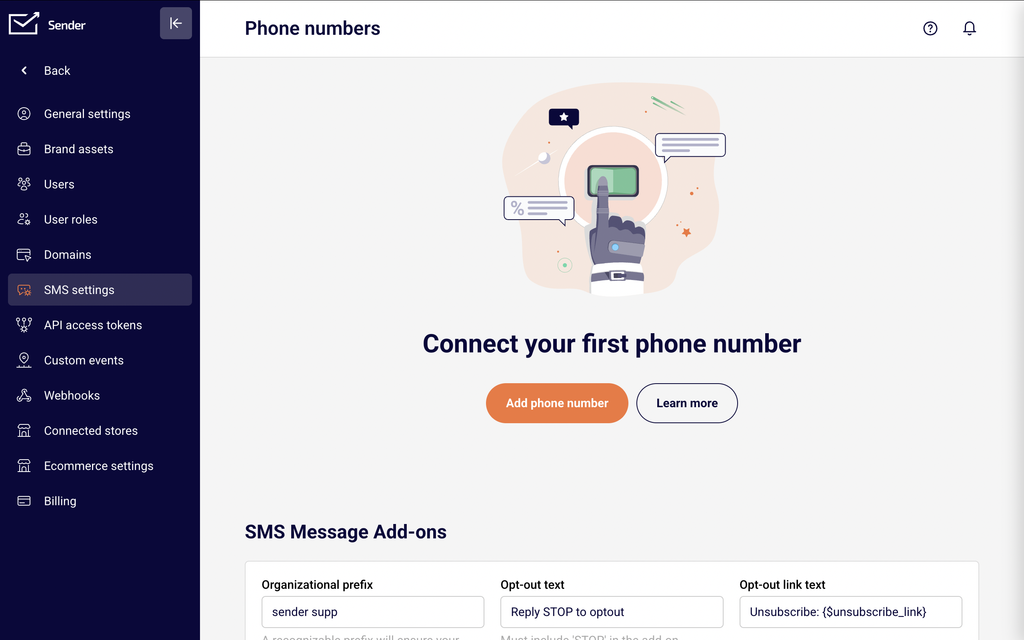
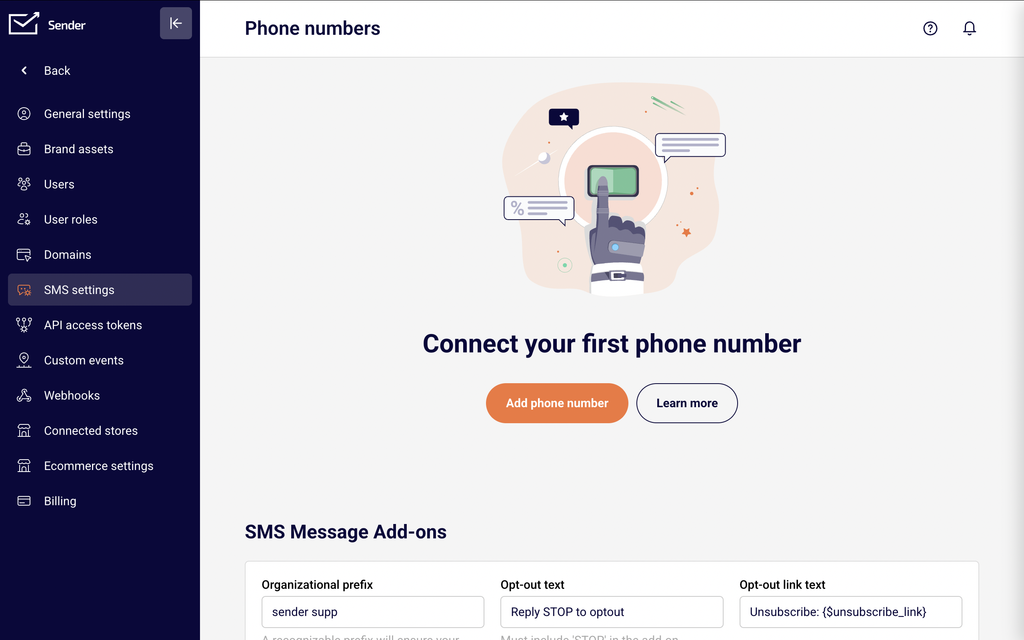
    On this page, you will see the Phone numbers table listing your registered sender IDs with their use case, status, and date added. Below it, the SMS Message Add-ons section displays your Organizational prefix, Opt-out text, and Opt-out link text fields — the core compliance settings that are appended to your SMS messages.

    Steps to Set Up SMS Compliance & Opt-In

    Step 1 — Collect explicit consent from subscribers

    Before sending any SMS, you must have explicit opt-in consent from each recipient. This means the subscriber actively agreed to receive SMS messages from your business — pre-checked boxes or implied consent do not qualify.

    Use Sender's Forms feature to create signup forms that include a clear SMS opt-in statement, such as "I agree to receive marketing text messages from [Your Business]." Make sure the phone number field captures numbers in international format with the country code (e.g., +1 for the US, +44 for the UK). After publishing the form, subscribers who opt in will appear in your Subscribers list with an Active SMS status.

    Step 2 — Configure your opt-out message settings

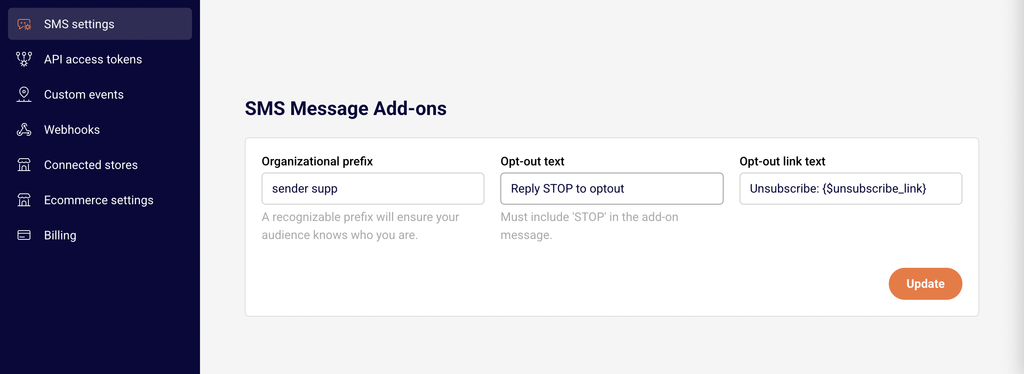
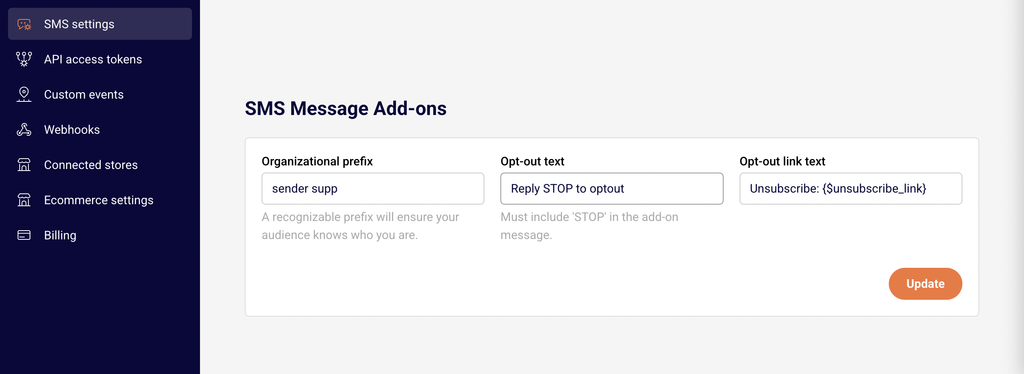
    Go to Account settings → SMS settings and scroll to the SMS Message Add-ons section. You will see three fields:

    Organizational prefix — Enter your business or brand name. This text is added to the beginning of every SMS so recipients know who is messaging them.

    Opt-out text — Enter opt-out instructions that include the word "STOP," such as Reply STOP to opt-out. This field is required and must contain "STOP" in the message.

    Opt-out link text — Enter unsubscribe link text, such as Unsubscribe: {{unsubscribe_link}}. This provides an additional way for recipients to opt out via a clickable link.

    Click Update to save your changes.

    Step 3 — Review prohibited content and sender ID compliance

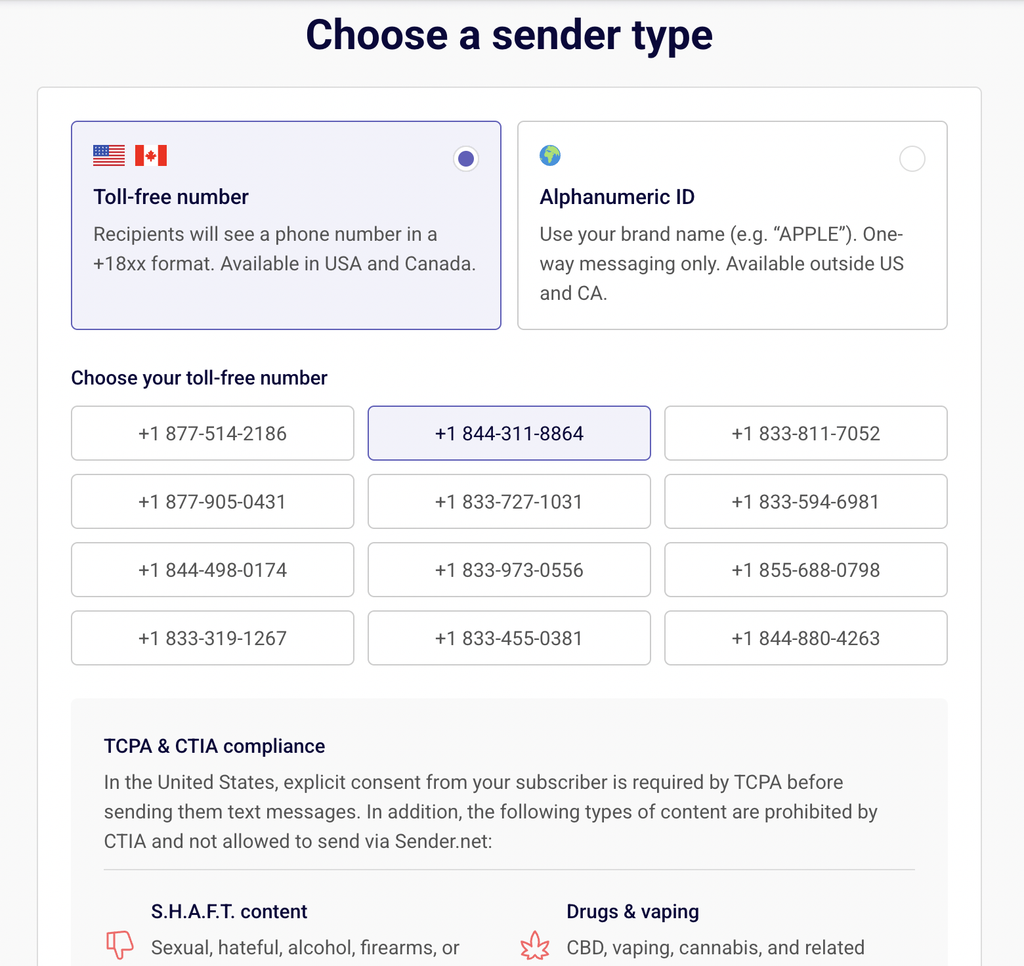
    When registering a sender ID in Sender (via Account settings → SMS settings → Add phone number), you will see the TCPA & CTIA compliance notice. This outlines that explicit consent is required before sending SMS to US subscribers and lists content categories that are prohibited on Sender:

    S.H.A.F.T. content — Sexual, hateful, alcohol, firearms, or tobacco-related content.

    Drugs & vaping — CBD, vaping, cannabis, and related products or content.

    Gambling — Betting, lotteries, gaming for money, and related content.

    High-risk finance — Loans, debt relief, investments, tax relief, and work-from-home offers.

    Ensure your SMS content does not fall into any of these restricted categories. Violations may result in message blocking or account suspension.

    Step 4 — Verify subscriber SMS status and phone number format

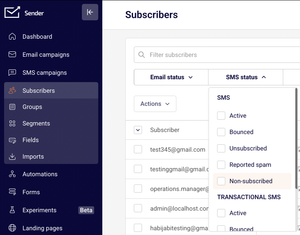
    Go to Subscribers in the left sidebar. Use the SMS status filter at the top of the subscriber list to check the status of your SMS contacts. Available statuses include Active, Bounced, Unsubscribed, Reported spam, and Non-subscribed.

    Click on any subscriber to open their profile. You will see separate sections for Email campaign and SMS campaign, each with its own status indicator. Confirm that the subscriber's phone number is stored with the correct country code prefix (e.g., +370 638 31693) and that their SMS campaign status shows Active before including them in an SMS send.

    SMS Compliance Requirements

    TCPA (Telephone Consumer Protection Act) — Applies to SMS recipients in the United States. Requires express written consent before sending marketing text messages. Sender displays a TCPA compliance notice during sender ID registration and requires you to confirm that you have obtained subscriber consent.

    CTIA (Cellular Telecommunications Industry Association) guidelines — Industry standards enforced by US carriers. CTIA guidelines prohibit certain content categories (S.H.A.F.T., drugs, gambling, high-risk finance) and require that every marketing SMS includes opt-out instructions. Sender enforces these restrictions through its SMS Message Add-ons settings, which require the word "STOP" in your opt-out text.

    GDPR (General Data Protection Regulation) — Applies to recipients in the European Union and European Economic Area. Requires a lawful basis (typically explicit consent) for processing personal data, including phone numbers used for SMS marketing. Subscribers must be able to withdraw consent easily at any time.

    Sender's own SMS policies — Sender requires an organizational prefix on every message, a valid opt-out mechanism in every SMS, and prohibits the content categories listed during sender ID registration. These policies apply regardless of the recipient's location and are enforced through the SMS Message Add-ons configuration on the SMS settings page.

    Always consult a legal professional for advice specific to your jurisdiction and use case. The information above is general guidance and does not constitute legal advice.

    What Happens Next

    After configuring your compliance settings, send a test SMS to your own phone number to verify that the organizational prefix, message content, and opt-out text all display correctly.

    You can manage your opt-out text and organizational prefix at any time by returning to Account settings → SMS settings and updating the SMS Message Add-ons section.

    Subscribers who reply "STOP" will automatically have their SMS status changed to Unsubscribed, which you can monitor using the SMS status filter on the Subscribers page.

    With your compliance settings in place, you are ready to create and send SMS campaigns from the SMS campaigns section in the left sidebar.

    Common Issues

    Opt-out text rejected → The Opt-out text field requires the word "STOP" to be included in the message. If your text is rejected, check that it contains "STOP" (e.g., Reply STOP to opt-out) and click Update to save.

    Subscriber SMS status shows Non-subscribed → This means the subscriber does not have a valid phone number on their profile or has not opted in to SMS. Open the subscriber's profile, add a phone number in international format with the country code, and confirm their SMS consent.

    Sender ID status shows In Progress → After registering a new sender ID, it may take time for carrier verification to complete. The status will update to Active once approved. Do not send campaigns until the status changes from In Progress.

    Prohibited content blocking → If your SMS messages are blocked, review your content against the restricted categories (S.H.A.F.T., drugs, gambling, high-risk finance). Remove any prohibited content and resubmit your message.

    Phone number format errors → Phone numbers must include the full country code prefix in international format (e.g., +1 for the US, +44 for the UK). If subscribers are not receiving messages, verify their phone numbers include the correct country code on their subscriber profile.

    FAQs

    What is a sender ID?

    A sender ID is the name or phone number that appears as the sender when recipients receive your SMS. In Sender, you can choose between a Toll-free number (a +18xx format phone number available in the US and Canada) or an Alphanumeric ID (your brand name, available outside the US and Canada, one-way messaging only). You select your sender type when clicking Add phone number on the SMS settings page.

    Do I need consent to send SMS messages?

    Yes. SMS regulations like TCPA (US) and GDPR (EU) require explicit consent from recipients before sending marketing SMS. Collect consent through signup forms with a clear opt-in statement. Sender displays a compliance notice during sender ID setup as a reminder. Consult a legal professional for guidance specific to your jurisdiction.

    What should I include in every SMS message for compliance?

    Every marketing SMS should include your business name (set via the Organizational prefix field) and opt-out instructions containing the word "STOP," such as "Reply STOP to opt-out." These are configured in the SMS Message Add-ons section under Account settings → SMS settings. Sender appends these automatically to your messages.

    What phone number format does Sender require?

    Phone numbers must be stored in international format with the country code prefix (e.g., +1 for the United States, +44 for the United Kingdom). You can verify the format on each subscriber's profile under the SMS campaign section, which displays the phone number with a country flag indicator.

    How do I check a subscriber's SMS opt-in status?

    Go to Subscribers and use the SMS status filter dropdown at the top of the list. You can filter by Active, Bounced, Unsubscribed, Reported spam, or Non-subscribed. Only subscribers with an Active SMS status should receive your marketing SMS messages.

    What content is prohibited in SMS messages sent through Sender?

    Sender prohibits S.H.A.F.T. content (sexual, hateful, alcohol, firearms, tobacco), drugs and vaping products, gambling-related content, and high-risk finance content (loans, debt relief, investments, tax relief, work-from-home offers). These restrictions are displayed during sender ID registration and align with CTIA carrier guidelines.

    Are there SMS sending restrictions by country?

    Yes. Some countries have specific carrier restrictions on sender IDs, content, or sending hours. For example, Toll-free numbers are only available in the US and Canada, while Alphanumeric IDs are available outside those countries. Check Sender's SMS documentation or contact support for details about restrictions in your target countries.

  • Sender ID setup

    This guide walks you through how to register a sender ID in Sender for the first time so recipients can identify your business when they receive an SMS.

    Where to find this feature

    In the Sender dashboard, go to: Account settings → SMS settings

    This opens the Phone numbers page. Here you will see a table listing all registered sender IDs with their use case, status, and date added. Above the table is the Add phone number button used to register a new sender ID. Below the table is the SMS Message Add-ons section, where you configure your organizational prefix, opt-out text, and opt-out link text.

    Steps to set up a sender ID

    Step 1 — Choose a sender type

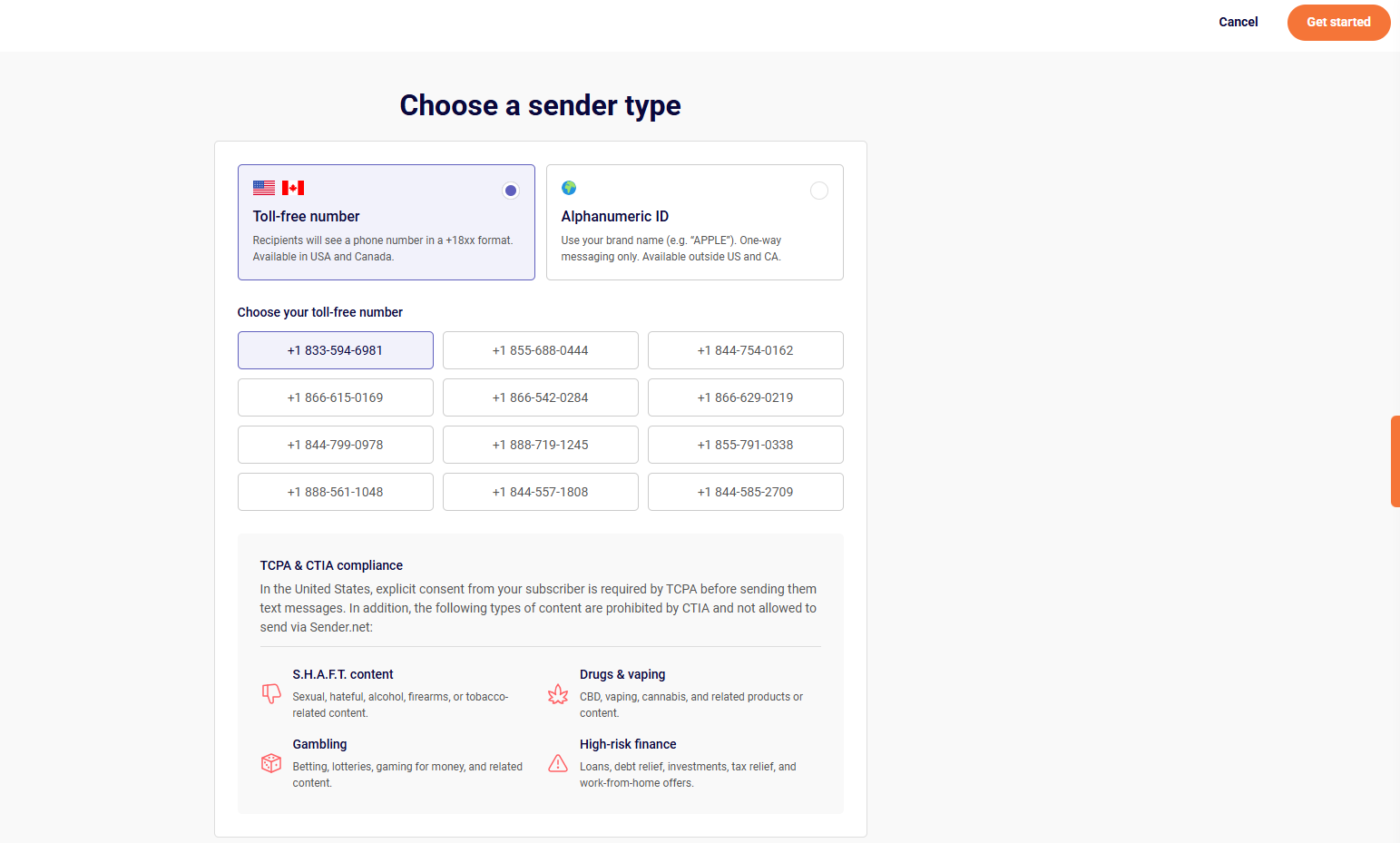
    Click the Add phone number button in the top-right corner of the Phone numbers page. This opens the Choose a sender type screen with two options.

    Toll-free number — Recipients see a phone number in +18xx format. Available in the United States and Canada. Supports two-way messaging.

    Alphanumeric ID — A custom brand name (e.g., "APPLE") that appears as the sender. One-way messaging only, meaning recipients cannot reply. Available outside the US and Canada.

    Select the option that matches your region and messaging needs, then proceed to the next section of the page.

    Step 2 — Configure your sender ID details

    The configuration depends on the sender type you selected in Step 1.

    If you selected Toll-free number: A list of available toll-free numbers appears under Choose your toll-free number. Click one of the numbers to select it. The selected number will be the phone number your recipients see when they receive your SMS.

    If you selected Alphanumeric ID: A Sender ID text field appears. Enter your business or brand name (up to 11 characters). This name will display as the sender on recipients' devices. Note the limitations listed on the page: alphanumeric sender IDs do not support multimedia (MMS) or two-way messaging.

    Step 3 — Register your sender ID

    Review the TCPA & CTIA compliance information displayed at the bottom of the page. This section lists content categories that are prohibited when sending SMS through Sender, including S.H.A.F.T. content, drugs and vaping, gambling, and high-risk finance.

    Once you have confirmed your sender type and details, click the Get started button. You will be redirected to the Phone numbers page, where your new sender ID appears in the table with an In Progress status and a Promotional use case.

    Step 4 — Configure SMS Message Add-ons

    On the Phone numbers page, scroll down to the SMS Message Add-ons section. Configure the following three fields:

    Organizational prefix — Enter your business name or a recognizable identifier. This prefix is added to outgoing SMS messages so recipients know who the message is from.

    Opt-out text — Enter an opt-out instruction such as Reply STOP to optout. This text must include the word "STOP." It is appended to your SMS messages to provide recipients with a way to unsubscribe.

    Opt-out link text — Enter unsubscribe link text such as Unsubscribe: {$unsubscribe_link}. This provides an alternative opt-out method via a clickable link.

    Click Update to save your SMS Message Add-ons configuration.

    SMS compliance requirements

    TCPA (Telephone Consumer Protection Act) — Applies to SMS sent to recipients in the United States. Requires explicit prior consent from subscribers before sending marketing text messages. Sender's signup forms and opt-in tools help you collect and document consent. Consult a legal professional for jurisdiction-specific requirements.

    CTIA (Cellular Telecommunications Industry Association) guidelines — Industry standards enforced by US carriers. Prohibit specific content categories including S.H.A.F.T. content (sexual, hateful, alcohol, firearms, or tobacco-related content), drugs and vaping, gambling, and high-risk finance. Sender displays these restrictions during sender ID registration and does not allow sending this content.

    GDPR (General Data Protection Regulation) — Applies when sending SMS to recipients in the European Union. Requires a lawful basis for processing personal data, which for marketing SMS typically means explicit opt-in consent. Recipients must be able to withdraw consent easily. Consult a legal professional for guidance specific to your jurisdiction.

    Opt-out requirements — Most carrier regulations and Sender's own SMS policies require that every marketing SMS includes opt-out instructions. Sender provides the Opt-out text and Opt-out link text fields in SMS Message Add-ons to help you meet this requirement. The opt-out text must contain the word "STOP."

    Sender's prohibited content policy — Sender does not permit sending SMS containing S.H.A.F.T. content, drug or vaping promotions, gambling content, or high-risk financial offers. These restrictions are displayed during sender ID registration and apply regardless of your target country.

    Always consult a legal professional for advice specific to your jurisdiction and use case before launching SMS campaigns.

    What happens next

    After registering your sender ID, it will appear on the Phone numbers page with an In Progress status while it is reviewed and approved. Once approved, the status will update, and you can use it to send SMS campaigns.

    To verify your setup, create a test SMS campaign from SMS campaigns and send it to your own phone number. Confirm that the message arrives, the sender ID displays correctly, and the opt-out text appears as expected.

    You can manage all registered sender IDs, add new ones, or delete existing ones from Account settings → SMS settings at any time. Your registered sender ID will be available for selection when creating SMS campaigns or automations.

    Common issues

    Sender ID shows "In Progress" status → Your sender ID is pending review or approval. Wait for the status to update before attempting to send SMS campaigns. If the status does not change after an extended period, contact Sender support.

    "Phone number already taken" error → The sender ID name or number you entered is already registered on your account or by another user. Choose a different alphanumeric name or select a different toll-free number from the available list.

    Alphanumeric ID not available in your target country → Some countries, including the United States and Canada, do not support alphanumeric sender IDs due to carrier restrictions. Select Toll-free number instead if you are sending to recipients in those regions.

    Opt-out text not saving → The Opt-out text field must include the word "STOP." Ensure your opt-out message contains "STOP" (e.g., Reply STOP to optout) before clicking Update.

    SMS not displaying sender ID correctly → Carrier networks in certain countries may override or modify the displayed sender ID. This is a carrier-level behavior outside Sender's control. Send a test SMS to verify how your sender ID appears on recipient devices.

    FAQs

    What is a sender ID? A sender ID is the name or phone number that appears as the sender when recipients receive your SMS. In Sender, you can register either a toll-free phone number (available in the US and Canada) or an alphanumeric ID using your brand name (available outside the US and Canada, up to 11 characters).

    What is the difference between a toll-free number and an alphanumeric ID? A toll-free number is a phone number in +18xx format that supports two-way messaging, meaning recipients can reply. An alphanumeric ID is a custom brand name that supports one-way messaging only — recipients cannot reply or send messages back. Toll-free numbers are available in the US and Canada, while alphanumeric IDs are available outside those regions.

    Do I need consent to send SMS messages? Yes. SMS regulations like TCPA (US) and GDPR (EU) require explicit consent from recipients before sending marketing SMS. Collect consent through signup forms with a clear opt-in statement. Consult a legal professional for guidance specific to your jurisdiction.

    What should I include in every SMS message for compliance? Every marketing SMS should include opt-out instructions, such as "Reply STOP to unsubscribe." This is required by most carrier regulations and Sender's own SMS policies. Configure your default opt-out text in Account settings → SMS settings under SMS Message Add-ons.

    How long does sender ID approval take? After registration, your sender ID appears with an In Progress status. Approval times vary depending on the sender type and region. Monitor the Status column on the Phone numbers page for updates, or contact Sender support if approval is delayed.

    Can I register multiple sender IDs? Yes. You can register multiple sender IDs by clicking Add phone number on the Phone numbers page. Each sender ID will be listed in the table with its own status and use case.

    Are there SMS sending restrictions by country? Yes. Some countries have specific carrier restrictions on sender ID types, content, or sending hours. For example, the US and Canada do not support alphanumeric sender IDs. Check Sender's SMS documentation or contact support for details about restrictions in your target countries.

    What phone number format does Sender require for subscribers? Phone numbers must be stored in international format with the country code prefix (e.g., +1 for the United States, +44 for the United Kingdom). Ensure subscriber phone number fields include the full international format.

    How do I test my SMS setup? After your sender ID is approved, create a new SMS campaign from SMS campaigns and send a test message to your own phone number. Verify that the message arrives, the sender ID displays correctly, and the opt-out text appears as expected.

  • SMS Limits by Plan

    This guide explains the SMS sending limits included with each Sender plan so you can choose the right plan and manage your SMS credits effectively.

    Where to Find This Feature

    In the Sender dashboard, go to: Account settings → Billing

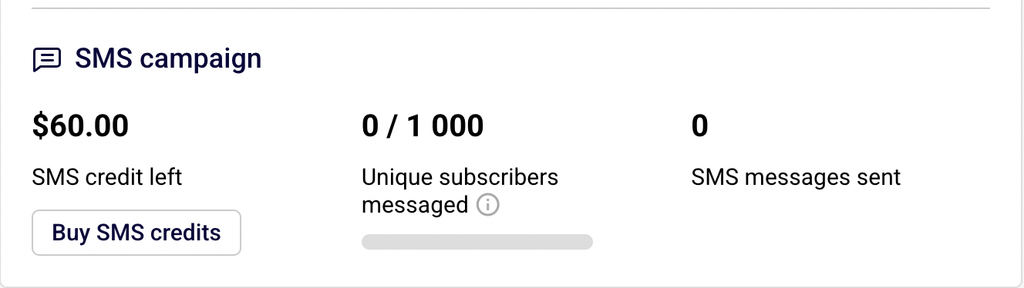
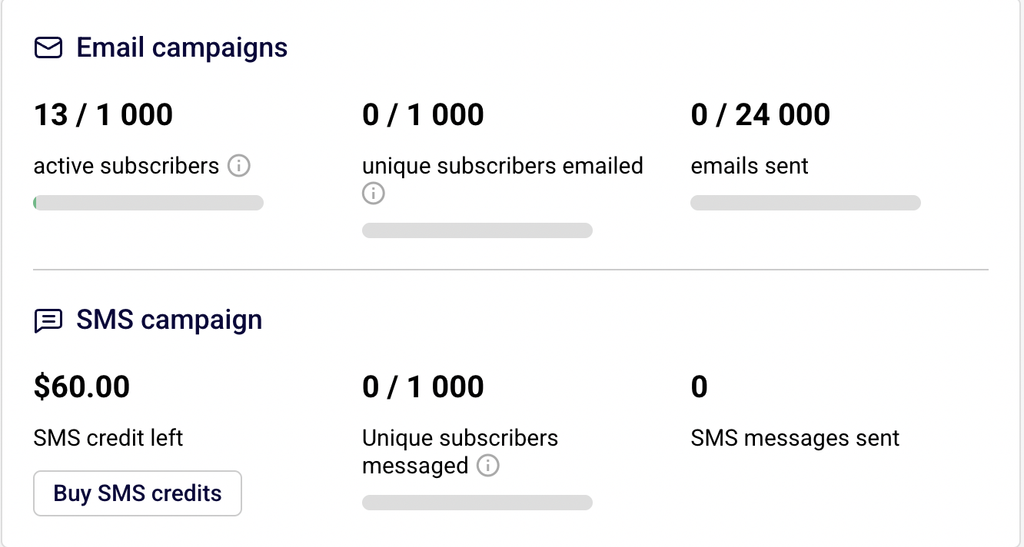
    On the Billing page, you will see an SMS campaign section that displays three key metrics: your current SMS credit left balance, the number of Unique subscribers messaged during the current billing period, and the total SMS messages sent. You can also click Buy SMS credits to purchase additional credits, or click Change or renew plan to upgrade your plan for higher SMS limits.

    Steps to Check and Manage Your SMS Limits

    Step 1 — Confirm Your Current Plan Supports SMS

    Not all Sender plans include SMS. The Free Forever plan and the Pay as you go plan do not support SMS campaigns. To send SMS messages, you need a Standard, Professional, or Enterprise plan. To check your current plan, go to Account settings → Billing and look at the Your plan card in the top-left corner. If you are on a plan that does not support SMS, click Change or renew plan to upgrade.

    Step 2 — Review Your SMS Usage and Credit Balance

    On the Billing page, locate the SMS campaign section. This displays three values: your SMS credit left (the remaining monetary balance available for sending SMS), the Unique subscribers messaged count (distinct subscribers who received at least one SMS during this billing period, shown against your plan limit), and the SMS messages sent total. Monitor these values to avoid reaching your limits mid-campaign.

    Step 3 — Understand SMS Limits by Plan Tier

    SMS limits depend on which plan you are on and the subscriber tier you selected:

    Standard — Includes SMS messaging capability, but no free monthly SMS credits. You must purchase SMS credits separately by clicking Buy SMS credits on the Billing page. Your unique subscribers messaged limit matches your plan's subscriber tier (for example, 1,000 on a 1k-subscriber plan).

    Professional — Includes free monthly SMS credits that are automatically added to your account each billing period. The credit value scales with your subscriber tier (for example, $20/month on the 1k plan, $320/month on the 30k plan). Your unique subscribers messaged limit also matches your subscriber tier. Free SMS credits expire after one month and do not roll over.

    Enterprise — Includes everything in the Professional plan. Contact Sender's sales team for details on SMS credit allocations and custom limits.

    Step 4 — Purchase Additional SMS Credits if Needed

    If you run out of SMS credits or need more than your plan provides, go to Account settings → Billing and click Buy SMS credits. On the purchase page, select a credit package or enter a Custom amount. Use the SMS price calculator to check the cost per message for your destination country — SMS pricing is character-based and varies by country. Select your payment method and click Purchase to add credits to your account. Additional credits are available on both the Standard and Professional plans.

    SMS Compliance Requirements

    Character-based billing — Sender bills SMS messages based on character count. A standard SMS using GSM-7 encoding (the default character set for Latin-alphabet text messages) supports up to 160 characters per message segment. If your message exceeds 160 characters, it is billed as two or more SMS messages. Keep messages concise to control costs.

    Opt-out requirements — Every marketing SMS must include opt-out instructions such as "Reply STOP to unsubscribe." You can configure your default opt-out text in Account settings → SMS settings under SMS Message Add-ons. This is required by most carrier regulations and Sender's own SMS policies.

    TCPA (US) — The Telephone Consumer Protection Act requires prior express written consent before sending marketing text messages to US recipients. Collect consent through signup forms with a clear opt-in statement. Consult a legal professional for jurisdiction-specific guidance.

    GDPR (EU) — The General Data Protection Regulation requires a lawful basis (typically explicit consent) for processing personal data, including phone numbers, for marketing purposes. Ensure your SMS consent collection process meets GDPR requirements. Consult a legal professional for guidance specific to your situation.

    Carrier restrictions — Some countries and carriers impose restrictions on sender IDs, message content, or sending hours. SMS pricing also varies by destination country. Check the SMS price calculator on the Buy SMS credits page or contact Sender support for details about restrictions in your target countries.

    Always consult a legal professional for advice specific to your jurisdiction and use case.

    What Happens Next

    After confirming your plan supports SMS, check your SMS credit left balance on the Billing page to ensure you have enough credits before sending a campaign.

    If you are on the Professional plan, your free monthly SMS credits will appear automatically at the start of each billing period — remember that unused credits expire after one month.

    To verify your setup is working correctly, send a test SMS to your own phone number from the SMS campaigns section before launching a campaign to a larger audience.

    You can monitor your SMS usage at any time by returning to Account settings → Billing and reviewing the SMS campaign section.

    Common Issues

    SMS campaigns option is not available → Your account is on the Free Forever or Pay as you go plan, neither of which supports SMS. Upgrade to a Standard or Professional plan under Account settings → Billing → Change or renew plan.

    SMS credit balance is zero or too low → Your free monthly credits (Professional plan) may have expired, or you have used all purchased credits. Go to Account settings → Billing and click Buy SMS credits to add more. Professional plan credits expire after one month and do not carry over.

    Unique subscribers messaged limit reached → You have sent SMS messages to the maximum number of distinct subscribers allowed by your plan tier during this billing period. To increase this limit, upgrade to a higher subscriber tier under Account settings → Billing → Change or renew plan.

    Message billed as multiple SMS → Your message exceeded 160 characters (GSM-7 encoding), so it was split into multiple message segments. Each segment counts as a separate SMS. Shorten your message or account for the additional cost when budgeting credits.

    SMS price varies by country → SMS pricing depends on the destination country. Use the SMS price calculator on the Buy SMS credits page to check the per-message cost for your target country before purchasing credits.

    FAQs

    Which Sender plans include SMS? SMS campaigns are available on the Standard, Professional, and Enterprise plans. The Free Forever and Pay as you go plans do not include SMS.

    Does the Professional plan include free SMS credits? Yes. The Professional plan includes a monthly SMS credit allocation that scales with your subscriber tier. For example, the 1k-subscriber Professional plan includes $20/month in free SMS credits. These credits expire after one month and do not roll over to the next billing period.

    Does the Standard plan include free SMS credits? No. The Standard plan enables SMS messaging, but you must purchase SMS credits separately through Account settings → Billing → Buy SMS credits.

    What is the unique subscribers messaged limit? This is the maximum number of distinct subscribers you can send at least one SMS to during a single billing period. The limit matches your plan's subscriber tier (for example, 1,000 on a 1k-subscriber plan, 30,000 on a 30k-subscriber plan).

    How is SMS pricing calculated? SMS pricing is character-based and varies by destination country. A single SMS supports up to 160 characters using GSM-7 encoding. Messages longer than 160 characters are billed as multiple SMS. Use the SMS price calculator on the Buy SMS credits page to estimate costs for your target country.

    What SMS credit packages are available? Sender offers preset credit packages as well as a Custom amount option. You can purchase credits on the Buy SMS credits page under Account settings → Billing.

    Do unused SMS credits expire? Free monthly SMS credits included with the Professional plan expire after one month. Separately purchased SMS credits may have different expiration terms — check your Billing page for details on your current credit balance.

    How do I check my remaining SMS credits? Go to Account settings → Billing and look at the SMS campaign section. Your remaining balance is displayed under SMS credit left.

  • SMS Pricing Explained

    This guide walks you through how SMS pricing works in Sender, including how credits are calculated, what affects the cost per message, and how to purchase SMS credits for the first time.

    Where to Find This Feature

    In the Sender dashboard, go to: Account settings → Billing

    On the Billing page, you will see an SMS campaign section that displays your current SMS credit left balance, the number of Unique subscribers messaged, and total SMS messages sent. Click Buy SMS credits to open the credit purchase page, where you can select a credit package, view per-message pricing by country, and complete your purchase.

    Steps to Understand and Purchase SMS Credits

    Step 1 — Check your current SMS credit balance

    Go to Account settings → Billing. Under the SMS campaign heading, you will see your current balance displayed as a dollar or euro amount next to SMS credit left. This balance represents the total value of credits available for sending SMS messages. Below it, you will see how many Unique subscribers messaged and SMS messages sent during the current billing period. If your balance is low or zero, click Buy SMS credits to add more.

    Step 2 — Select a credit package

    On the Buy SMS credits page, choose your preferred currency using the € EUR or $ USD toggle at the top of the SMS credits section. Then select a preset credit amount — $15, $50, $100, $200, or $500 (or equivalent in EUR: 13€, 43.32€, 86.65€, 173.29€, 433.23€). If none of the preset amounts fit your needs, click Custom and enter a specific amount in the Custom amount field. The Order summary panel on the right updates automatically to show the total excluding tax, applicable VAT, and the final total.

    Step 3 — Use the SMS price calculator to estimate costs

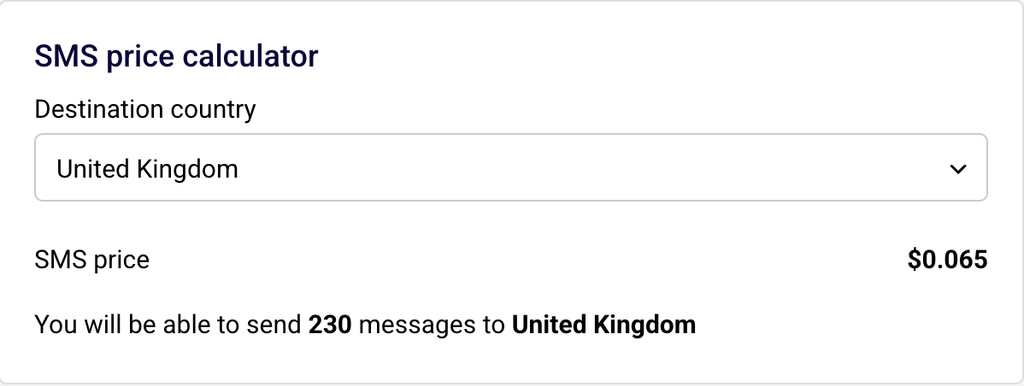
    Below the credit packages, locate the SMS price calculator. Select your target Destination country from the dropdown. The calculator displays the SMS price per message for that country and shows how many messages you can send with your selected credit amount. For example, a $15 credit package at $0.015 per SMS to the United States lets you send approximately 1,000 messages, while the same amount at $0.065 per SMS to the United Kingdom lets you send approximately 230 messages. Pricing varies by destination country, so always check the calculator before purchasing.

    Step 4 — Complete your purchase

    In the Payment method section, enter your card details under New credit or debit card, or select PayPal as an alternative. Review your Billing information and click Edit if any details need updating. Once everything is correct, click Purchase to complete the transaction. Your SMS credit balance on the Billing page updates immediately after a successful purchase.

    Step 5 — Understand how credits are included with your plan

    If you are on a Standard, Professional, or Enterprise plan, Sender includes free SMS credits equal to your monthly subscription fee each billing cycle. For example, the Professional plan includes free SMS credits worth 12.13€/month. These credits are added automatically and can be used to send messages without an additional purchase. If you need to send more messages than your included credits cover, purchase additional credits using the steps above.

    SMS Compliance Requirements

    TCPA (Telephone Consumer Protection Act) — This US regulation generally requires businesses to obtain prior express written consent before sending marketing SMS messages to recipients. Sender's opt-out tools help you comply by including unsubscribe instructions in every message, but consult a legal professional for guidance specific to your situation.

    GDPR (General Data Protection Regulation) — This EU regulation generally requires a lawful basis, such as explicit consent, for processing personal data including phone numbers used for SMS marketing. Sender allows you to collect consent through signup forms and manage subscriber preferences. Consult a legal professional for jurisdiction-specific requirements.

    Carrier requirements — Mobile carriers in many countries enforce rules about sender identification, message content, and opt-out handling. Sender provides configurable Opt-out text and Opt-out link text fields in Account settings → SMS settings to help you meet these requirements. Some carriers also restrict sending hours or require specific sender ID formats.

    Sender's SMS policies — Sender requires that every marketing SMS include opt-out instructions. The SMS Message Add-ons section in SMS settings lets you configure an Organizational prefix (a recognizable name so recipients know who sent the message), Opt-out text (which must include "STOP"), and an Opt-out link text for unsubscribe links. These add-ons are appended to your messages automatically.

    Always consult a legal professional for advice specific to your jurisdiction and industry before launching SMS campaigns.

    What Happens Next

    After purchasing SMS credits, your updated balance appears on the Billing page under SMS campaign. You can manage your credits and view usage at any time by returning to Account settings → Billing.

    To verify that your setup is working, send a test SMS to your own phone number before launching a campaign. Your credit balance decreases with each message sent, and the per-message cost depends on the recipient's country.

    SMS credits can be used for both SMS campaigns (created under SMS campaigns in the main menu) and SMS steps within automations. Monitor your SMS credit left balance regularly to avoid running out of credits mid-campaign.

    Common Issues

    SMS credit balance not updating after purchase → This can happen if the payment is still processing. Wait a few minutes and refresh the Billing page. If the balance still does not update, check your payment method for errors or contact Sender support.

    Higher-than-expected credit usage → SMS pricing varies by destination country. Messages to some countries cost significantly more per SMS than others. Use the SMS price calculator on the Buy SMS credits page to check per-message rates before sending.

    Cannot find the Buy SMS credits button → The Buy SMS credits button is located on the Billing page under the SMS campaign section. If you do not see it, ensure you are on a Standard, Professional, or Enterprise plan, as SMS features are not available on the Free Forever plan.

    Credits running out during a campaign → If your credit balance reaches zero, remaining messages in the campaign will not be sent. Purchase additional credits on the Buy SMS credits page and resend the campaign to the unsent recipients.

    VAT added to the total → Sender applies VAT based on your billing country. The Order summary on the Buy SMS credits page shows the amount excluding tax, the VAT percentage and amount, and the final total. Update your billing information by clicking Edit in the Billing information section if your tax details are incorrect.

    FAQs

    How does SMS pricing work in Sender?

    Sender uses a credit-based system for SMS. You purchase credits in a dollar or euro amount, and each SMS message you send deducts from your balance based on the per-message rate for the recipient's country. There are no recurring SMS fees — you buy credits as needed, and they remain in your account until used.

    What credit packages are available?

    Sender offers preset packages of $15, $50, $100, $200, and $500 (or equivalent amounts in EUR). You can also enter a custom amount by selecting the Custom option on the Buy SMS credits page.

    Why does SMS pricing vary by country?

    Carrier and network costs differ by country. Sender's per-message rate reflects these underlying costs. For example, sending an SMS to the United States costs approximately $0.015 per message, while sending to the United Kingdom costs approximately $0.065 per message. Always use the SMS price calculator to check rates for your target country.

    Do any plans include free SMS credits?

    Yes. The Standard, Professional, and Enterprise plans include free SMS credits each billing cycle. The free credit amount equals your monthly subscription fee. For example, the Professional plan includes free SMS credits worth approximately 12.13€ per month. Any additional sending beyond these included credits requires purchasing more credits.

    Is SMS available on the Free Forever plan?

    No. SMS messaging is available starting from the Standard plan. To access SMS features, upgrade to a Standard, Professional, or Enterprise plan.

    What payment methods can I use to buy SMS credits?

    You can pay with a credit or debit card or through PayPal. Both options are available on the Buy SMS credits page under the Payment method section.

    How do I check my remaining SMS credit balance?

    Go to Account settings → Billing. Your current balance is displayed under the SMS campaign section next to SMS credit left.

    Can I switch between EUR and USD when purchasing credits?

    Yes. On the Buy SMS credits page, use the € EUR and $ USD toggle at the top of the SMS credits section to switch currencies before selecting a package.

  • Creating SMS campaigns

    This guide walks you through how to create and send your first SMS campaign in Sender, from composing your message to selecting recipients and scheduling delivery.

    Where to Find This Feature

    In the Sender dashboard, go to: SMS campaigns → New campaign

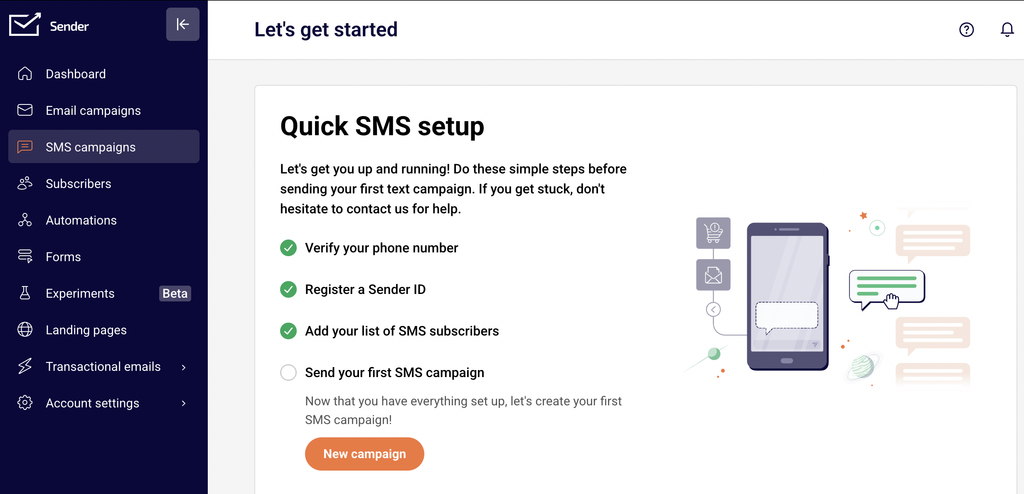
    Click SMS campaigns in the left sidebar. If this is your first campaign, you will see the Quick SMS setup checklist page — click New campaign to begin. If you already have campaigns, you will see the SMS campaigns library with tabs for All, Draft, Scheduled, Sending, and Sent campaigns. Click New campaign in the top-right corner to start a new campaign.

    The campaign creation workflow has three stages displayed in a stepper at the top of the page: Settings → Recipients → Review and schedule.

    Steps to Create an SMS Campaign

    Step 1 — Configure campaign settings

    On the Settings page, start by entering a name in the Campaign name field. Select your verified phone number from the Sender dropdown — this is the number recipients will see when they receive your SMS. If no verified numbers appear, click Go to SMS settings to register one first.

    In the Message text area, write your message. A character counter at the bottom (e.g., 0/160) tracks your usage and shows the SMS count. Click Custom fields to insert personalization tags such as First name or Phone number. Use the emoji icon to add emojis. You can also click Use a template to choose from pre-built templates under categories like Promotional, Holiday, and Feedback, or click Save as template to save your own.

    The Automatically shorten links checkbox is enabled by default and will compress any URLs in your message.

    Below the message area, enable Add Opt – Out instructions to automatically append opt-out text (e.g., "Reply STOP to optout") to your message. Enable Insert your organisation name to prepend your brand name. Both are recommended for compliance and are reflected in the Message preview on the right side of the page. Once your message is ready, click Save and continue.

    Step 2 — Select recipients

    On the Recipients page, you will see the Select subscribers panel. Choose who receives your SMS by selecting from the available options.

    Check All active subscribers to send to your entire SMS subscriber list. Alternatively, select specific groups under Subscriber groups or specific segments under Saved segments. Each section includes a search field and a Select all / Deselect all option. The number next to each group or segment shows how many subscribers it contains.

    To exclude certain subscribers, enable the Exclude recipients toggle and select which groups or segments to remove from the recipient list. The total Recipients selected count displays at the bottom of the page. Click Save and continue to proceed.

    Step 3 — Review and send or schedule

    On the Review and schedule page, review a summary of your campaign before sending. The Settings section shows your campaign name and sender phone number. The Subscribers section shows the recipient count, total subscribers, and Estimated campaign cost. Each section has an Edit button to return to that stage and make changes.

    The Message preview on the right displays your message exactly as recipients will see it, including any opt-out text or organisation name. Click Send a test SMS to send a test message to your own phone number and verify everything looks correct.

    When you are ready, click Send now to deliver the campaign immediately, or click Schedule to send to choose a future date and time. In the Schedule campaign dialog, select a date from the calendar, set the time, and click Schedule to confirm.

    SMS Compliance Requirements

    TCPA (Telephone Consumer Protection Act) — Applies to SMS recipients in the United States. Generally requires express written consent before sending marketing SMS messages. Sender's opt-in tools and consent collection forms help you document subscriber consent. Consult a legal professional for jurisdiction-specific guidance.

    GDPR (General Data Protection Regulation) — Applies to recipients in the European Union and European Economic Area. Generally requires a lawful basis (such as explicit consent) for processing personal data, including phone numbers used for SMS marketing. Sender allows you to collect and store consent records through signup forms.

    Carrier requirements — Mobile carriers in many countries enforce rules on sender identification, opt-out mechanisms, and message content. Sender provides the Add Opt – Out instructions toggle to append opt-out text to every campaign and the Insert your organisation name toggle to identify your brand, helping you meet these carrier requirements.

    Sender's SMS policies — Sender requires that marketing SMS messages include opt-out instructions. You can customize your default opt-out text and organisation prefix in Account settings → SMS settings on the Phone numbers page under SMS Message Add-ons. The Opt-out text field must include "STOP" in the message.

    Always consult a legal professional for advice specific to your jurisdiction and industry before launching SMS campaigns.

    What Happens Next

    After sending or scheduling your campaign, it will appear in the SMS campaigns library under the appropriate tab (Sending, Scheduled, or Sent). You can monitor delivery status and performance by clicking View report next to a sent campaign.

    To manage your SMS settings going forward, go to Account settings → SMS settings to update your verified phone numbers, organisation prefix, or opt-out text. Any draft campaigns can be resumed by clicking Edit from the campaign library.

    Your SMS campaign setup also connects to Sender's automation features, where you can trigger SMS messages based on subscriber actions or events.

    Common Issues

    "No verified phone numbers have been found" → Your account does not have a verified sender phone number. Go to Account settings → SMS settings and click Add phone number to register and verify a phone number before creating a campaign.

    Phone number status shows "In Progress" → Your phone number registration is still being reviewed. Wait for the status to change to verified before attempting to send campaigns. Contact Sender support if the status does not update.

    Message exceeds 160 characters → A standard SMS message using GSM-7 encoding (basic Latin characters) supports up to 160 characters. If your message exceeds this limit, it will be split into multiple SMS segments, increasing cost. The character counter below the message text area (e.g., 65/160 - 1 SMS) shows your current usage and segment count.

    Opt-out text not appearing in preview → The Add Opt – Out instructions toggle is turned off. Enable it in the Settings step to append opt-out text automatically. The Message preview will update in real time to reflect the change.

    Recipients selected shows 0 → No subscriber groups or segments have been selected on the Recipients page. Select at least one group, segment, or check All active subscribers to proceed.

    Campaign cost appears higher than expected → The estimated campaign cost on the Review and schedule page is based on the total number of selected subscribers and the number of SMS segments per message. Using special characters or emojis may switch encoding from GSM-7 to Unicode, reducing the character limit per segment to 70 and increasing segment count.

    FAQs

    What is a sender ID?

    A sender ID is the name or phone number that appears as the sender when recipients receive your SMS. In Sender, you register a sender ID by adding and verifying a phone number in Account settings → SMS settings. Depending on your country and carrier, this may be a phone number or an alphanumeric name.

    Do I need consent to send SMS messages?

    Yes. SMS regulations like TCPA (US) and GDPR (EU) generally require explicit consent from recipients before sending marketing SMS. Collect consent through signup forms with a clear opt-in statement. Consult a legal professional for guidance specific to your jurisdiction.

    What should I include in every SMS message for compliance?

    Every marketing SMS should include opt-out instructions, such as "Reply STOP to optout." Enable the Add Opt – Out instructions toggle in the Settings step to add this automatically. This is required by most carrier regulations and Sender's own SMS policies.

    What phone number format does Sender require?

    Phone numbers must be stored in international format with the country code prefix (e.g., +1 for the United States, +44 for the United Kingdom). Ensure subscriber phone number fields include the full international format.

    How do I test my SMS setup?

    After composing your message in the Settings step, click Send a test SMS in the Message preview panel. You can also send a test from the Review and schedule step. Verify that the message arrives, the sender ID displays correctly, and the content appears as expected.

    What is the character limit for an SMS message?

    A standard SMS using GSM-7 encoding supports up to 160 characters per segment. If you use special characters or emojis, the encoding switches to Unicode, which reduces the limit to 70 characters per segment. The character counter below the Message text area tracks your usage and shows the segment count in real time.

    Can I use message templates?

    Yes. In the Settings step, click Use a template to browse pre-built templates organized by category (such as Promotional, Holiday, and Feedback). You can also save your own message as a template by clicking Save as template for reuse in future campaigns.

    Can I personalize SMS messages?

    Yes. Click Custom fields below the Message text area to insert personalization tags such as First name, Last name, Email, Phone number, or Birthday. These tags are replaced with each subscriber's actual data when the message is sent.

    Are there SMS sending restrictions by country?

    Yes. Some countries have specific carrier restrictions on sender IDs, content, or sending hours. Check Sender's SMS documentation or contact support for details about restrictions in your target countries.

  • Verify toll-free number

    Why do I need to get the Toll-Free number verified?

    From the 15th of May 2022, all toll-free numbers used to send SMS messages are required to get verified.

    This is an industry-wide change focused on consumer protection in fighting fraud, reducing spam, and ensuring that US and Canadian recipients only get the text messages they consented to receive. More on collecting SMS consent here.

    How to get a Toll-Free number?

    Please note that the SMS feature is available only for accounts with a Standard or Professional plan. So make sure you have one of the plans active before moving further.

    If you are purchasing a plan solely for the SMS feature, make sure that you are not planning to send SMS with the following content, as it is prohibited by CTIA and not allowed to be sent via Sender.net:

    • S.H.A.F.T. (Sex, Hate, Alcohol, Firearms, and Tobacco);

    • CBD, Vaping, marijuana/cannabis and any content associated with either one of these;

    • Gambling, Casino, and Bingo and any content associated with it;

    • Any High Risk Financial offers such as: loans; debt consolidation and reduction; investment opportunities; credit repair, tax relief, work from home programs.

    Here you will find more content and behaviors that are not permitted using our Toll-Free SMS service. Messages found to be associated with the following content may be blocked regardless of opt-in status:

    • Social Marketing

    • Financial services whether account notifications, marketing, collections or billing for:

      • High-risk/subprime lending/credit card companies
      • Auto loans
      • Mortgages
      • Payday loans
      • Short-term loans
      • Student loans
      • Debt consolidation/reduction/forgiveness
    •  Insurance

      • Car Insurance
      • Health Insurance
    • Gift cards

    • Sweepstake’s

    • Free prizes

    • Investment opportunities

    • Lead generation

    • Recruiting

    • Commission programs

    • Credit repair

    • Tax relief

    • Illicit or illegal substances 

    • Work from home

    • Get rich quick

    • UGGS and RayBan campaigns

    • Phishing

    • Fraud or scams

    • Deceptive marketing

    If none of these are included in your SMS content, continue with the following steps.

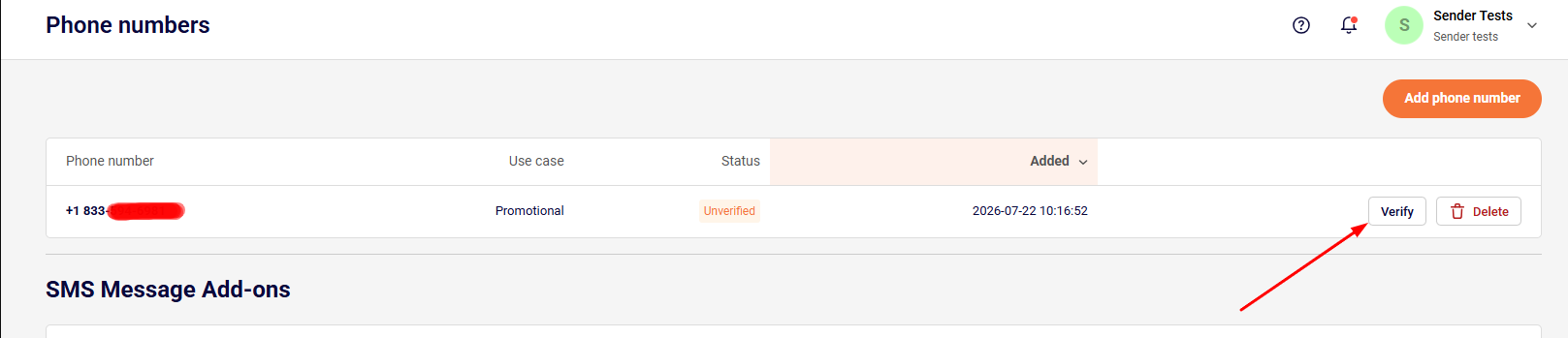
    Go to Settings -> SMS settings and click “Add phone number”.

    Then choose the “Toll-free” type, select a number from the list and click “Save and continue”.

    Your chosen toll-free number will now appear in your SMS settings list with “unverified” status. 

    How to verify your Toll-Free number?

    Once you have the toll-free number added to your account go to Settings -> SMS settings and click “Verify” next to the number you have added.

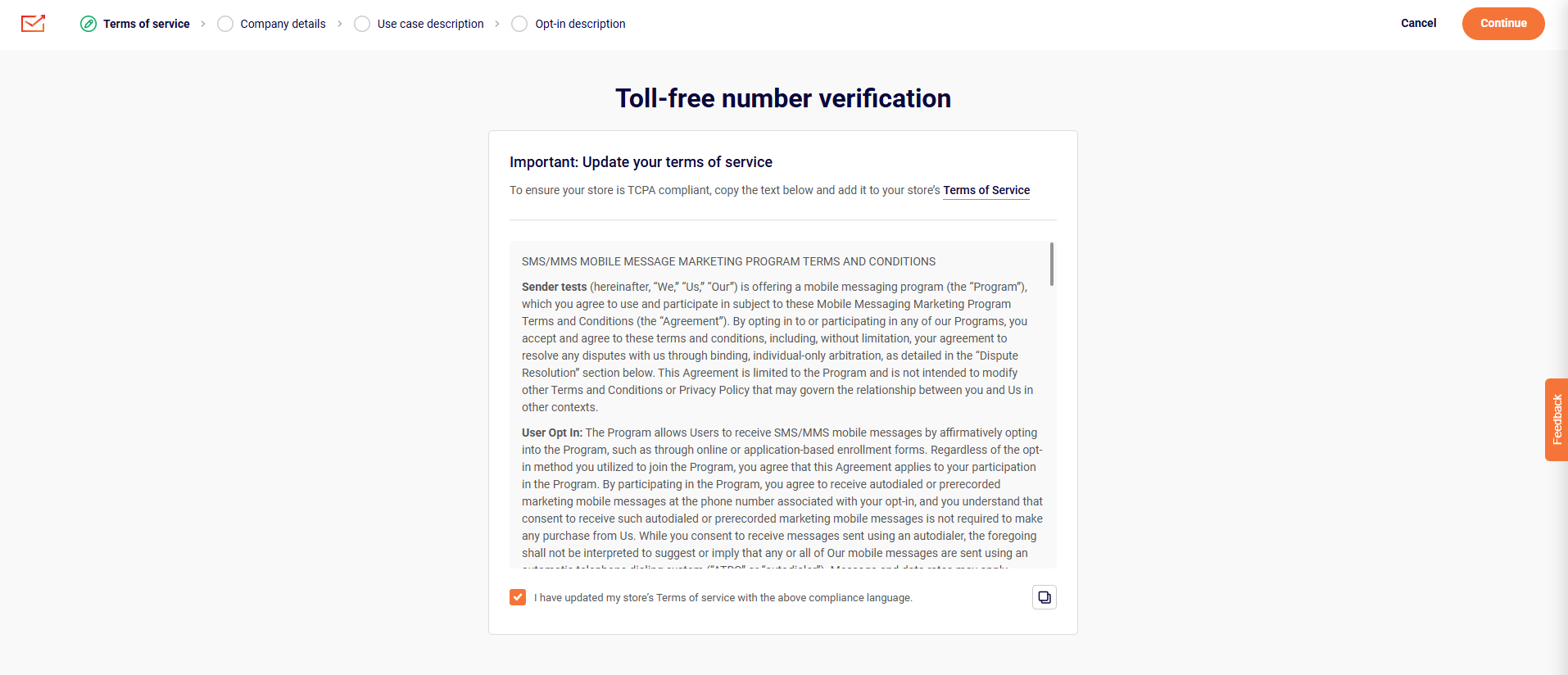
    In the first step will be reminded of the content that is not allowed to be sent via Sender.net. Double-check if none of it applies to you. If it doesn’t then click “Continue”.

    The next step is for you to update your website’s/store’s Terms of Service (TOS). Copy the text below and add it to your website’s TOS.

    Once you have done that, confirm it by ticking the box and click “Continue”.

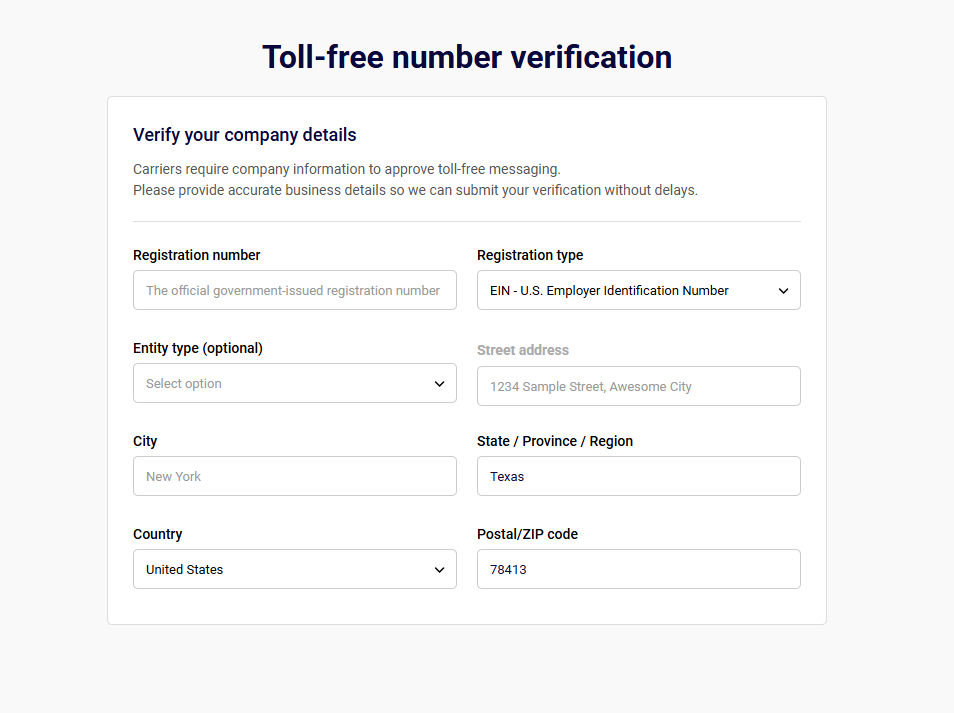
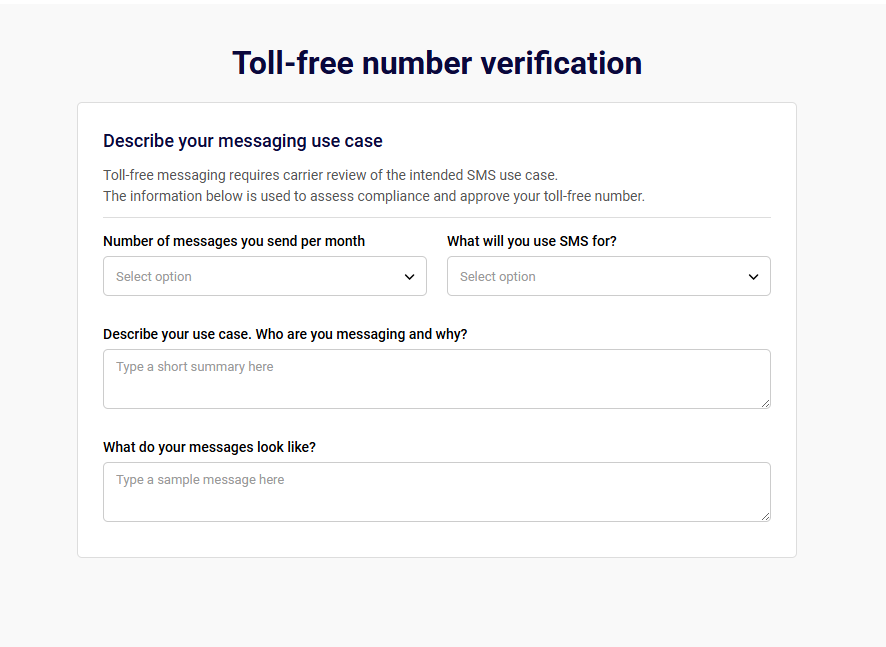
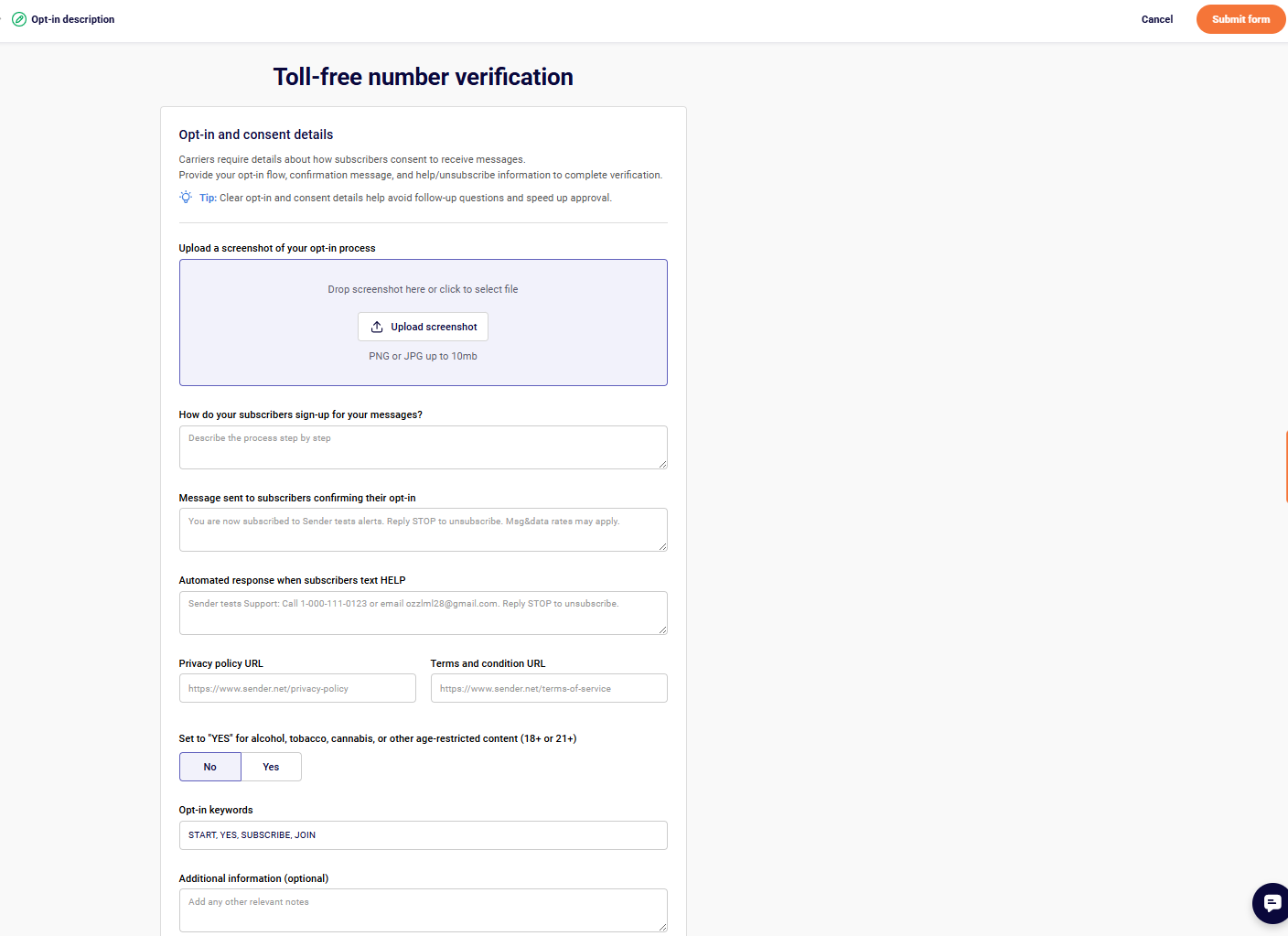
    You will now be asked about your messaging plans, SMS consent collection process, and company information.

    IMPORTANT NOTE: make sure that your website is up and running before filling out the verification form. If not, the toll-free number will NOT get verified, and the whole verification application process will have to be redone.

    • Message Volume Per Month – choose the average number of SMS you plan to send per month.
    • Use Case Category – choose the best-fitting category that reflects the content you plan to send from the drop-down bar selection.
    • Provide Use Case Summary – provide a general idea of the use case and customer. Who are you messaging and why?
    • Provide sample message content – give an example of what your messages will look like to your recipients.
    • Workflow steps – describe the process step-by-step of collecting your recipients’ SMS consent.
    • Additional information – include any additional relevant information for the toll-free number verification.
    • Workflow Image URL – include the URL of the image of your workflow setup for collecting SMS consent.
    • WORK/HOME
    • Company info – fill in your company information.

    Once you fill in all the required information, submit the form, and you will see the status of the phone number set to “In progress”.

    Once the toll-free number is verified, you will receive a notification, the status in SMS settings will change to “Verified”. This means you can start sending SMS to your subscribers.

    That’s it!

    If you got stuck on a specific task or can’t find a way to execute a particular job, contact our support team via LiveChat or [email protected] – we’re here to help 24/7.

  • Collect SMS consent

    What is SMS consent? Why is it important?

    There are stricter requirements on what SMS consent means because it is more regulated than other marketing channels such as email:

    • SMS consent must be received from new subscribers and those that already agreed to receive your content via email. 
    • Please note that consent cannot be forced or made to look as required, which might result in fines or compliance issues.
    • New subscribers can provide both email and SMS consent in the same form, you simply must use a separate opt-in button or check-box for SMS.
    • Make sure to use disclosure language whenever you collect SMS consent, whether that is at the checkout, form or an email campaign.

    Consent for SMS Marketing in the EU

    To send SMS marketing in the EU, you must comply with the rules set out in the GDPR.

    GDPR

    GDPR compliant consent forms must include:

    • The type of data being collected, in this case, phone number.
    • How data will be used – what the subscriber will be opting-in for.
    • Details of the privacy policy.
    • How to easily opt out from receiving marketing SMS.

    Consent for SMS Marketing in the USA

    To send SMS marketing in the USA, you must comply with the rules set out in the Telephone Consumer Protection Act (TCPA) and CAN-SPAM Act. It is important to remember that in addition to these federal regulations, there may be additional rules and requirements from state to state.

    TCPA

    The TCPA introduces a few rules that apply to SMS marketing:

    • Marketing SMS must include the identity of the sending business and contact information, including the number used to send the SMS.
    • Marketers cannot send marketing messages to consumers before 8 am or after 9 pm local time without their express consent.

    CAN-SPAM Act

    According to the CAN-SPAM Act :

    • You cannot send someone a marketing SMS without their express consent, even if you already have their contact details. Consent must be obtained separately for each contact method.
    • Consent is not  considered valid if the subscriber has not received a clear explanation of what kind of messages they agree to receive and their frequency.
    • All marketing SMS must be clearly identified as advertising.
    • Every marketing SMS must contain clear instructions on how to stop receiving future SMS.

    Make sure that you abide by the set regulations in the EU and the USA, and give the subscribers an option to unsubscribe whenever they want by inserting an unsubscribe link in your SMS campaigns. More on that here.

    How to collect SMS consent?

    There are several ways to collect SMS consent, and you should use at least one once you start SMS marketing. Others can be left for later or used only sporadically.

    Pop-up and embedded forms

    Using embedded or pop-up forms is a great way to collect email and SMS consent. It makes it easy for your website visitors to sign up, no matter if they are new or existing subscribers. More on creating subscription forms here.

    At Checkout

    You can also collect SMS consent via your ecommerce store by placing a checkbox at the checkout. It is the smoothest way for your customers to sign up. Check out Sender’s integrations with several ecommerce websites for more information:

    1. Shopify
    2. WooCommerce

    Via email

    If you already have a list of subscribers that have agreed to receive your content via email, you can use that to send them an email with a link to an embedded form to sign up for SMS as well. You should especially do that with your most engaged audiences. Click here to identify your most active subscribers.

    FAQ

    What if I already have my subscriber’s phone number, does it count as having consent for SMS?

    No. In addition to having your subscriber’s phone number, you must also receive their explicit consent to receive your marketing text messages.

    What if I already have consent for sending emails, can it also count as SMS consent?

    No. SMS consent must be received separately from email marketing consent.

    Can single opt-in button or checkbox be used for both SMS and email?

    No. This would put you at risk at falling out of compliance. You should always use separate button or checkbox for SMS consent.

    Is is enough for SMS marketing to have a general “agree to marketing” button or checkbox?

    No. Having a “agree to marketing” button or checkbox is not sufficient for SMS in most countries.

    Where should I put the disclosure language in a form?

    The best placing for the disclosure language would be above the SMS consent button or checkbox.

    That’s it!

    If you got stuck on a specific task or can’t find a way to execute a particular job, contact our support team via LiveChat or [email protected] – we’re here to help 24/7.

  • Purchase SMS credits

    To buy SMS credits, you need a standard or a professional plan. To check or renew your current plan, do the following steps: 

    1. Head to app.sender.net and log into your account
    2. Click on ‘Settings’ and select the ‘Billing’ section at the top
    3. Click ‘Upgrade plan’ to send SMS

    Once the purchase of a standard or a professional plan is made you unlock the ability to buy SMS credits.

    When you subscribe to a Professional plan, you will also receive SMS credits. It’s important to keep in mind that the SMS credits provided with the Professional plan expire after one month. More information can be found by clicking here.

    The price of the SMS depends on the destination country. The pricing can be found here.

    Please note: our SMS pricing is character-based. Once you exceed the 160-character limit, the message is billed as two SMS.


    If you got stuck on a specific task or can’t find a way to execute a particular job, contact our support team via LiveChat or [email protected] – we’re here to help 24/7.