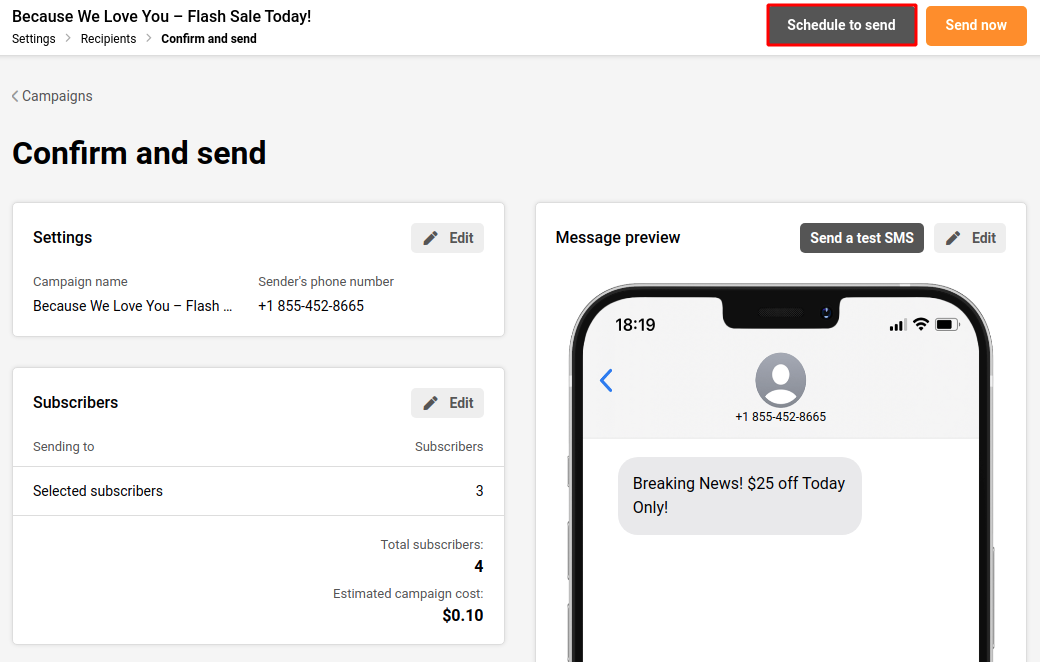
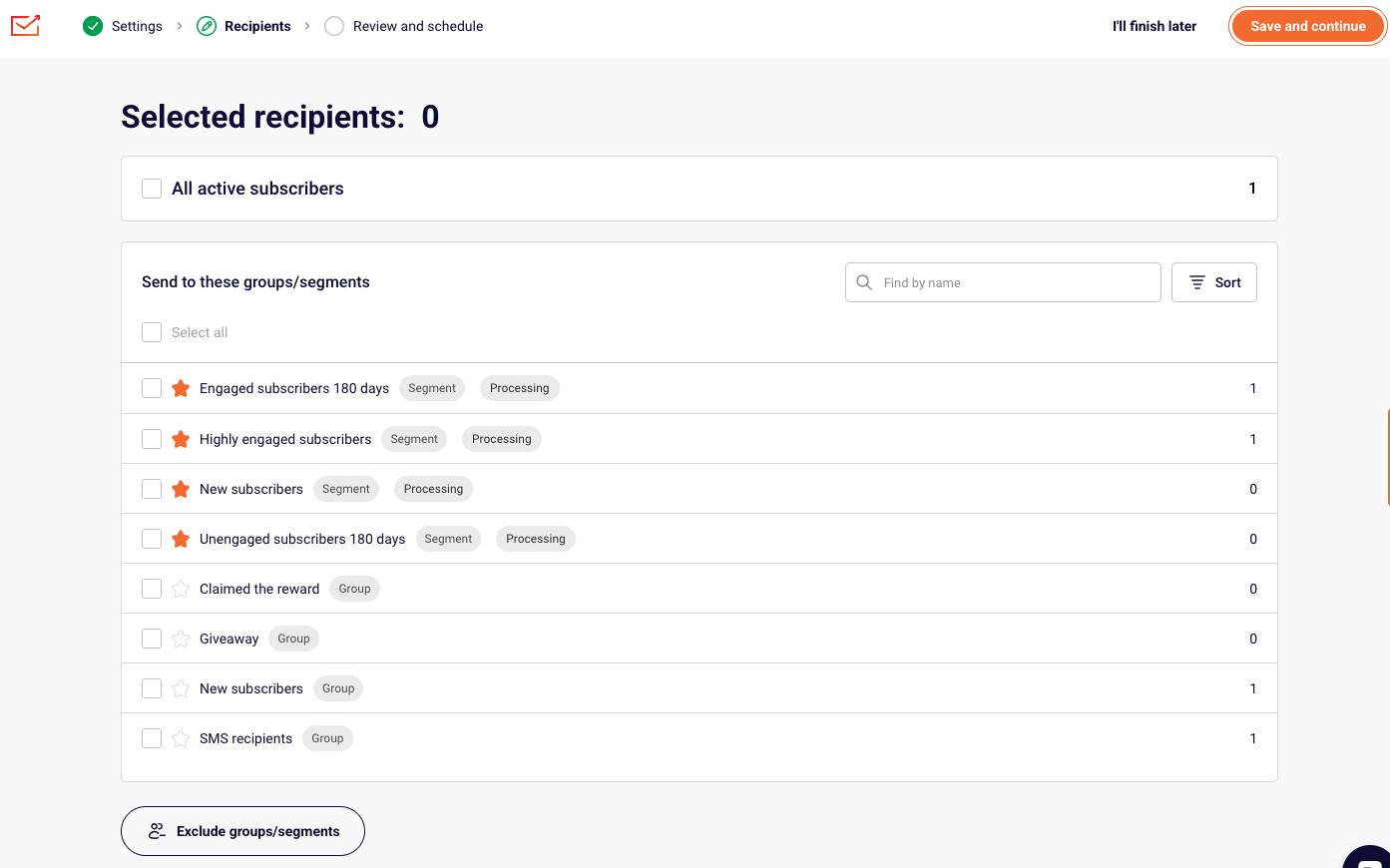
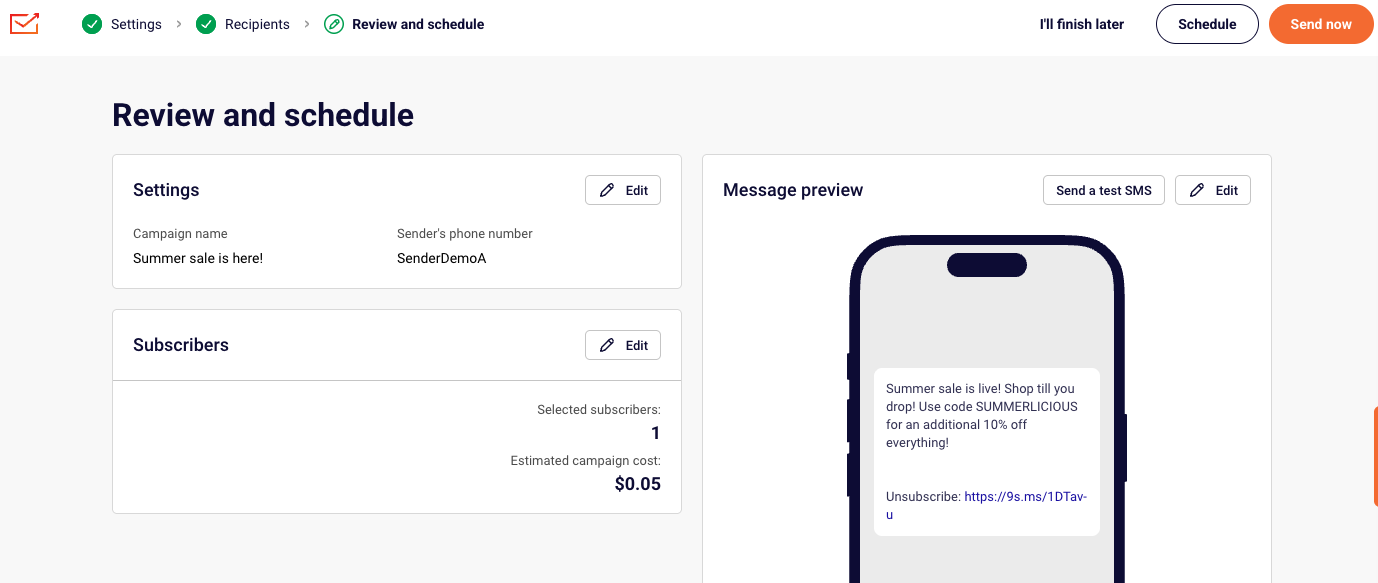
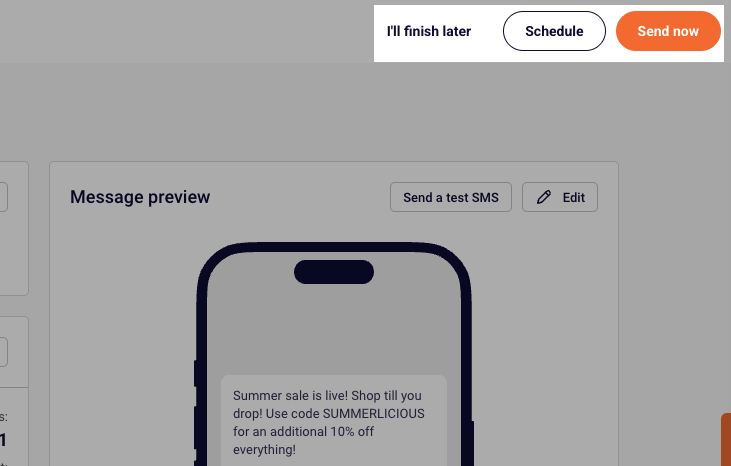
The SMS campaign scheduling option appears at the last step of the campaign creation. Once everything with the SMS campaign is done, click on the “Save & Continue” button, select your desired subscriber list, click continue to get into the final step.
Click on “Schedule to send”
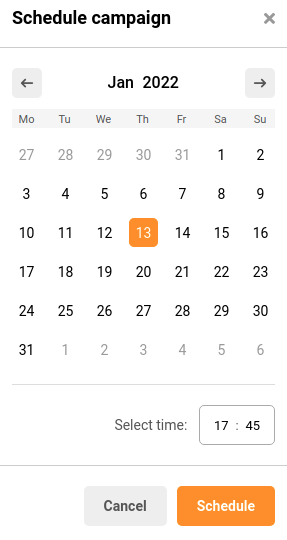
When the schedule button is clicked, a calendar appears, where a date and time can be picked for when the SMS should be delivered.
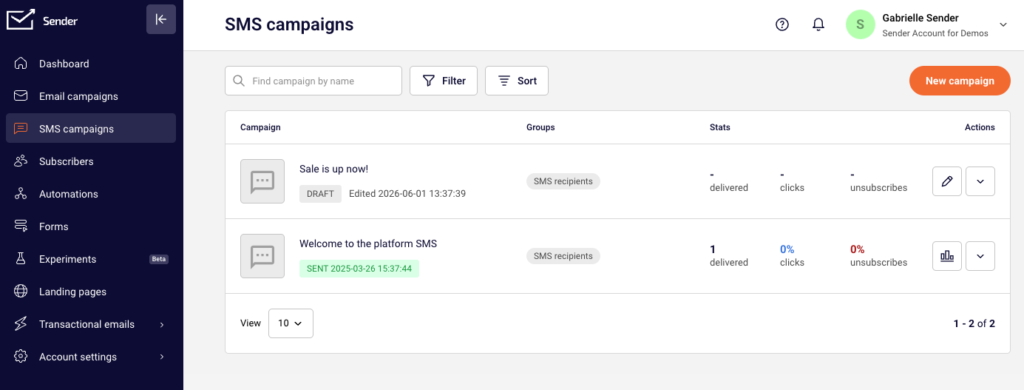
Scheduled SMS appears in the SMS campaign section together with the delivery date and time.
If you got stuck on a specific task or can’t find a way to execute a particular job, contact our support team via LiveChat or [email protected] – we’re here to help 24/7.
Once the SMS campaign section is opened, the campaign library can be accessed. It contains scheduled and sent campaigns as well as their drafts.
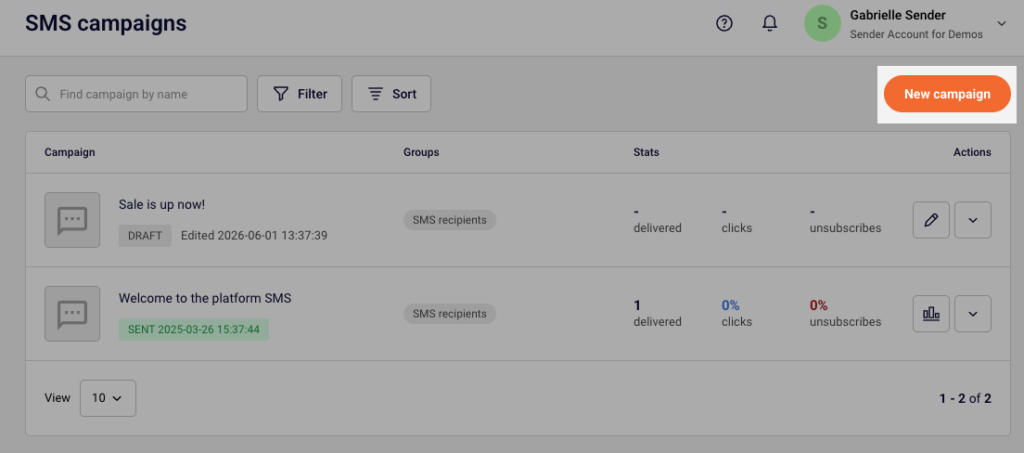
Click the “New campaign” button to start creating a new SMS campaign.
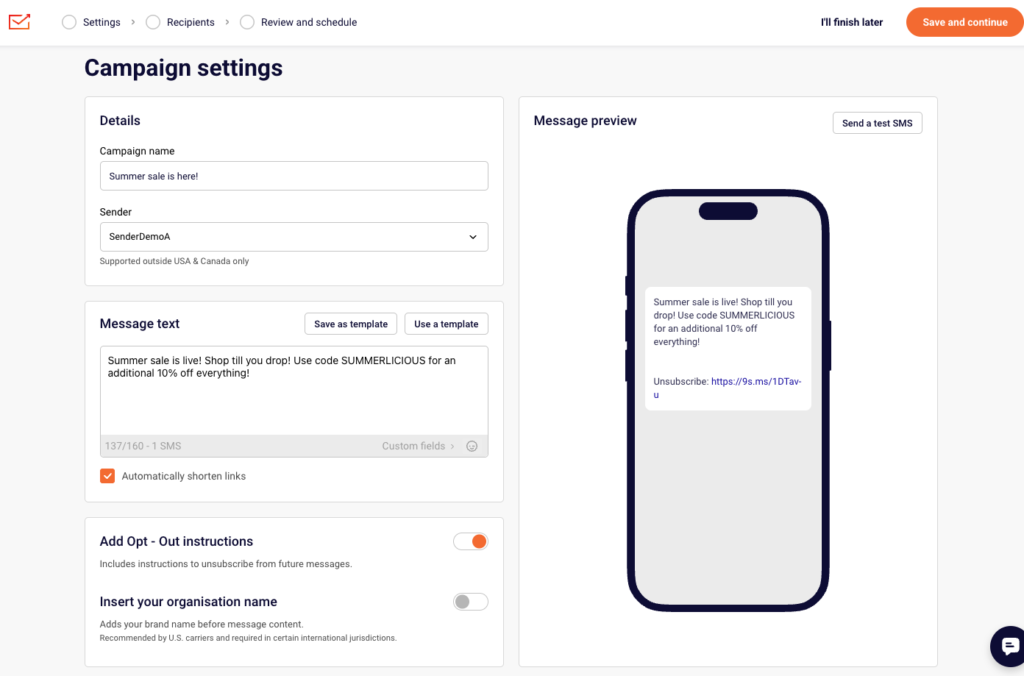
The first stage of creating an SMS campaign:
Moving from one stage to another will not cause any loss to the progress that has been made. Therefore, if the Campaign name needs to be changed, simply press on the “Settings” stage and go back to change it:
Settings is where the editing of the SMS campaign is done. This stage contains:
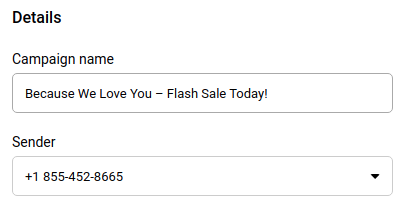
Details (example):
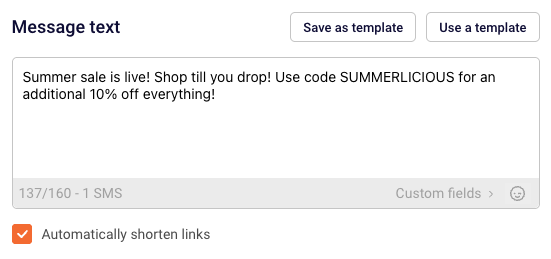
Message text (example):
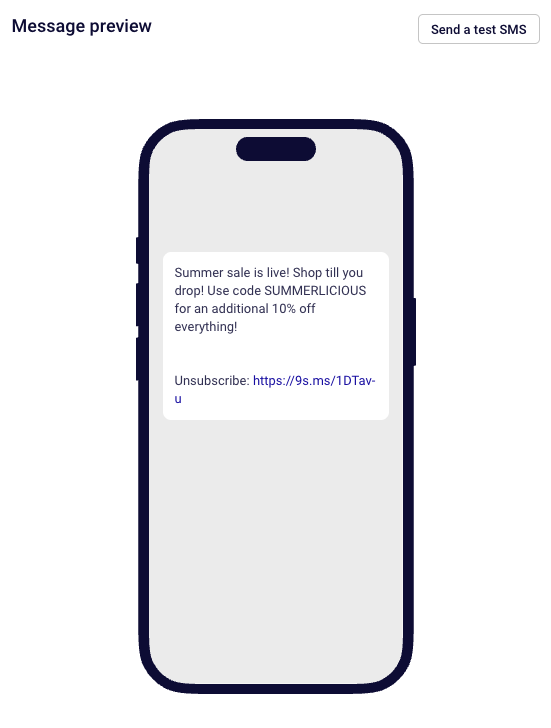
The preview of the SMS campaign and the option to Add Opt-Out instructions:
Once everything is completed in the Settings stage, the “Save and continue” button needs to be clicked to save the progress and move to the next stage – Recipients. Here recipients can be selected by choosing specific Groups or Segments that have been created:
After the recipients (subscribers) are selected, the last thing that is left is to “Confirm and send”. Here the estimated cost of the campaign is displayed together with the total number of subscribers that has been selected and the settings that have been set:
Please note: our SMS pricing is character-based. Once you exceed the 160-character limit, the message is billed as two SMS, if you exceed two SMS character limit, the SMS will be charged as two SMS and so on.
If you include custom fields into the SMS, final price might be more than the estimated one due to various length of customer data that will be included instead of the custom field code.
If you include non latin characters, it will drastically change the number of characters used in the SMS campaign.
At the last stage, the SMS campaign can be sent as a test SMS, scheduled to be sent later or sent immediately. You can also click “I’ll finish later,” and all of your progress will be saved.
If you are stuck on a specific task or can’t find a way to execute a particular job, contact our support team via LiveChat or [email protected] – we’re here to help 24/7.
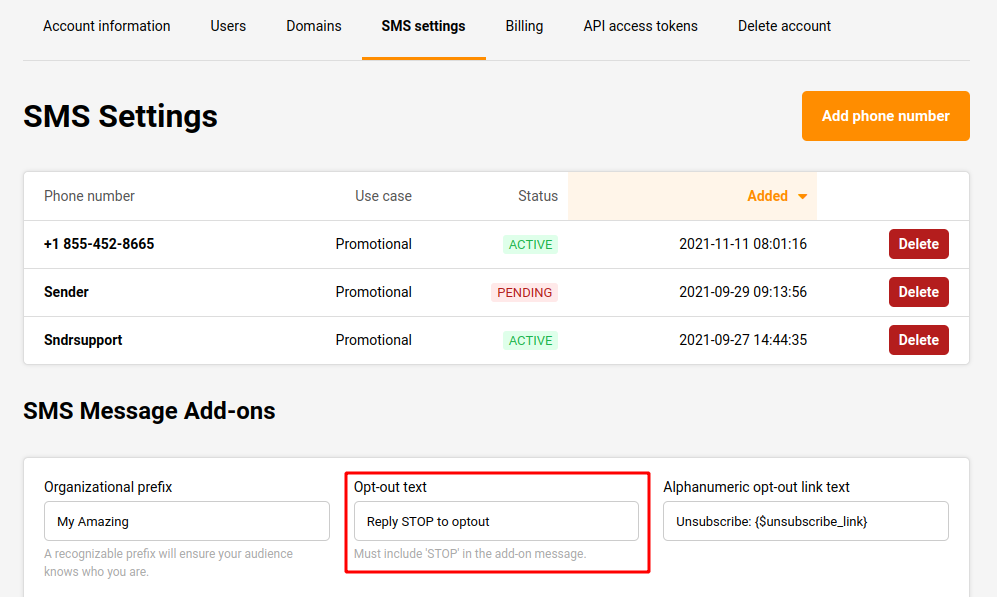
Yes. There is an “Opt-Out” feature in the SMS campaign with customizable Opt-Out text. This feature can be found under the “SMS Message Add-ons” section in the SMS settings.
Go to “Settings” on the left sidebar under the account, then select the “SMS settings” section. The “Opt-out text” box can be seen at the bottom of the page. From here the “Opt-Out” text can be customized.
That’s it!
If you got stuck on a specific task or can’t find a way to execute a particular job, contact our support team via LiveChat or [email protected] – we’re here to help 24/7.
Zapier is an online automation tool that connects your favorite apps, such as Gmail, Slack, Shopify, Squarespace, and 3000+ others with Sender.net.
You can connect two or more apps to automate repetitive tasks. It’s easy enough that anyone can create workflows with just a few clicks.
Use cases
Due to the integration between Sender.net and Zapier, you can move new contacts straight to your Sender’s contact list and/or activate custom events based on particular triggers. Here are several different examples on automated workflows between Sender.net and Zapier:
Start automation workflow based on the custom event, e.g., send welcome emails each time clients fill in a survey.
New contacts from in the Google Form are automatically moved to your contacts list on Sender.net
Use Zapier to integrate with LinkedIn Lead Gen Forms and automatically move new subscribers to Sender.net
With Zapier, you can create custom and individual connections with your favorite apps. Each automation sequence is named “Zap” which includes a trigger and action steps.
Triggers
New campaign. Triggers when a new campaign is created.
New subscriber. Triggers when a new subscriber is added.
New unsubscriber. Trigger when a subscriber unsubscribes.
New group. Triggers when a new group is created.
New subscriber in the group. Triggers when the subscriber is added to the group.
New unsubscriber from the group. Triggers when a subscriber is removed from the group.
Updated subscriber. Triggers when subscriber is updated.
Actions
Add/Update Subscriber. Add a new subscriber or update subscriber’s data.
Create campaign. Creates a draft campaign.
Unsubscribes an email address.
Add subscriber to the group. Adds a subscriber to the group.
Remove a subscriber from a group.
Send campaign. Send a drafted campaign.
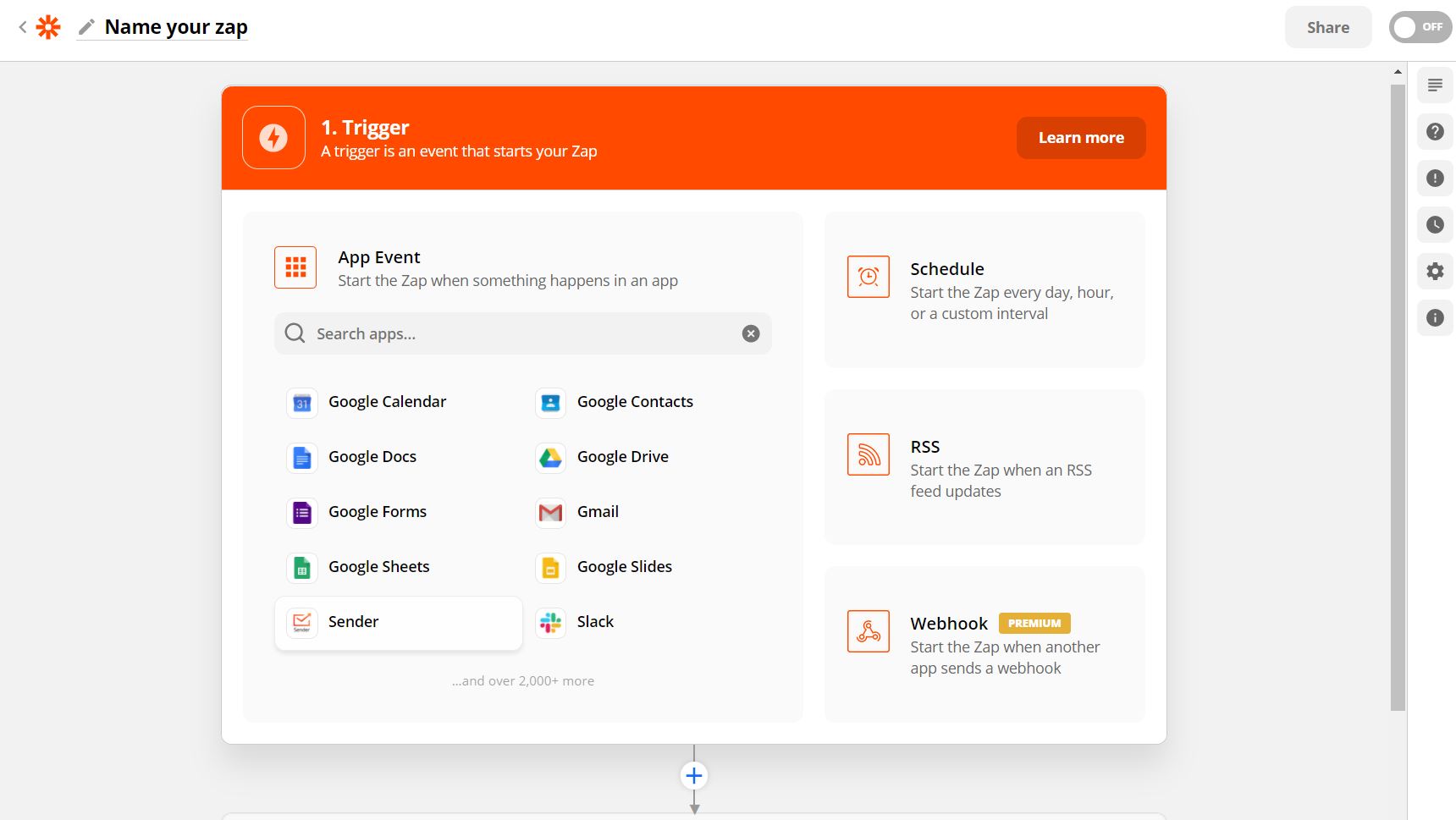
Next, choose the app that will begin the automated sequence and the action trigger. Continue by authenticating the application’s account on the appeared popup and continue building the sequence.
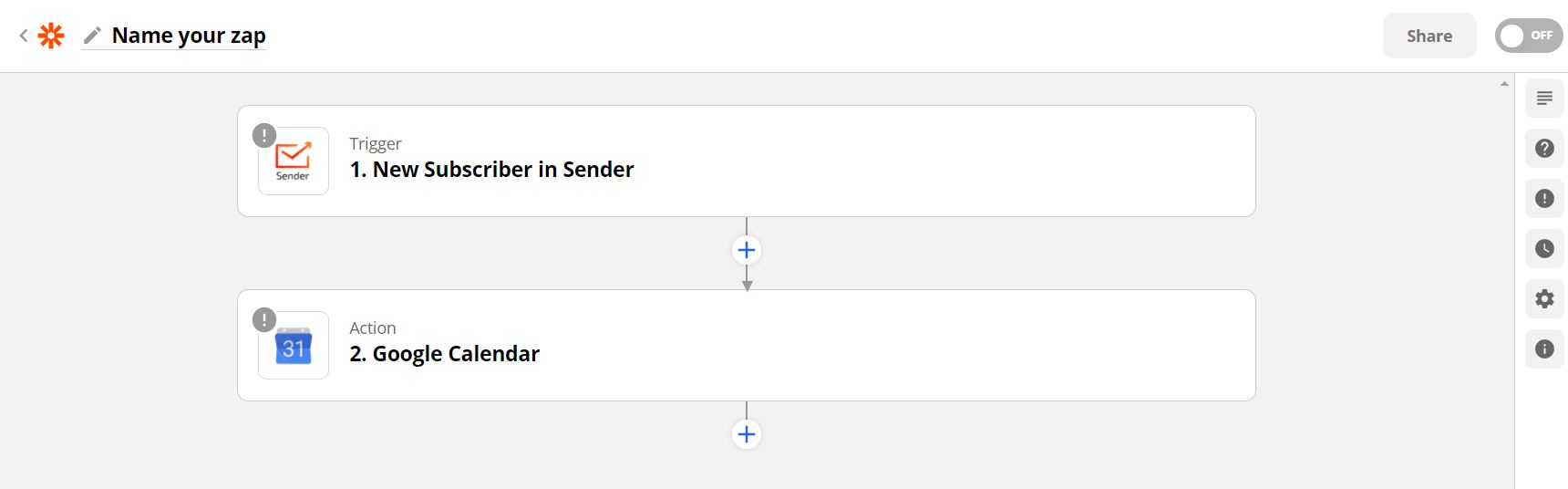
Proceed by selecting a different app and the action step that will be performed according to the workflow – the equivalent procedure applies.
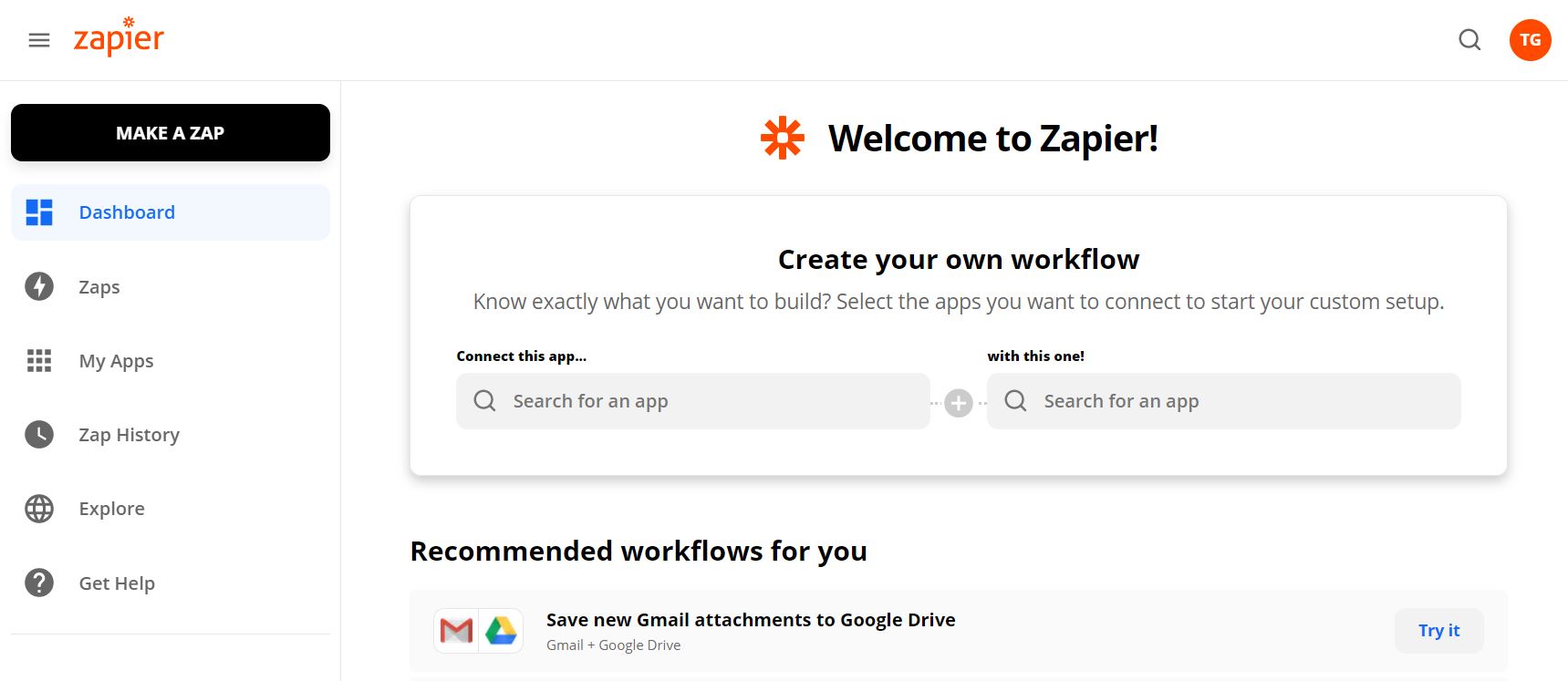
Here’re the shortcuts to the ready-to-use Zapier templates – click on “Try It” to proceed with a Zap.
Add subscribers in Sender for new spreadsheet rows in Google Sheets
If you got stuck on a specific task or can’t find a way to execute a particular job, contact our support team via LiveChat or [email protected] – we’re here to help 24/7.
In order to provide users with the best possible email marketing experience and avoid email deliverability problems, we take mailing practices seriously.
We do this by ensuring that our email sending infrastructure, responsible for sending your emails, is maintained at the highest quality and excellent IP reputation.
To maintain email-sending infrastructure, we actively monitor all sendings across the platform. For new accounts, we also conduct a comprehensive account verification check that considers multiple factors.
For an account to be verified, there has to be a legitimate website added and verified. A campaign that reflects the verified website’s content also must be created.
The QA department reserves the right to request additional information about the account and the subscriber-gathering process.
If you are stuck on a specific task or can’t find a way to execute a particular job, contact our support team via LiveChat or [email protected] – we’re here to help 24/7.
Integrations with various platforms and gadgets considerably enhance the product’s overall experience due to continuous and smooth transitioning between systems. Here you’ll find a list of commonly used integrations with Sender.
Product import
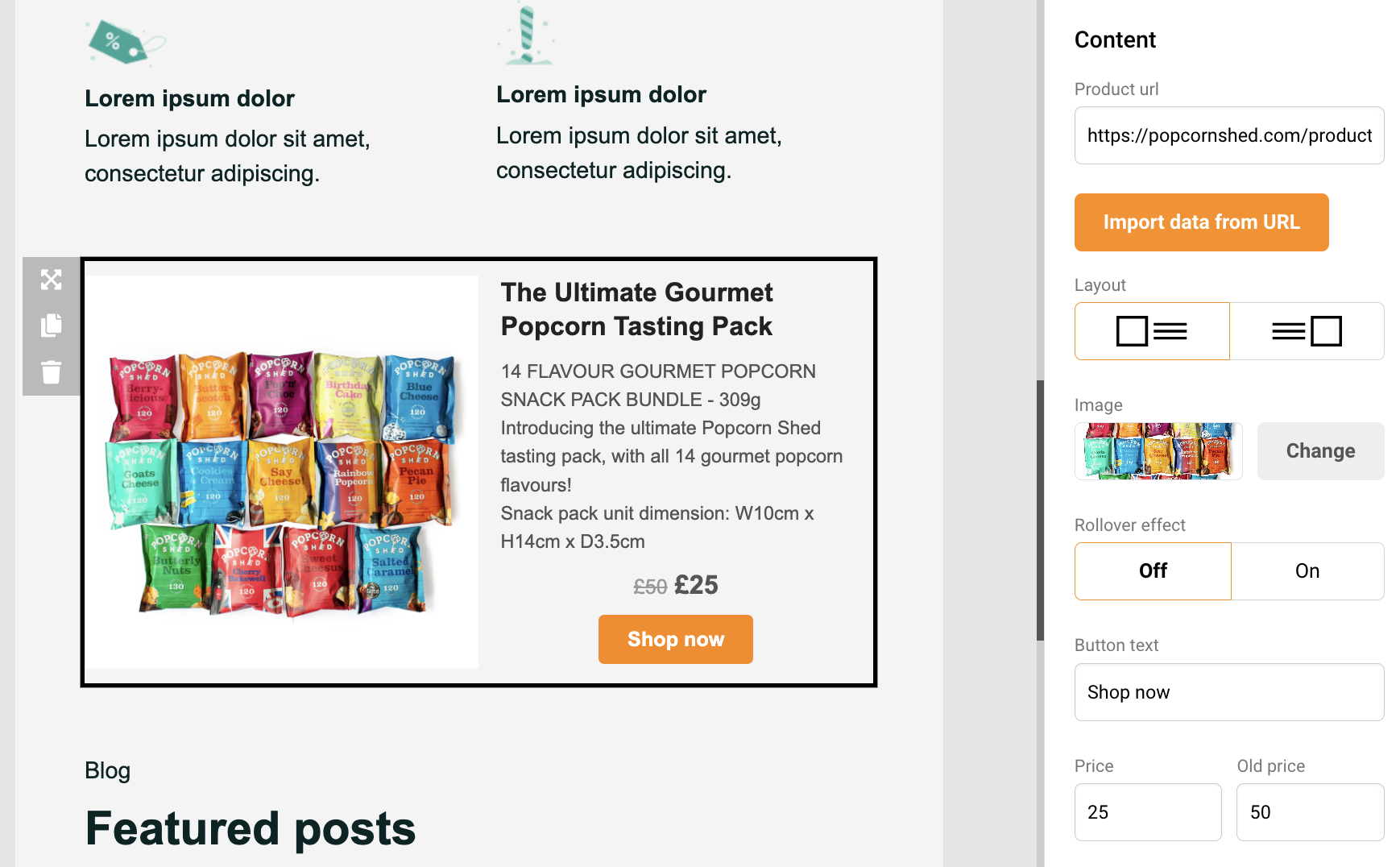
Product block is designed mainly for e-commerce clients but can be used by all users. With product block, you can easily import items from any online store. The most significant part about that – no integrations are needed.
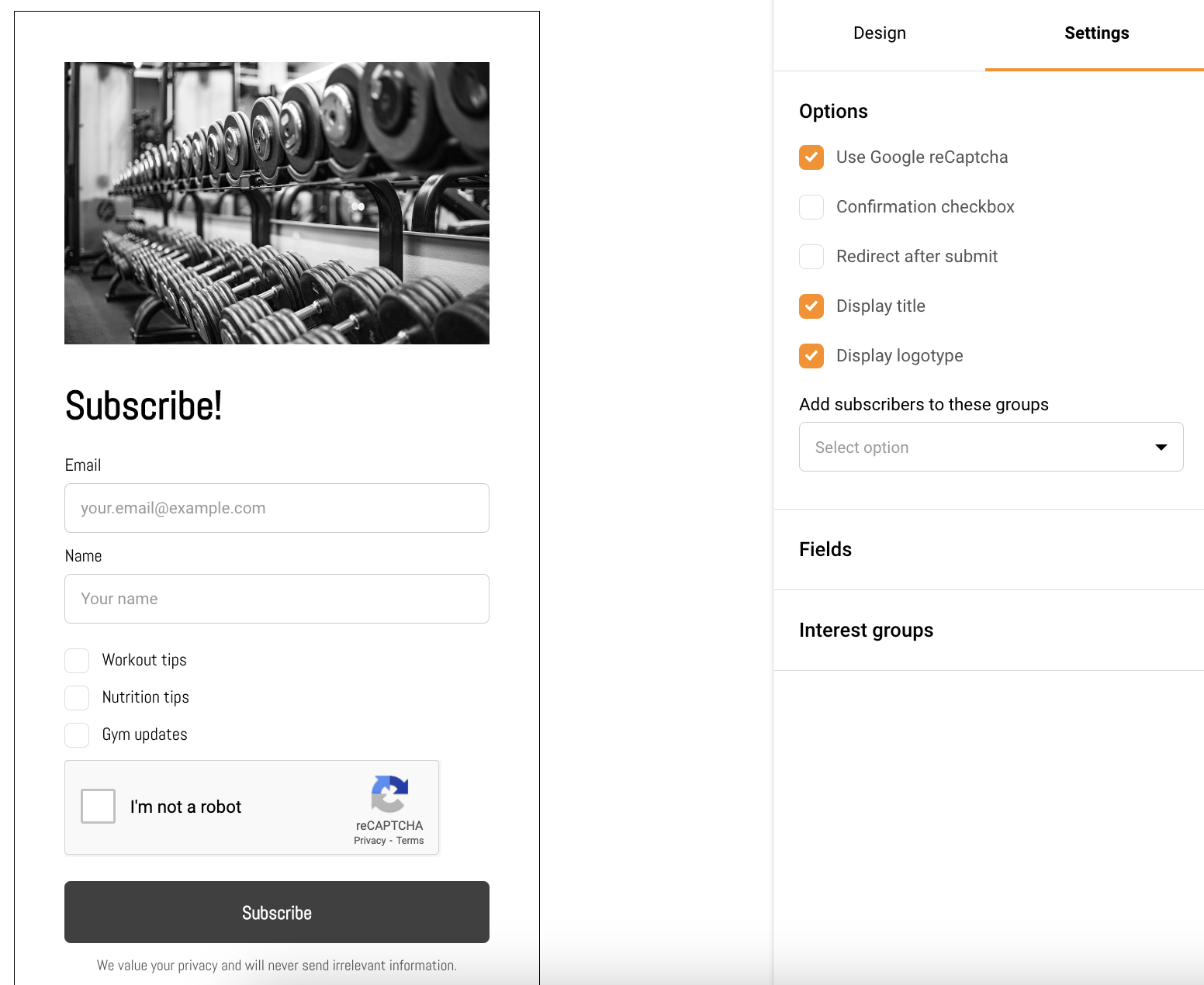
Gathering subscribers was never an easy task, though comprehensive subscription forms or functioning popups help with the matter. With Sender, you’re able to create customizable and easy-to-integrate opt-in forms with ease.
The best way to save time and increase your revenue is to automate your email marketing. Automation is an irreplaceable feature for creating automated abandoned cart or post-purchase email sequences and keeping profits growing.
Integrate with custom systems using advanced yet easy-to-use API.
If you are stuck on a specific task or can’t find a way to execute a particular job, contact our support team via LiveChat or [email protected] – we’re here to help 24/7.
It may be a confusing term for those who are new to email marketing. But do not worry, the whole process is easier than you think.
In simple terms, email marketing automation is a futuristic-sounding name for a tool that takes your email marketing to a whole new level. It makes your campaigns more personalized and precise (time-wise). It converts manual tasks into automated sequences.
Developing an automated workflow could appear difficult at first, though the entire process is user-friendly and straightforward. In practice, any needed sequence can be built using different steps, conditions, and triggers.
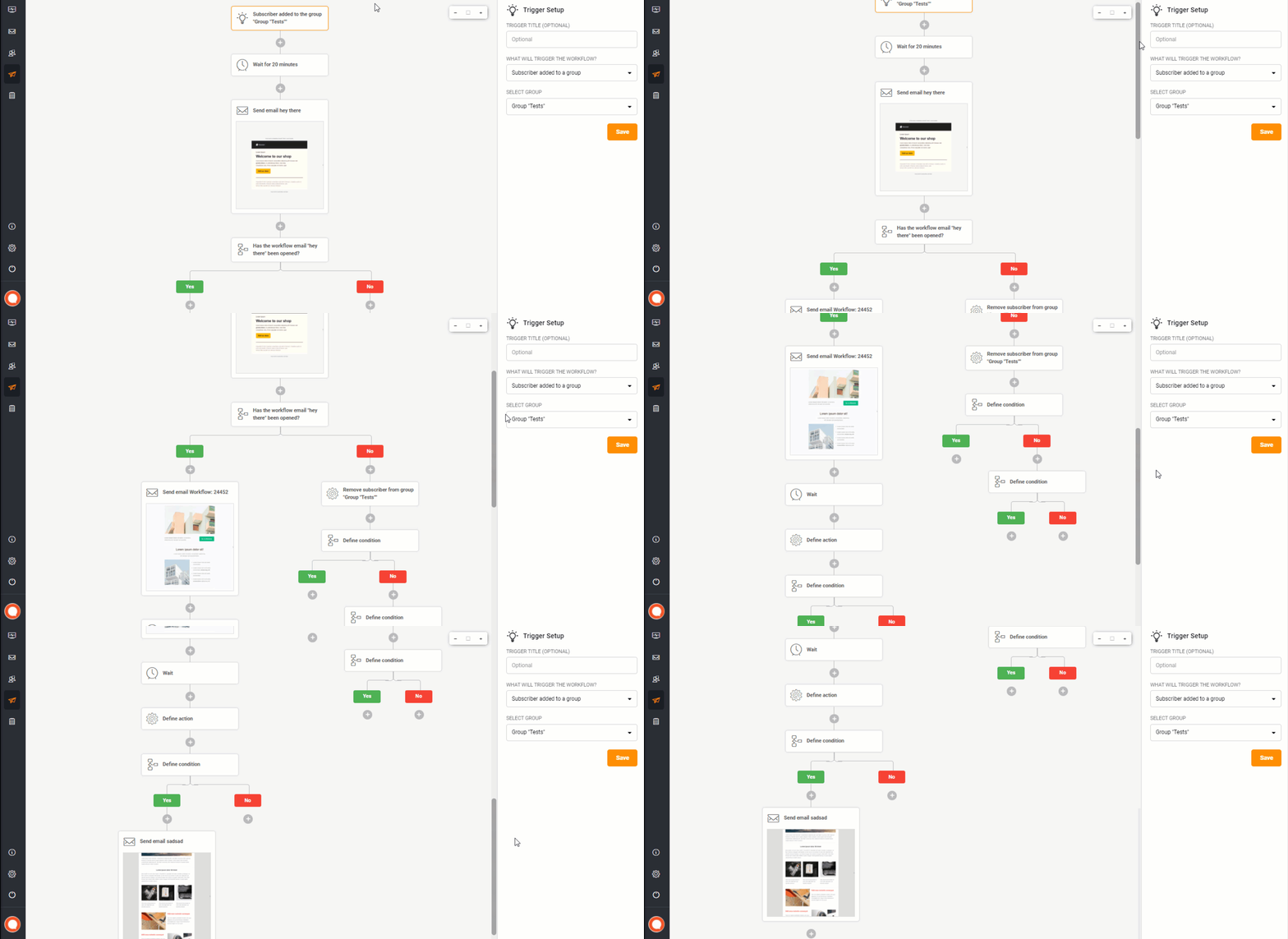
Here’s how it looks in motion.
Automation triggers
Automated workflows allow you to create thousands of different scenarios of sending automated emails without lifting a finger. Nevertheless, every automated sequence must start with a trigger.
At the start, you will be asked to select a starting trigger. Starting triggers are:
A Date – To activate the date trigger, the subscriber’s custom field must have the “date” type selected. For example, you have the ‘last purchased’ date as a custom field next to each subscriber.
An Anniversary Of A Date – Perfect for sending Birthday cards or for any other anniversary date. For this trigger, you need to have a defined date custom field information for each subscriber. The automation will start each year automatically.
Subscriber is added to a group – This automation workflow will be started when a subscriber is added to a certain subscriber list via a subscription form or API call.
Subscriber Is Removed From a group – The automation will start whenever the subscriber is removed from a defined group via an API call or a separate automation workflow. Manually removing subscribers will not trigger the automation.
A link Is Clicked – Automation starts its first action whenever a subscriber clicks on a specific link. It might be a link to a particular product or any other link used in previous campaigns. After subscribers click on a link, they automatically participate in a secondary automation sequence which starts after the “A link is clicked” trigger.
Cart Is Abandoned – Abandoned cart reminders might be a great source of revenue. It starts the automation workflow once a cart is abandoned. Requires e-commerce integration!
A Product Is Purchased – Send customers Thank-you letters, post-purchase feedback requests, or get notified when somebody buys your product or service. Requires e-commerce integration!
An order is fulfilled – This trigger gets activated once a seller marks an order as fulfilled in Shopify.
An API Call Is Made – Start the automation with any of your system events. Send an API call from any other system or program and start the automation.
When the automation trigger is set, continue by adding the following steps.
Automation Steps
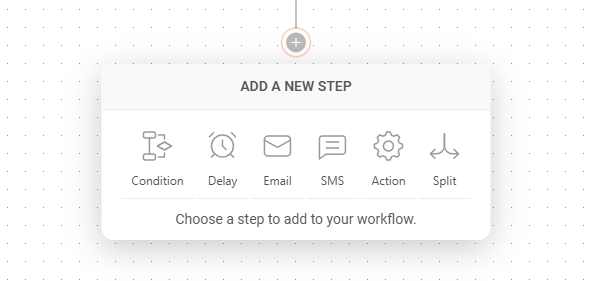
Each automation sequence is a combination of different steps: condition, delay, email, SMS, action.
Condition – continue the workflow in a different way depending on whether conditions are matched.
Delay – wait for a certain period of time.
Email – a newsletter which will be sent to a subscriber.
SMS – an SMS which will be sent to subscribers.
Action – change subscribers details or list membership, notify yourself or send a web-hook.
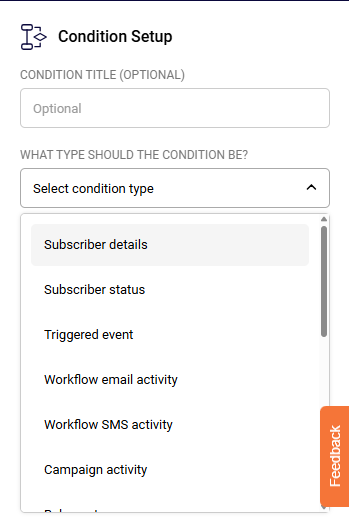
The condition step is one of the most effective ways to create a unique route for different occasions. What activity can be selected?
Subscriber details (any custom field)
Subscriber status
Triggered event
Workflow email activity
Workflow SMS activity (Professional plans)
Campaign activity
Belongs to group
Belongs to segment
Abandoned cart
Purchase product
Placed an order
Total lifetime spent
Quantity of products per basket
Order specific product
Order refunded
Order value
The Delay step is pretty self-explanatory. Delay can be set for a set amount of:
Minutes
Hours
Days
Weeks
Months
Email step is pretty basic; firstly, enter these fields:
Email title
From name
Sender’s email address
Email Subject
Email preview text (optional)
Then click the “Create” button, and the Drag & Drop design builder will be launched.
SMS setup is all done within the sidebar. Fill in the following information:
Campaign name
Sender
Message text
Add Opt-out instructions
Then click “Save,” and the SMS is prepared.
The action step is used for executing activities for specific conditions. These are possible actions:
Move subscriber to another group
Copy subscriber to another group
Remove subscriber from a group
Mark subscriber as unsubscribed
Update subscriber’s custom field
Remove subscriber’s custom field
Notify me
Send webhook
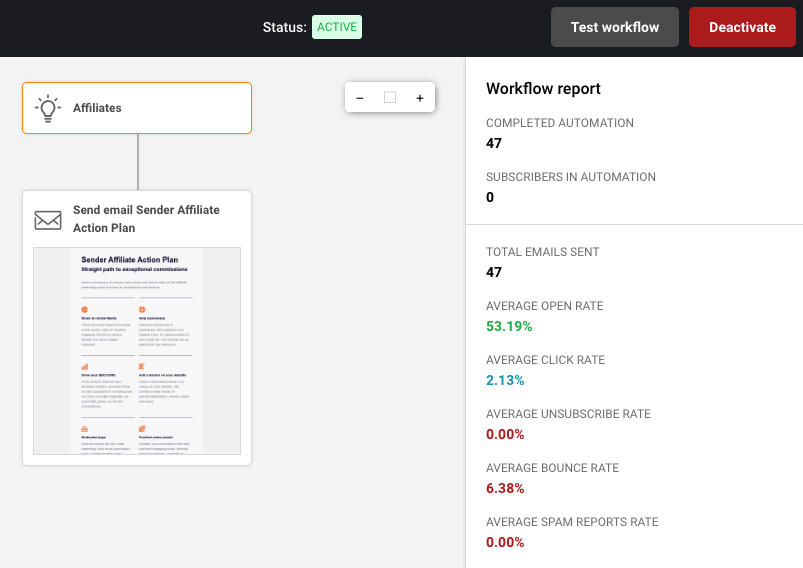
Automation reports
Automation reports are located in the particular automation workflow itself; open the automation to view extensive report statistics.
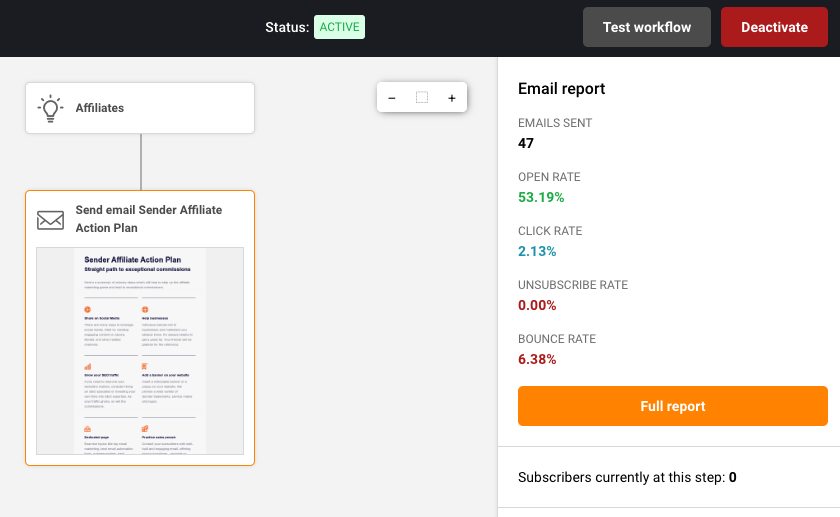
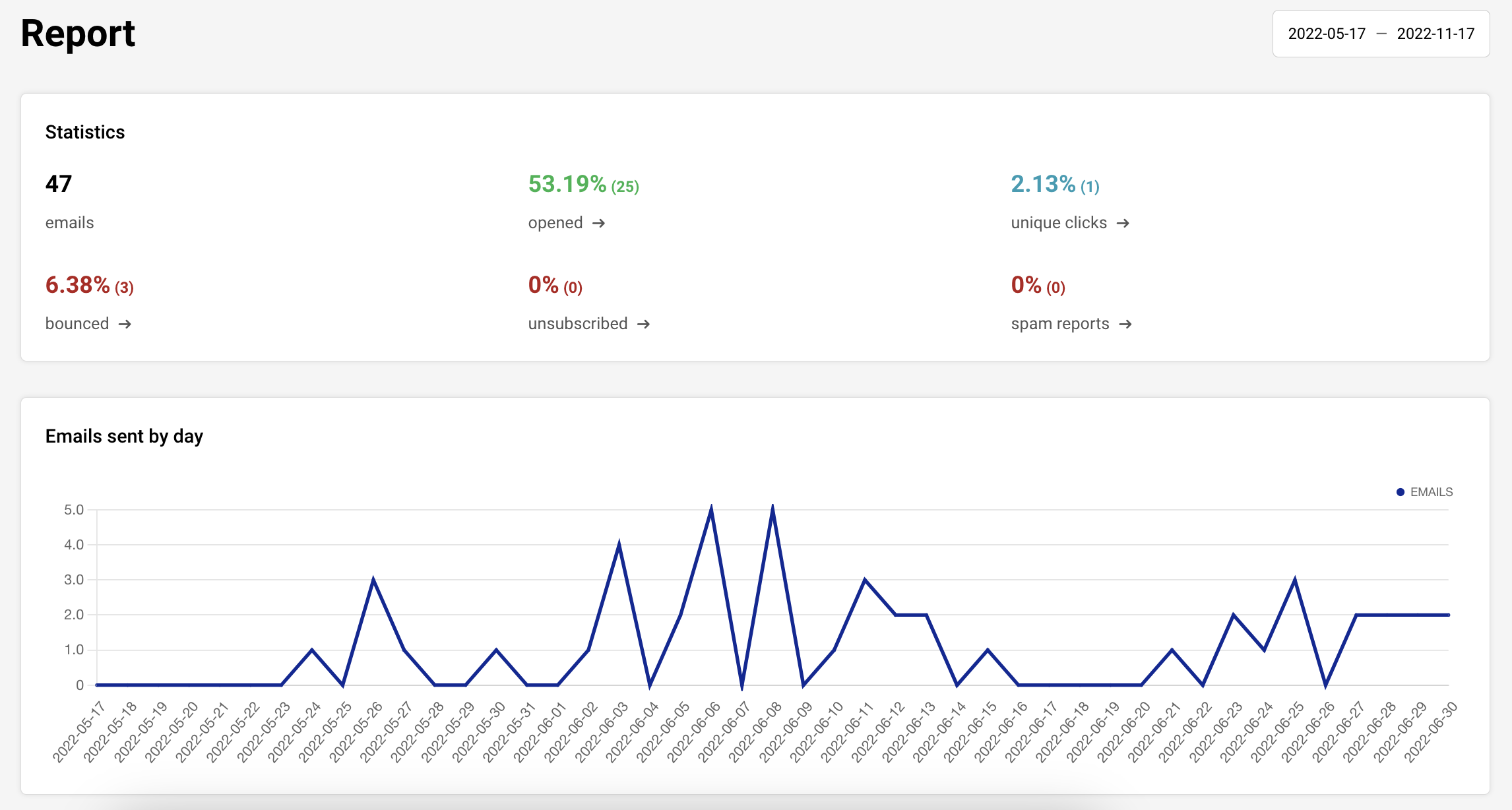
In order to view the complete report of a particular action step – click on the step and select the “Full Report” button. Next, a new window with comprehensive statistics will appear.
If you are stuck on a specific task or can’t find a way to execute a particular job, contact our support team via LiveChat or [email protected] – we’re here to help 24/7.
An objective perspective on a particular subject goes a long way in improving customers’ experience and service in general. That’s why feedback is essential.
With Sender, collecting feedback is clear and straightforward.
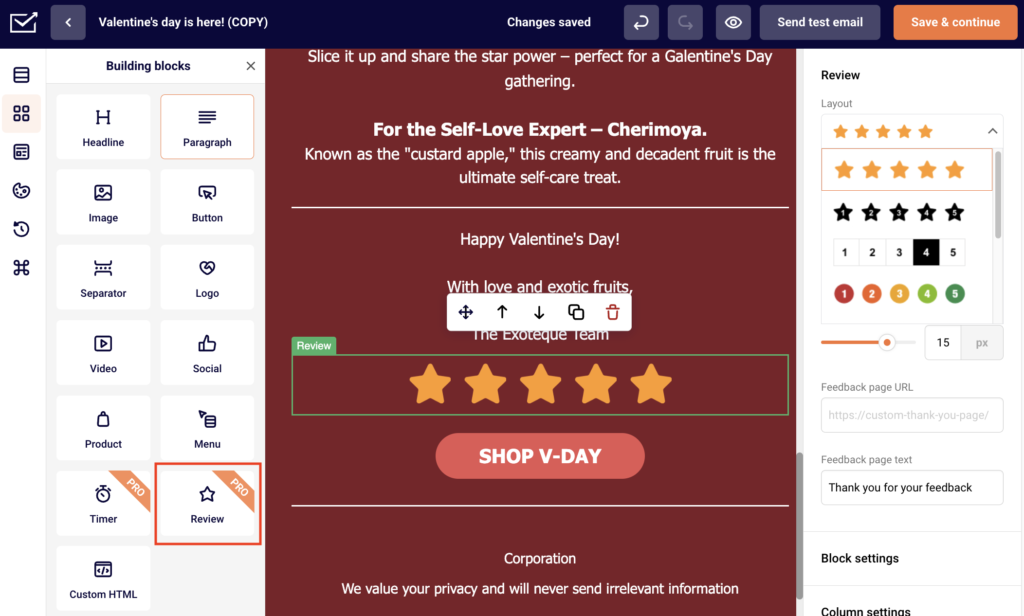
In order to insert review form into a newsletter design, you’ll need to pick a review block and drag it into a required section.
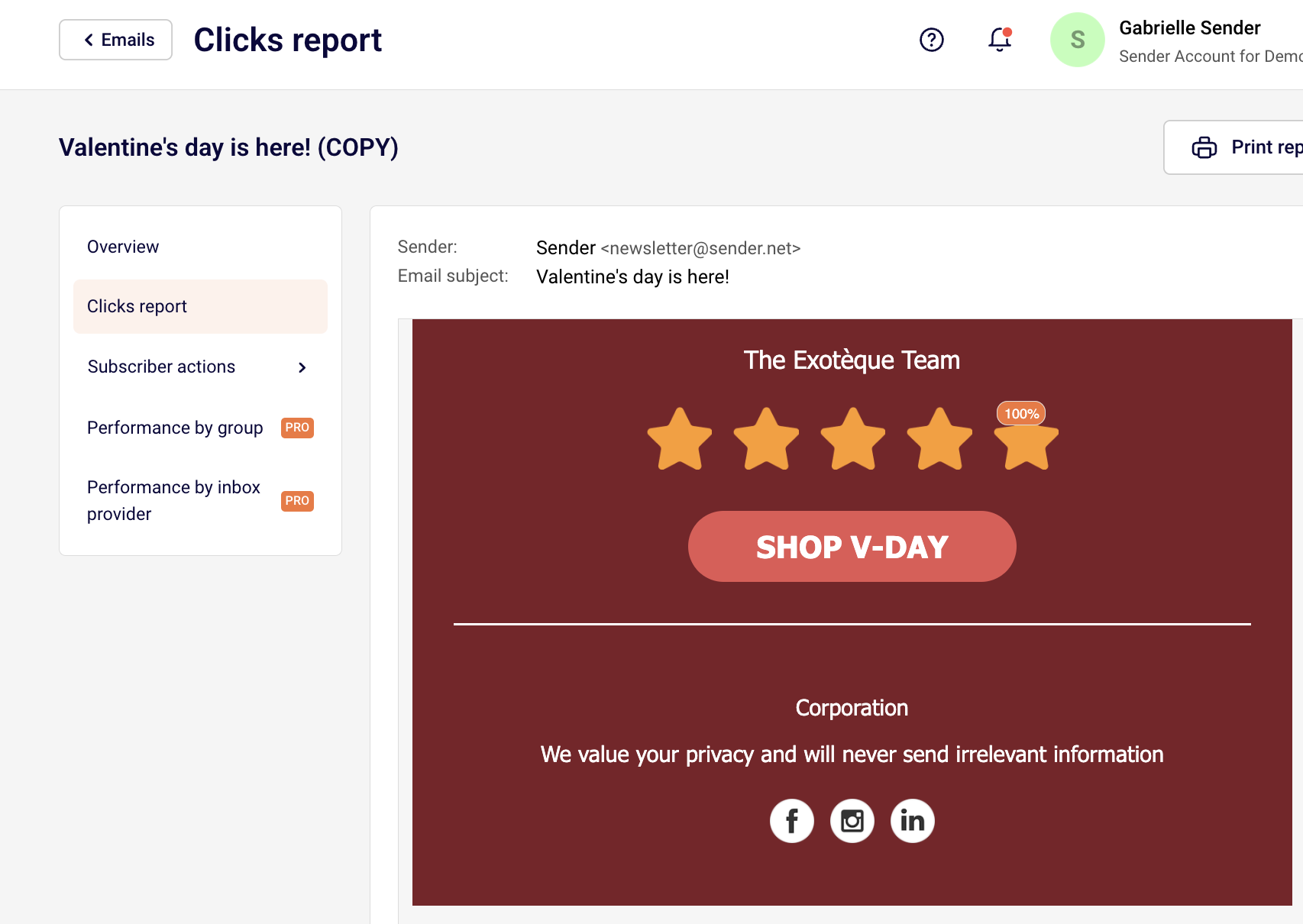
When the campaign is completed and sent, recipients will be able to click on a score and contribute feedback. The feedback score is presented in the campaign reports > clicks report
If you got stuck on a specific task or can’t find a way to execute a particular job, contact our support team via LiveChat or [email protected] – we’re here to help 24/7.
This is the official documentation for Sender.net’s WordPress 2.11.1 integration plugin.
This plugin doesn’t require WooCommerce to be installed; you can use it as a separate product. However, to use most of the features, it’s necessary to have Woocommerce installed.
KEY FEATURES
Embedded subscription forms
Pop-up forms
INSTALLATION PROCESS
Head to app.sender.net and log in to your account
Download the Sender.net plugin integration from the WordPress plugin store.
Install the plugin
Activate the “Sender.net email marketing” plugin by inserting the API token.
Congrats, you’re done with implementation.
Here’s a short video guide on how it’s done:
EMBEDDED FORMS
First of all, only published (activated) subscription forms on Sender’s “forms” section will appear in the widget’s customization menu. Later, you’ll be able to select which subscription form to use on the website. Newly designed subscription forms will be automatically updated and shown in the widget menu.
Note: If you have implemented a subscription form or popup manually in the past, remove the snippets from your website to use the plugin integration, or else they will interfere with it.
POP-UP FORMS
Pop-up forms will automatically appear on your website without further configuration. Simply “Activate” a required pop-up on the Sender.net platform, and it will appear on the website.
Next time you open your website, the popup will appear according to its behavior settings.
Integration with Elementor
If you use the Elementor plugin to build your website, you can check this guide to see how to embed your forms.
Integration with WP WooCommerce plugin
If you’re looking for an e-commerce solution for the WordPress WooCommerce plugin, click here for comprehensive documentation.
That’s it!
If you got stuck on a specific task or can’t find a way to execute a particular job, contact our support team via LiveChat or [email protected] – we’re here to help 24/7.
This is the official documentation for Sender.net’s WooCommerce v2.0 integration plugin.
WooCommerce is an open-source e-commerce plugin for WordPress. It is designed for small to large-sized online merchants using WordPress.
Key features
Transfer guest customers‘ email addresses.
Transfer customer account email addresses.
Use the “Cart is abandoned” trigger on the automation feature.
Use the “Product is purchased” trigger on the automation feature.
Installation process
Note, before the installation process, make sure a WooCommerce plugin is installed on your WordPress website.
Head to app.sender.net and log into your account
Download Sender.net plugin integration from WordPress plugin store.
Install the plugin
Activate the “Sender.net email marketing” plugin by inserting API token.
Congrats, you’re done with implementation.
Here’s a short video guide on how it’s done:
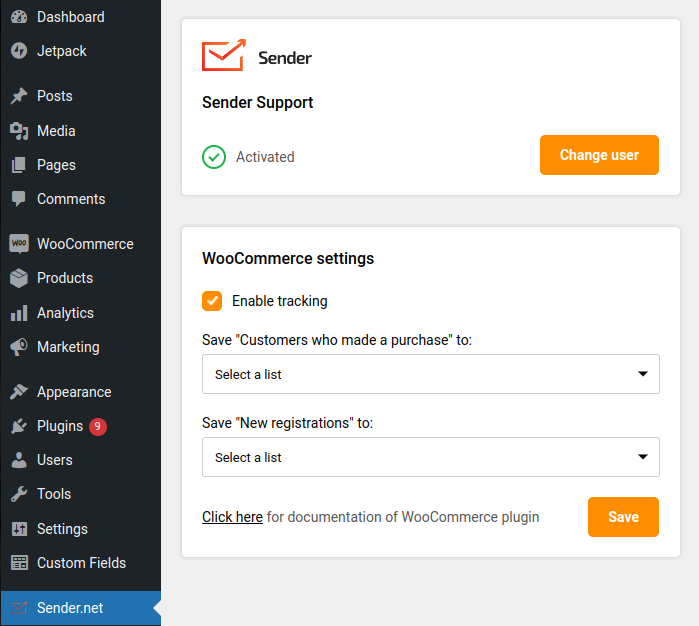
When Sender’s plugin for WooCommerce is successfully installed, Sender.net section will appear on the left side. Select “Sender.net” section to open integration settings.
“Enable tracking” option permits users to enjoy abandoned carts and product purchased triggers with an automation feature and transfer customer’s email addresses to the Sender.net platform. Enable this feature to use “abandoned carts” and “product purchased” automation triggers.
When tracking is enabled, you’ll be able to:
Save “Customers who made a purchase” – feature allows you to capture recent customers ( that made a purchase) and automatically add them to the selected subscriber list. Select a Sender.net subscriber list into which the new user emails will be saved.
Save “New registrations” – feature allows you to capture registered clients and automatically and add them to the selected subscriber list. Select a Sender.net subscriber list into which the new user emails will be saved.
Additionally, integration lets users use the abandoned cart, and the product is purchased triggers on the automation feature.
Use the “Cart is abandoned” trigger in the email automation feature.
Use the “Product is purchased” trigger in the email automation feature.
Note, you’ve not required additional configurations. When the “Enabling tracking” is active, abandoned cart and product is purchased triggers will work automatically if a customer on your website meets the conditions.
If you got stuck on a specific task or can’t find a way to execute a particular job, contact our support team via LiveChat or [email protected] – we’re here to help 24/7.